




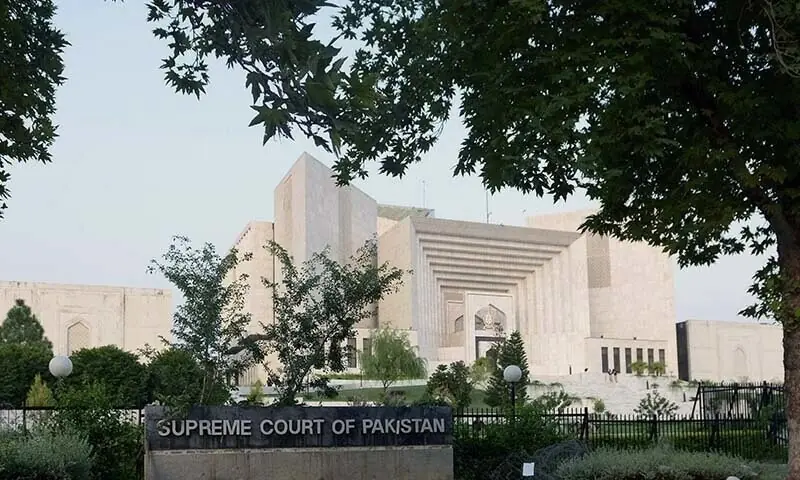
ISLAMABAD: The country’s courts will be observing four-day work weeks while litigants and counsels will be encouraged to participate in proceedings through video-link facilities, where feasible, as part of austerity measures amid the fuel crisis resulting from the Middle East conflict.
To this effect, a notification issued by the Supreme Court of Pakistan stated: “In view of likely disruption in the supply of petroleum products resulting in escalating energy costs, it is imperative to adopt prudent and responsible measures to conserve resources.
“Accordingly, following austerity and fuel conservation measures, as far as possible, shall be adopted in the Supreme Court of Pakistan with immediate effect until further notice.”

The measures outlined in the notification included four-day work weeks, from Monday to Thursday.

“The court shall observe holidays from Friday to Sunday,” the notification said.
It further stated that the monthly ceiling of Petroleum, Oil and Lubricants (POL) allocated to judges and entitled officers should be reduced by 50 per cent.

The notification also said that “no additional protocol or security vehicles shall be deployed during movement within designated high-security zones. However, the quarters concerned shall ensure route security as per required protocols”.
Moreover, litigants and counsels should be encouraged to participate in proceedings through video-link facilities, where feasible, it added.
“The court shall implement rotational attendance arrangements for staff, wherever practicable, to minimise commuting and reduce energy consumption while maintaining essential court functions,” the notification read.
The notification was issued after Chief Justice of Pakistan Yahya Afridi chaired a virtual meeting of the National Judicial Policy Making Committee (NJPMC) at the SC, where it was decided that similar measures would be adopted by the Federal Shariat Court (FSC), high courts and district courts.
“The meeting approved a comprehensive Judicial Austerity and Energy Conservation Strategy aimed at ensuring responsible use of national resources while maintaining uninterrupted access to justice across the country. It reflects the institution’s proactive response to the anticipated disruption in petroleum supply and rising global energy costs, underscoring the judiciary’s commitment to national resilience and institutional responsibility,” a press release issued after the meeting said.
It added, “Recognising that the justice sector must lead by example in times of economic and energy uncertainty, the NJPMC resolved that courts across Pakistan will adopt a series of practical measures designed to reduce fuel consumption, limit operational costs, and promote efficient use of resources without compromising the delivery of justice.”
The press release said that the FSC and high courts would observe a four-day work week (Monday to Thursday) to reduce fuel consumption and operational expenditure.
“However, while ensuring that urgent judicial and administrative functions continue without disruption on Fridays and Saturdays, the courts may take necessary internal governance measures keeping in view their operational priorities,” it added.
Likewise, the district courts should work for four days a week (Monday to Thursday) with full capacity, while the respective high courts “shall keep their human resource at bare minimum on Fridays and Saturdays, as per workload and performance benchmarks”.
The monthly ceiling of POL allocated to the FSC and high courts is also being reduced by 50pc, while the allocation for judicial officers of these courts is being reduced by 25pc.
As in the SC’s notification, the press also stated: “No additional protocol or security vehicles shall be deployed during movement within designated high-security zones. However, the quarter concerned shall ensure route security as per required protocols.”
While the FSC and high courts should rationalise security and protocol, the judges and judicial officers serving in Khyber Pakhtunkhwa and Balochistan should maintain their security as per circumstances, it added.
Litigants and counsel should be encouraged to participate in proceedings through video-link facilities, where feasible, including through the premises of high Courts and district courts, and the FSC and high courts should implement rotational attendance arrangements for staff, wherever practicable, to minimise commuting and reduce energy consumption while maintaining essential court functions, the press release said.
Meanwhile, a notification by the Federal Constitutional Court (FCC) said: “In pursuance of the austerity and fuel conservation measures announced by the federal governmentt … and in view of the prevailing global and regional situaiton, the FCC, while keeping in view its functional requirements being the newly established apex court of the country, is pleased to adopt the following measures as far as possible, with immediate effect until further orders.”
The measures include a “maximum reduction” of fuel provision for official vehicles in use of the FCC and observance of four-day work weeks, with holidays from Friday to Sunday.
The notification did not specify how much the “ maximum reduction “ is in fuel provision.


