


For Komeil Soheili, an Iranian filmmaker, the latest protests in the Islamic Republic did not come as a surprise.
“People are exhausted after the 12-day war with Israel,” he said over the phone. “It’s the uncertainty. You can’t even plan for the near future because things keep changing.”
Iran is buckling under mounting economic pressure. Inflation has exceeded 36 per cent since March. The rial has lost roughly half its value, trading at around 1,390,000 to the US dollar. Sanctions linked to Iran’s nuclear programme have returned, utilities remain strained, and global financial bodies are forecasting a recession in 2026.
Unrest, at the worst possible time
Iran’s most significant protests since 2022 erupted around two weeks ago among traders and shopkeepers in downtown Tehran, triggered by the rapid collapse of the rial, which has driven up prices and left traders unable to restock goods.

Isolated market shutdowns in Tehran’s commercial districts quickly escalated into street demonstrations, drawing in wider sections of the public and prompting security deployments. Like falling dominoes, the unrest spread to other cities, claiming dozens of lives, according to rights groups.
Last week, major Iranian cities were gripped overnight by new mass rallies denouncing the Islamic Republic, as activists expressed fear that authorities were intensifying their suppression of the demonstrations under the cover of an internet blackout.
The crackdown follows what was initially a relatively soft response, with Iranian President Masoud Pezeshkian calling for a kind and responsible” approach, acknowledging public frustration. The government had also announced cash handouts to ease economic woes.

The regime appears to have shifted its tone since, accusing the US and Israel of orchestrating the protests. “The enemy has infiltrated trained terrorists into the country. Rioters and saboteurs are not the protesting people. We listen to the protesters and have made our utmost efforts to solve their problems,” Iranian President Masoud Pezeshkian said.
The US, meanwhile, has offered to “help” the Iranian people, and the Trump administration also reportedly discussed the possibility of strikes targeting Iran.
Posting on social media on Saturday, US President Trump said: “Iran is looking at FREEDOM, perhaps like never before. The USA stands ready to help!!!”
In a phone call on Saturday, Israeli Prime Minister Benjamin Netanyahu and US Secretary of State Marco Rubio discussed the possibility of US intervention in Iran, according to Reuters.
Meanwhile, addressing parliament on Sunday, Iran’s speaker Mohammad Bagher Ghalibaf warned the US against any miscalculation. If the US attacked, “both the occupied territory and centres of the US military and shipping will be our legitimate targets,” he told lawmakers. The warning came hours before Trump disclosed that Iran’s leadership had called seeking “to negotiate”.
“The leaders of Iran called yesterday,“ Trump told reporters aboard Air Force One, adding that “a meeting is being set up … They want to negotiate.”
However, Trump added that “we may have to act before a meeting“.
The timing could have hardly been worse.
US jets had just flown into Venezuela and captured President Nicolas Maduro and his wife. Maduro was taken to New York, and footage posted online showed him blindfolded in a grey tracksuit — an unsettling image, regardless of one’s politics.
A cat-and-mouse relationship
Miles away, in Tehran, Venezuela’s anti-American ally felt the pressure.
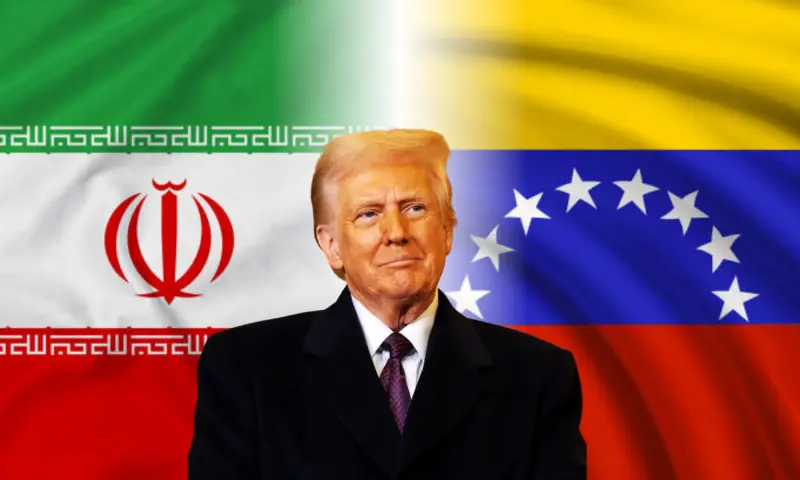
Could Trump pull a Venezuela on Iran, its longest adversary?
“We know that Donald Trump is not a reliable president, and he doesn’t care about international law,” said Soheili.
Iran and the US have long shared a cat-and-mouse relationship. Washington has consistently viewed Iran’s nuclear programme and its network of regional proxies with suspicion.
In 2020, an American strike killed Iran’s most revered military commander and foreign policy architect, Gen Qasem Soleimani. In June 2025, US jets struck key Iranian nuclear sites as Iran, shaken but defiant, fought a brief war with Israel.
Iran is a signatory to the Nuclear Non-Proliferation Treaty (NPT), which allows non-nuclear states to pursue civilian nuclear energy under international inspections. Tehran insists its programme remains peaceful, a claim disputed by the United States and its allies, who argue that Iran’s enrichment levels exceed civilian requirements. Iran, for its part, has repeatedly accused Washington of selectively enforcing the treaty while ignoring violations by its partners, including Israel.
Following the Iran-Israel war, sweeping UN sanctions lifted under the 2015 nuclear deal were reimposed, while Tehran suspended nuclear inspections, effectively freezing its remaining commitments under the agreement.
Trump’s oil gambit
Iran, no stranger to the consequences of foreign intervention, was quick to condemn Washington’s actions in Venezuela as a “clear violation” of sovereignty and international law.
“In past decades, interventions were justified under slogans such as democracy and human rights,” Iran’s foreign ministry spokesman Esmail Baghaei said on Monday. “Today, they openly say the issue is Venezuela’s oil.”
After Maduro’s capture, Trump promised that American companies would gain access to Venezuela’s vast oil reserves. “We’re going to be taking out a tremendous amount of wealth out of the ground,” he told reporters.
After vowing to “run” Venezuela, Trump later softened his tone, saying the United States would not deploy troops if the country “does what we want.”
Venezuela holds the world’s largest proven oil reserves, accounting for roughly 17pc of the global total, according to the US Energy Information Administration.
That is another point of comparison with Iran.
As the United Nations and states around the world debate the legality of Trump’s move, one thing is clear: the US president has moved on from peacemaker to interventionist. And that shift is making Tehran uneasy.
Iran on edge
Inside the country, the debate has already begun.
Pro-Iran outlets have quietly explored the implications.
“Following the US military attack on Venezuela and … Donald Trump’s threatening remarks … a serious question has emerged: could Tehran be the next target of Washington’s adventurism …,” wrote Nournews, an Iran-based digital news outlet.
Tehran-based foreign policy expert Mohammad Khatibi agrees that there is cause for concern.
“Yes, in light of what has occurred in Venezuela, there is clear reason for concern. Threats of intervention and open advocacy for regime change raise serious questions under international law and established norms,” he told Dawn.
That said, he cautioned against drawing direct parallels.
“From a geopolitical perspective, Iran is a central regional power in the Middle East with deep strategic depth, strong state institutions, and significant influence across multiple regional theatres,” he added.
Khatibi asserted that any attempt to replicate the Venezuelan model in Iran would therefore carry far greater risks of regional escalation and international confrontation.
Iran’s leverage in the Middle East has rested not only on its military capabilities but also on its network of allies and proxies, including Hamas, Hezbollah, and the Houthis. An attack on Iran could create ripples through the region.
Apples and oranges?
Syed M. Ali, a security studies lecturer at Johns Hopkins University, cautioned against overstating the comparison.
“It is somewhat like comparing apples and oranges,” he said. “While the Venezuelan action will be tough for the US to justify internationally, this intervention is motivated by Trump’s desire to reassert hemispheric hegemony, which resonates with the historical Monroe Doctrine (a policy opposing European colonialism in the Americas, asserting that any foreign interference in the Western Hemisphere would be seen as a threat to US interests).”
Iran’s regional position, he added, makes any direct intervention far more complicated. And with the events happening in Gaza, the public perception not just in the Muslim world but also in the West has moved against the nexus between the US deep state and Israel, which act in tandem.
“After Iraq and Afghanistan, there has been little appetite for that kind of operation. Iran is not as isolated as it once was. There has been a rapprochement with Saudi Arabia. These are the reasons why I say Trump’s statement is more rhetorical — intended to increase pressure for change within Iran.”
While comparisons with Venezuela fuel anxiety, Tehran’s regional influence makes any direct foreign intervention unlikely — at least for now.
In turbulent times, hope often becomes a strategy.
Amid internal frustrations, a faltering economy, and the shadow of international pressure, ordinary Iranians are left clinging to the hope that cautious diplomacy, rather than confrontation, will chart the path forward.


