





On August 7, 2025, a divisional bench of the Sindh High Court, headed by Justice Muhammad Karim Khan Agha, disposed of Constitutional Petition No. D-6052 of 2024 (Ghulam Fakhruddin v Province of Sindh & Others).
The petitioner argued that despite being the senior-most qualified officer, he had been bypassed for the post of chief fire officer, Karachi Metropolitan Corporation, in favour of a junior officer transferred from another department in violation of service rules.
The court declined to adjudicate the merits. Instead, it directed the mayor of Karachi to examine the petitioner’s service record and, if found eligible, consider him for promotion along with other candidates — within three months. No decision followed.
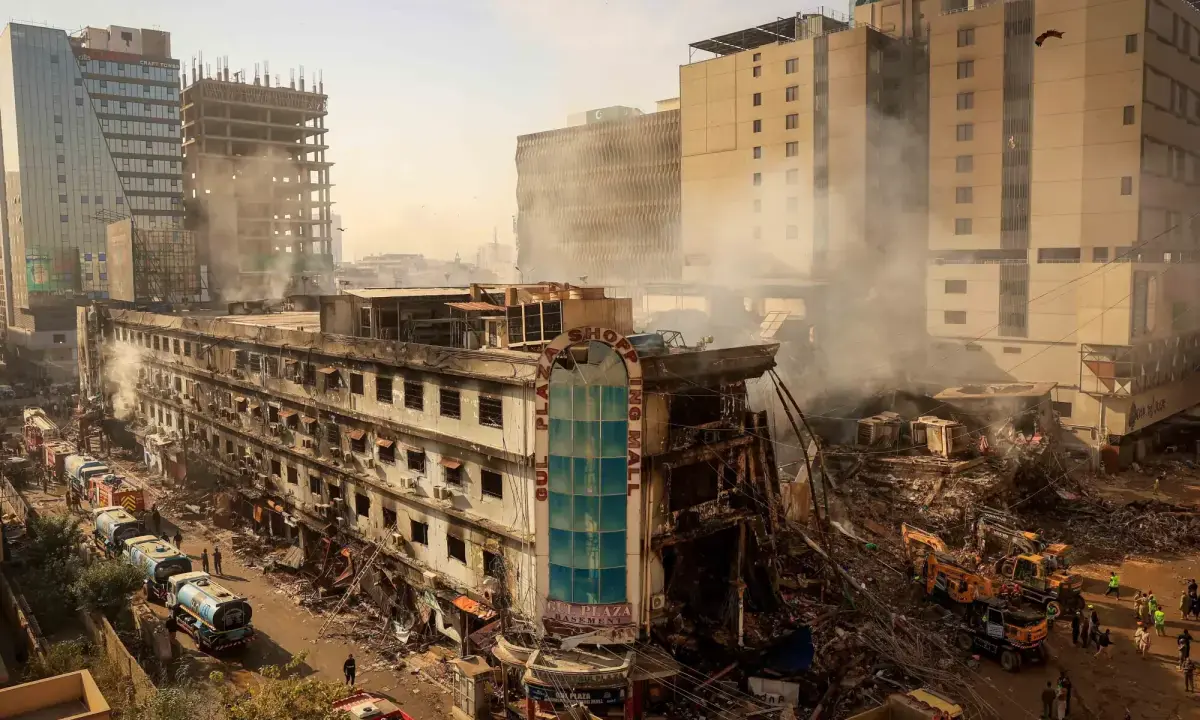
Six months later on the night of January 17, 2026, barely a kilometre from the constitutional court as the crow flies, at around 10 pm, a massive fire erupted at Gul Plaza, once one of the city’s most significant commercial spaces. Spread across four floors and more than 200,000 square feet, the complex housed approximately 1,200 densely packed shops.

What the Gul Plaza inquiry did not do is far more revealing than what it did. By treating the blaze as an isolated tragedy rather than a recurring risk, it erased institutional memory and accountability


For decades, Gul Plaza had been a rare equaliser in a divided city—serving customers across class lines with an unmatched mix of garments, fabrics, carpets, household goods, toys, jewellery, furniture, electronics, and everyday necessities.
As journalist Aniqa Khan noted in an earlier Dawn article, Gul Plaza’s singular appeal lay in its promise of completeness. It was one of the few places in Karachi where affordability, convenience, and variety converged, allowing class distinctions to quietly dissolve.

That promise went up in flames within hours.
The fire spread rapidly, fuelled by an exceptionally high combustible load and exacerbated by dry January weather. At temperatures of 250–300°C, concrete begins to lose strength; between 600–1,000°C, reinforcing steel fails. Beyond this point, materials — and people — do not merely burn; they are incinerated. Roof slabs collapsed in succession as firefighters struggled against severe shortages of water and chemical suppressants. By dawn, Gul Plaza was reduced to smouldering ruins. Lives were lost. Thousands of livelihoods were erased overnight.
Predictably, outrage followed. Equally predictably, so did scapegoating.
In a knee-jerk response, the municipal commissioner of KMC was removed, as was the DIG traffic Karachi — though the latter’s transfer may have been coincidental, given reports of unrelated inquiries. What did not follow was any serious reckoning with the systemic failures that made the disaster inevitable.
On January 19, the Sindh government constituted an inquiry committee comprising the Commissioner and the additional inspector general of police, Karachi. Within nine days, the committee submitted a 21-page report with 17 findings and five recommendations. It reviewed CCTV footage, recorded 16 witness statements, and incorporated reports from five departments responsible for fire prevention and response.
What it did not do is far more revealing than what it did.
Acts of omission
The inquiry confirms that the fire spread rapidly due to flammable materials and poor ventilation. It documents dispatch timings, lists the number of fire tenders and snorkels mobilised, and recounts police and district administration responses. It narrates the disaster—but never interrogates it.
There is no forensic determination of the fire’s cause. No technical analysis. No assessment of compliance with building or fire safety regulations. No acknowledgment that Gul Plaza had suffered multiple previous fires, including major incidents in 2008 and 2016. By treating the blaze as an isolated tragedy rather than a recurring pattern of risk, the inquiry erases institutional memory—and with it, accountability.
Responsibility is conspicuously absent. The report does not examine the conduct of approving or inspecting authorities. It does not identify ownership or management structures with clarity. It assigns no liability to the building’s owners or management committee. No findings of negligence or breach of duty are made. No civil, criminal, or administrative action is recommended.
Those legally responsible for public safety are treated as bystanders.
Operational failures are acknowledged but never examined. Water scarcity — central to the disaster — is mentioned without serious analysis of hydrant availability, water pressure, or decades of corruption in a neglected fire-fighting infrastructure. There is no assessment of the combustible load, unsafe storage practices, or structural vulnerabilities that accelerated collapse.
The report is also silent on the future. It offers no framework for compensation, rehabilitation, or protection for displaced traders. In a city where disasters have often cleared the ground for lucrative redevelopment, this omission is not benign. The shop-owners and traders of Gul Plaza are rendered invisible at the very moment their vulnerability is greatest.
To understand the depth of this failure, some historical context is instructive.
The question of water
M.A. Jinnah Road — formerly Bunder Road — was constructed in 1915. Walker, the colonial engineer overseeing its construction was criticised by the Bombay Presidency for building a road deemed excessively wide. He defended the decision, insisting that a road leading to the port must be at least as wide. He insisted that a port city required infrastructure built for the future.
Crucially, hydrants connected to subsoil wells duly covered for public safety and marked with steel plates with standard inscription SSW 10’ (subsoil well within 10’ radius) were installed along the road, serving both fire-fighting and washing Bunder Road — at a time when Karachi’s formal water supply system did not yet exist.
More than a century later, those priorities have been abandoned. On the night of the Gul Plaza fire, large sections of an increasingly encroached upon M.A. Jinnah Road were dug up for years-long BRT construction. Fire tenders, lacking water at nearby stations, were forced to shuttle more than 15 kilometres each way to the NIPA hydrant. Time was lost. Structures collapsed. People died.
Gul Plaza itself is no planning accident. Built on Plot No. 32 in Preedy Quarters, the property has passed through multiple owners and regularisations. Originally approved for fewer floors, additional storeys were legalised under successive political regimes—without meaningful fire safety audits. No-objection certificates were issued despite the absence of even rudimentary fire suppression systems.
This is not bureaucratic oversight. It is governance by abdication.
Administratively, city falls under the authority of the commissioner and the additional IGP Karachi. Rather than fixing responsibility where it belonged, both were tasked with “assigning responsibility at the earliest” — a formulation that ensured precisely what followed: nothing.
The Gul Plaza inquiry reads less like an investigation than a damage narrative. It reflects institutional self-protection, not a commitment to preventing the next catastrophe.
Yet, Gul Plaza is not an anomaly. It is a warning.
What the city should aspire towards
Karachi’s disaster management capacity remains severely constrained by the absence of a unified incident command structure, inadequate emergency service coverage, weak enforcement of building regulations, poor risk-informed urban planning, insufficient protection for vulnerable livelihoods, and the lack of independent post-disaster accountability.
For a dense, resource-constrained Afro-Asian megacity, preparedness benchmarks must be realistic, affordable, and scalable — drawn from cities facing similar constraints. The goal is not perfection, but systems that are good enough to save lives consistently.
Fire services must meet basic urban standards. Response times should average no more than six to eight minutes in dense areas, with stations spaced every three to four kilometres. Special-risk zones — ports, industrial areas, high-rise clusters, old city precincts — require dedicated coverage. Most importantly, stations must be self-sufficient for at least 24 to 48 hours during disasters. Unfortunately, 17 out of 28 fire stations in Karachi has no water connection provision for its storage.
Equipment standards need not be extravagant: one to two foam-capable fire tenders, rapid-response vehicles for congested streets, basic rescue tools. High-risk areas should share aerial ladders and Urban Search and Rescue units.
Most importantly, Karachi must prioritise rugged, repairable vehicles built on proven local truck platforms, not over-specialised imports that fail under local maintenance conditions. Staffing must be adequate, led by a senior station chief and 18-24 firemen manning three shifts. They must be trained monthly — not annually — and supported by reliable water supply, functional hydrants, and dedicated radio communications. During disasters, radio — not WhatsApp — saves lives.
But hardware alone will not save Karachi.
Leadership crisis
What the city lacks most is executive leadership during emergencies — a unified incident command with legal responsibility as well as authority to override routine bureaucracy, mobilise all civil agencies, and requisition para-military support when civilian capacity is overwhelmed. Disaster response cannot be run by committees or parallel press briefings. Fragmented authority costs time — and time costs lives.
Preparedness is political. Disasters in Karachi are not acts of fate; they are foreseeable governance failures. Less than a month since the incident, the Gul Plaza fire already appears to be fading from the public discourse. However, it did not merely expose broken infrastructure. It exposed a system unwilling to assign responsibility, enforce standards, or learn from tragedy.
Given that key approvals and regularisations occurred during the tenures of MQM’s senior minister in Sindh Farooq Sattar and Jamaat-i-Islami mayor Naimatullah Khan, the current Sindh government may have found it politically expedient to seek a judicial inquiry. Yet inquiries of the kind required after the Gul Plaza fire demand more than legal formality.
They require specialised technical expertise, an understanding of Karachi’s uniquely complex socio-political and historical context, and — above all — carefully framed terms of reference that determine whether accountability is pursued or quietly evaded.
It may be a high time that a city as heavily barricaded and policed by federal and provincial law enforcement agencies as Karachi, need to refocus itself on actual public safety.
Until that changes, the next siren will arrive too late.
The writer is a former administrator of Karachi city
Published in Dawn, February 12th, 2026


