



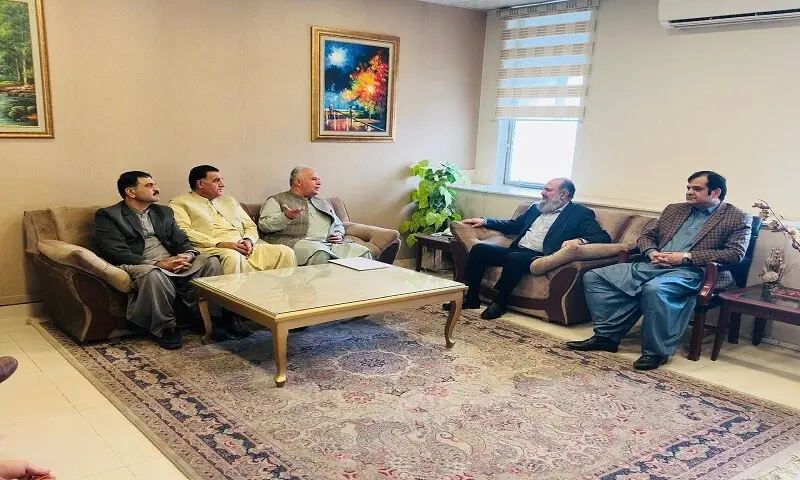
ISLAMABAD: Traders from Chaman have arrived in the federal capital to press the government to reopen the border crossing with Afghanistan for cross-border trade, a member of the delegation said on Friday.
All border crossings with Afghanistan have remained closed since October 11, and trade has been at a standstill following ground fighting and retaliatory Pakistani airstrikes across their 2,600-kilometre frontier that killed dozens on both sides—the worst fighting since the Taliban’s 2021 takeover of Kabul.
There are no signs of the border reopening, with Taliban rulers refusing to allow United Nations humanitarian aid to use Pakistan’s land route. Many people in Afghanistan depend on UN aid.
The traders have held a series of meetings with government officials, including Federal Minister for Commerce Jam Kamal Khan, and sought their help in reopening the border, the second key crossing with Afghanistan, the former president of the Chaman Chamber of Commerce and Industry told Dawn.

A delegation led by the President of the Chaman Chamber of Commerce and Industry Abdul Nafi Jan Chakzai also met Senate Deputy Chairman Saidal Khan Nasir, Coordinator to the Prime Minister on Commerce Rana Ihsaan Afzal, and Pakistan’s Special Representative for Afghanistan Mohammad Sadiq.
Community representatives from the region and the Chaman Chamber of Commerce and Industry were also part of the delegation.
The meeting with the minister focused on the challenges arising from the frequent and prolonged closure of the Pak-Afghan border crossing at Chaman.

“Stakeholders highlighted severe socio-economic impacts of the closures, including financial losses for traders, disruptions in the export of perishable goods, rising unemployment, and hardships faced by the local population that relies heavily on the cross-border trade,“ said a statement by the Ministry of Commerce.
The minister clarified that while the Ministry of Commerce would actively advocate for improved border trade facilitation, the decision regarding the opening or closure of the border was taken by the government, based on broader national considerations, and it is not the sole mandate of the ministry.
Khan assured that the issues raised during the meeting would be taken up with the relevant authorities and at appropriate bilateral forums to explore sustainable, predictable, and transparent border management solutions that balance security requirements with the need to promote lawful trade and economic activity.
Earlier, the traders met with the coordinator to the PM on commerce on December 17, in which they addressed challenges arising from frequent and prolonged border closure, according to a statement issued by the ministry.
Afzal also took the same stance, escalating the matter to relevant national and bilateral forums, and reaffirmed the government’s commitment to addressing the challenges and ensuring that local communities continue to thrive.
Meanwhile, business leaders in Khyber Pakhtunkhwa said the border’s closure for more than two months had affected trade volumes, employment, revenues and regional connectivity.
The closure has paralysed a vital trade corridor worth billions of dollars annually, said another trader.
Daily exports during peak seasons (e.g., agriculture and construction) reached $50-60 million, including cement, sugar, kinnows (citrus fruits), potatoes, medicines, and surgical items.
Value-added industrial products, raw materials, and miscellaneous goods worth billions of rupees are stranded at the border crossings, with local exporters claiming losses of over $4 million daily.


