



• Proposed commission to have 18 members from all non-Muslim communities
• Govt drops overriding-effect clause, withdraws suo motu powers
• Law minister insists bill will not dilute anti-Ahmadiyya provisions
• Gohar questions president’s initial refusal to give assent to bill
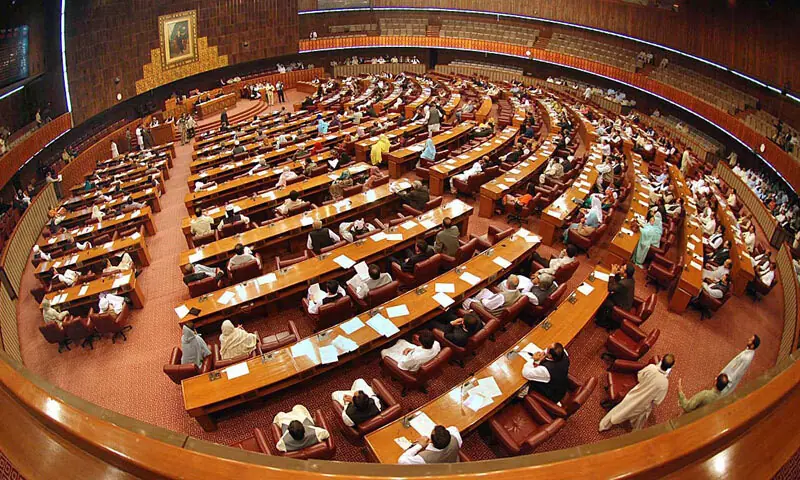
ISLAMABAD: Amid stiff opposition from both sides of the aisle, parliament on Tuesday passed by majority vote a bill to establish a statutory body to protect and promote the rights of minority communities in the country.
The opposition was based on fears that a provision giving the law an overriding effect would affect the anti-Ahmadiyya ordinance promulgated in 1984.
A motion seeking leave of the House to take up the bill for immediate consideration was opposed by around one-third of the members present in the joint sitting. A total of 160 members voted in favour of the bill while 79 opposed it.

The bill was, however, passed with certain amendments, including the omission of the clause giving it overriding effect and a change to withdraw the suo motu powers earlier proposed for the National Commission for Minorities’ Rights.

Law Minister Azam Nazeer Tarar tabled the bill amid outcry from some members, particularly those belonging to the PTI and Jamiat Ulema-i-Islam-Fazl (JUI-F).
However, Mr Tarar made it clear that the bill would neither dilute the anti-Ahmadiyya provisions nor affect any court judgement. “Neither the law nor the Constitution, nor our conscience, allows us to make a proposal that contradicts the Holy Quran and Sunnah,” he remarked.
He said the Constitution and the state had declared Ahmadis as non-Muslims, but they did not accept this and therefore did not fall within the ambit of the bill. He said that when the decision declaring Ahmadis non-Muslims was challenged, the Supreme Court had held that the protection under Article 20 of the Constitution was not available to those who did not recognise their non-Muslim status.
The minister said four amendments had been suggested to the original draft and these had been incorporated into the proposed legislation. Saying that minorities were defined as “non-Muslims” in the Constitution, he added: “This is a commission for non-Muslims. Our Hindu, Christian and Parsi brothers are as good Pakistanis as we are.”
Mr Tarar recalled that a 2014 Supreme Court judgement had called for the constitution of a commission for minorities. The matter had landed in the joint sitting after around 10 years, he added, before the debate on the bill began. He underlined that the proposed commission would not have punitive powers and would instead send its recommendations to the government.
“Our Christian, Hindu, Parsi, Sikh and other non-Muslim brothers and sisters deserve a forum to address issues — whether forced conversions, job quotas, sanitation workers’ rights or other matters of dignity,” he said.
Presidential assent
During the debate, PTI Chairman MNA Gohar Ali Khan pointed out that the bill had come to the joint session after the president returned it without giving his assent and with certain objections. “It should be seen why the president did not give his assent to the bill,” Mr Gohar said.
He pointed out that the president had objected to the proposed procedure for the removal of the chairperson and members of the commission on the pattern of superior court judges, as well as to the proposed powers of the commission to create and upgrade posts and maintain independent accounts.
The PTI chairperson also objected to Section 35 of the bill, a point further elaborated on by JUI-F Senator Kamran Murtaza. He said the section stated that the legislation would have an overriding effect. This meant that, being the more recent law, the bill under consideration, once approved, would have precedence over all previous legislation.
He said the provision should be omitted from the bill in its entirety. Moreover, he also objected to Section 12 of the bill, which he said gave suo motu powers to the commission to be established under the proposed legislation.
“On the one hand, you are taking away suo motu powers from courts. And on the other hand, you are giving this power to commissions,” he said, apparently referring to the recent 27th Amendment that curtailed the Supreme Court’s suo motu powers. If these two provisions were omitted, he said, “we could say that this is acceptable”.
Senator Allama Raja Nasir Abbas also participated in the debate, saying: “We are here today to give some people their rights, to legislate so that they get more rights.”
He said that at present the biggest issue in Pakistan was the violation of fundamental and civil rights. “There is democracy, (and) you are presiding over a session where there is no opposition … It is not a good sign.”
As he went on to express his grievances on this matter, National Assembly Speaker Ayaz Sadiq interrupted him and asked him to confine his remarks to the bill.
JUI-F chief Maulana Fazlur Rehman also stated that the Pandora’s box of Ahmadis, who were declared non-Muslim in 1974, should not be opened again. He pointed out that the law minister himself had stated that Ahmadis were non-Muslims and did not follow the Constitution. “But at the same time, I will ask the minister that he should also be aware of the past tricks of Qadianis,” he said.
He also expressed concerns regarding the recently passed 27th Amendment and other legislation passed by the ruling coalition.
Lamenting that no one was taken into confidence regarding the amendment, he stressed that the legislation “will remain controversial”.
Noorul Haq Qadri of the PTI endorsed the position taken by Maulana Fazlur Rehman. He also suggested that the bill be referred to the Council of Islamic Ideology. Abdul Qadir Patel of the PPP also opposed the bill.
Proposed commission
According to the bill, the proposed commission will include representatives from all provinces and minority communities, promoting inclusivity and effective oversight. There shall be a council of the commission to be established under this act. The council shall exercise all powers, perform all functions and do all acts and things assigned to it by the commission.
It shall consist of 18 members, including three Hindu members (of whom two shall be from the scheduled castes); three Christian members; one Sikh member; one member from the Bahai community; one member from the Parsi community; two Muslim members with a human rights background; one representative from each provincial human rights or minorities affairs department; and one minority member from Islamabad Capital Territory.
Upon the commencement of this act, or whenever required thereafter, the National Assembly Secretariat shall, within 60 days, initiate and complete the process for appointing the chairperson.
A four-member parliamentary committee is to be constituted by the National Assembly speaker after consultation with the Senate chairman, consisting of two members from the Senate, preferably non-Muslims, and two members from the National Assembly, also preferably non-Muslims. If the parliamentary committee fails to take a majority decision, the prime minister will appoint the chairperson of the commission.
The joint sitting also passed the National Assembly Secretariat Employees (Amendment) Bill 2025, the Biological and Toxin Weapons Convention (Implementation) Bill 2024, the Pakistan Institute of Management, Sciences and Technology Bill 2023, the National University for Security Sciences, Islamabad Bill 2023, and the Ghurki Institute of Science and Technology Bill 2025.
Published in Dawn, December 3rd, 2025


