





It was the monsoon season of 2021. The opposition alliance, the Pakistan Democratic Movement (PDM), was locked in a direct confrontation with the government of Prime Minister Imran Khan.
The Pakistan Tehreek-i-Insaf (PTI) administration was running the affairs of the state with little room for opposition voices, an increasingly constrained press and an aggressive stance against any narrative seen as anti-establishment.
At the centre of this political standoff was the then leader of the opposition, Shehbaz Sharif, who had taken a hard line against the ruling PTI. During a lengthy and closely watched visit to Karachi in August 2021, Shehbaz spent three days meeting industrialists, businessmen, political leaders, intellectuals, media professionals and other stakeholders.
As his visit drew to a close, he invited a select group of journalists over a cup of tea at a local hotel — an informal setting that followed days of intense political engagement and quiet maneuvering.

Four years on, Karachi is still waiting
Ranging from foreign policy to the economy and from political uncertainty to the fast-eroding space for genuine democratic forces, he argued for the need of a political consensus keeping the audience gripped, unmoving, and fully attentive.

For Karachi’s journalists, the pleasant surprise came when Shehbaz Sharif spoke with rare candour about the neglect the city had long endured. He laid out his thinking on Karachi’s revival, outlining plans for its rebuilding and development, and spoke with calculated clarity about restoring the metropolis to its rightful status as the country’s financial capital.
“Believe [me] when I was chief minister of Punjab, I came to realise that funding or resources for development has never been an issue,” he cited before sharing his Karachi plan. “I have been here for three days meeting industrialists, businessmen, industrialists, political leaders, intellectuals, media persons, and many others. I firmly believe Karachi only needs political will and ownership to turn things around. We do have a strong, in-depth and comprehensive strategy for Karachi but let me share with you one thing very briefly.”

“The federal government would have to pump in more money every year for Karachi than what is allocated by the Sindh government in its annual budget for the city’s development. And this cycle should continue for 15 or maybe 20 years. Then we would be able to fix this city’s problems,” Shehbaz asserted.
His convictions were so firm that few dared to question his intentions or calculations. The formula put forward by the three-time chief minister of Punjab was accepted without scrutiny, leaving little room for dissent or debate.
When his statements began making headlines, many in Karachi believed their voices had finally been heard. There was a sense that the national leadership, if not immediately then eventually, would sit in Islamabad and work to address the city’s long-standing grievances.
More than four years on, however, those hopes have proven to be little more than wishful thinking. After serving 16 months as prime minister from April 2022 to August 2023 and returning to office again in March 2024, the expectations attached to his leadership remain unfulfilled for the Karachiites.
A story of stalled initiatives and unmet promises
Why have his ideas and commitments for Karachi yet to translate into tangible outcomes? Is this due to an apparent shift in approach, or are there concrete plans that may materialise in the coming years? When contacted by Dawn, Minister for Planning and Development Ahsan Iqbal did not directly respond to these questions.
Instead, he pointed to the shrinking fiscal space available to Islamabad and the growing resource availability of the provinces over the years. Regardless of the views held by Karachi’s residents, experts, political parties, and other stakeholders, the federal minister maintains that the Centre is still “making a contribution” to the development of the metropolis.
“Federal government share in national development budget has shrunk from 50 per cent to 25pc, whereas provincial governments share has increased from 50pc to 75pc. Despite that, the federal government is making contribution towards the development of Karachi through billions of rupees worth projects like Green Line extension project, Site area development project and K-IV water project,” he said.
However, this explanation is contested by his predecessors, who were directly involved in planning and financing development initiatives for Karachi. They argue that the issue has been less about fiscal constraints and more about political prioritisation and continuity.
Among them is Asad Umar, who, as finance minister and later as planning minister during the PTI government, oversaw several federally funded projects for the city under the Karachi Transformation Plan, and maintains that viable, economy-linked initiatives for Karachi were not only conceived but taken to advanced stages before being stalled.
Questioning the argument of limited fiscal space, Umar said the issue was not the absence of resources but the consistency of federal priorities.
“If a sports stadium in Narowal (the hometown and constituency of Ahsan Iqbal) can be justified under the federal Public Sector Development Programme (PSDP), then there should also be space for Karachi’s extremely critical, economy-linked projects from which the entire country would benefit,” he said.
He also referred to the Lahore-Bahawalnagar motorway, a project located entirely within one province, which had also been approved under the federal PSDP.
“If development spending is to be undertaken at the federal level, it should be applied consistently. Why is Karachi treated like a stepchild?” he asked.
Umar argued that Karachi’s economic importance alone warranted sustained federal investment.
“Karachi has a special role by far. It’s the largest revenue base, export hub, and industrial centre in the country. There is definitely a case for the Centre supporting Karachi in a meaningful way,” he said.
Referring to the PTI government’s ‘Karachi Transformation Plan’, Umar said the initiative comprised five major projects, two of which were completed during the PTI’s tenure.
“The first phase of the Green Line BRT was completed and significant road and drainage projects were also carried out under the package,” he said.
He said the federal government had assumed full responsibility for the K-IV water supply scheme, with a clear timeline for completion.
“We had planned to complete K-IV by September 2023, and the entire project was taken over by the federal government to ensure progress,” he said.
Two additional transport projects, he said, had reached advanced stages before work was halted. One involved a modern Karachi Circular Railway designed as a 42-kilometre system, including a 27-kilometre elevated track, modelled on systems such as Delhi’s. “All the preliminary work had been completed, and the project had entered the bidding phase,” he said.
The second was a dedicated rail freight corridor running parallel to existing railway lines from the port to Pipri. “This would have shifted freight traffic off city roads, significantly reducing heavy truck movement, easing congestion within Karachi and at the ports,” he said, adding that the project was in the design stage when progress stalled.
A closer examination of official budgetary allocations also raises questions about the scale and seriousness of Islamabad’s claimed contribution. Despite repeated references to flagship projects, the federal government has earmarked only Rs3.2 billion for the K-IV water supply scheme in the current fiscal year, which is far short of the estimated annual requirement of around Rs40 billion to keep the project on track.
Similarly, beyond a limited extension of the Green Line BRT covering only a few additional kilometres, there appears to be no major federally funded infrastructure initiative currently planned or underway for Karachi.
This growing gap between rhetoric and resource allocation has prompted criticism from political leaders, business representatives, and development experts, who argue that without sustained and substantial federal investment, the long-promised revival of the country’s largest city will remain elusive.
The funding paradox
Syed Aminul Haq, a senior leader of the Muttahida Qaumi Movement-Pakistan (MQM-P) and a key ally of the ruling PML-N at the Centre, argued that the federal government has not completely ignored Karachi in recent years.
He pointed to a number of development initiatives, including the construction of three flyovers in the Central district, rehabilitation of Garden Road, and the induction of 52 fire tenders into the city’s fire brigade. According to him, these interventions helped address some of the city’s most urgent infrastructure and emergency response needs.
However, Haq acknowledged that these projects were initiated during the previous PTI government, when MQM-P was also part of the ruling coalition at the Centre. At the same time, he agreed that Karachi’s contribution to the national exchequer has not been matched by federal spending.
“Karachi generates around 66pc of the country’s federal revenue, and this alone justifies a much larger and sustained investment by Islamabad,” he said, adding that without a long-term federal commitment, the city’s structural problems would continue to resurface.
Beyond the political and policy debate, concern is also growing within Karachi’s business community, which increasingly views the city’s prolonged underinvestment as a risk to national economic stability.
In recent weeks, a group of 15-20 leading businessmen and experts from Karachi formed a committee, holding detailed discussions on how the city’s deteriorating infrastructure and governance challenges could be addressed. They studied the city’s problems and proposed practical solutions.
In these discussions, the participants also emphasised the need for the federal government to play a stronger and more consistent role in addressing Karachi’s infrastructure and development challenges, given the city’s critical contribution to national revenue, exports and industrial output.
Among those involved was prominent businessman Hanif Gauhar, who argued that without sustained federal involvement, Karachi’s economic potential could not be fully realised. “The federal government’s involvement in Karachi is far less than it should be. In such a large and economically critical province, the Centre needs to play a meaningful role,” he said.
“We have presented our findings and recommendations directly to Speaker Ayaz Sadiq and Federal Minister for Board of Investment (BOI) Qaiser Ahmed Sheikh,” he confirmed, further stating that the committee is focused solely on identifying Karachi’s issues and suggesting actionable steps.
Highlighting the city’s disproportionate contribution to national revenue, Gauhar argued that federal investment should reflect this economic significance.
“This is exactly what frustrates us. This city generates the highest revenue, yet when we look at even the roads, the support is minimal. Ayaz Sadiq himself told us that his constituency received a budget of Rs38 billion. Just imagine if a single MNA gets Rs38 billion for their area, you can see tangible results. Why can’t Karachi, which contributes so much more, see the same level of federal attention?” he asked.
The issue is not just funding but also long-standing neglect and a lack of political will to address Karachi’s structural problems. Among those raising these concerns is City Council’s opposition leader Advocate Saifuddin, who said that the city’s grievances remain largely unaddressed despite repeated promises from both federal and provincial authorities.
According to him, the federal government has effectively “handed over” Karachi to the Sindh government, absolving itself of responsibility for the city’s long-neglected infrastructure and development needs.
“The federal government has shown no serious interest in Karachi. Projects that fall squarely under the Centre’s domain have either been ignored or left incomplete for years,” he said.
Questioning Shehbaz Sharif’s priorities, Saifuddin said the premier’s recent engagement with Karachi had been largely symbolic.
“The prime minister recently visited Karachi only to inaugurate new lounges and facilities at the Cantt Railway Station. This reflects the limited scope of federal interest in the city,” he said.
He also referred to “an unjust allocation” of development funds.
“Out of the federal PSDP of Rs1,100 billion, Karachi receives only around Rs40 to Rs50 billion. Based on population alone, the city’s share should be at least Rs200 billion and if revenue contribution is taken into account, it should be closer to Rs300 billion,” he said.
Comparing Karachi to Lahore, Saifuddin alleged a clear imbalance in federal spending.
“Lahore has been given far more development schemes than Karachi, while this city continues to receive a disproportionately small share,” he said and criticised both tiers of government. “The federal government has been unfair to Karachi, and whatever funds are transferred to Sindh are also insufficient when distributed for Karachi, whether measured by population or by revenue contribution. As a result, the city continues to suffer from systemic neglect.”
How Karachi slipped down PML-N’s priority list
While debates over funding, policy and governance continue, and criticism of the federal government for neglecting the city comes from both political and business circles, there is a growing sense even within PML-N ranks that the party’s interest in Karachi has been waning.
One example is Nasiruddin Mahmood, who was once the party’s face in the city as the general secretary of its Karachi chapter. But he quit the party in 2025, at a time when it was in power at the Centre, citing its continued apathy towards Karachi and its local party workers.
His exit served as a powerful indictment of the party’s attitude towards the country’s economic and revenue-generating hub, reinforcing the perception that Karachi has remained peripheral to the federal government’s priorities under Shehbaz. He claimed that the PML-N has long lost interest not only in governing Sindh but also in functioning as a meaningful political force there, with Karachi in particular having been largely neglected.
“In my view, the persistent electoral failures of PML-N across Sindh stem primarily from the lack of attention by the party’s central leadership,” he said. “During the 2024 election campaign, no key leader including Nawaz Sharif, Shehbaz Sharif, or Maryam Nawaz, led any public rally or procession in Sindh. Moreover, Shehbaz, who was contesting from Karachi’s Baldia Town, left without even filing his nomination papers. His sudden withdrawal from the election deeply demoralised party workers. As a result, despite a significant political vacuum in Karachi, PML-N failed to win a single seat, while MQM won 15 seats and the PPP secured seven.”
Per Mahmood, the city’s influence within the party was much stronger when Mian Nawaz Sharif was personally active in politics. Over time, however, successive leadership transitions and political crises have gradually pushed Karachi down the party’s list of priorities.
“After 2015, following Nawaz Sharif’s political crisis, disqualification, imprisonment and subsequent departure to the UK, the city’s importance within the party gradually declined. When Shehbaz Sharif and Maryam Nawaz later took over the party’s leadership, Karachi’s standing continued to diminish. By the time of the 2024 elections, it became evident that Karachi and Sindh more broadly held little significance for the party. This gives a clear indication of where Karachi ranks in their priorities,” he said.
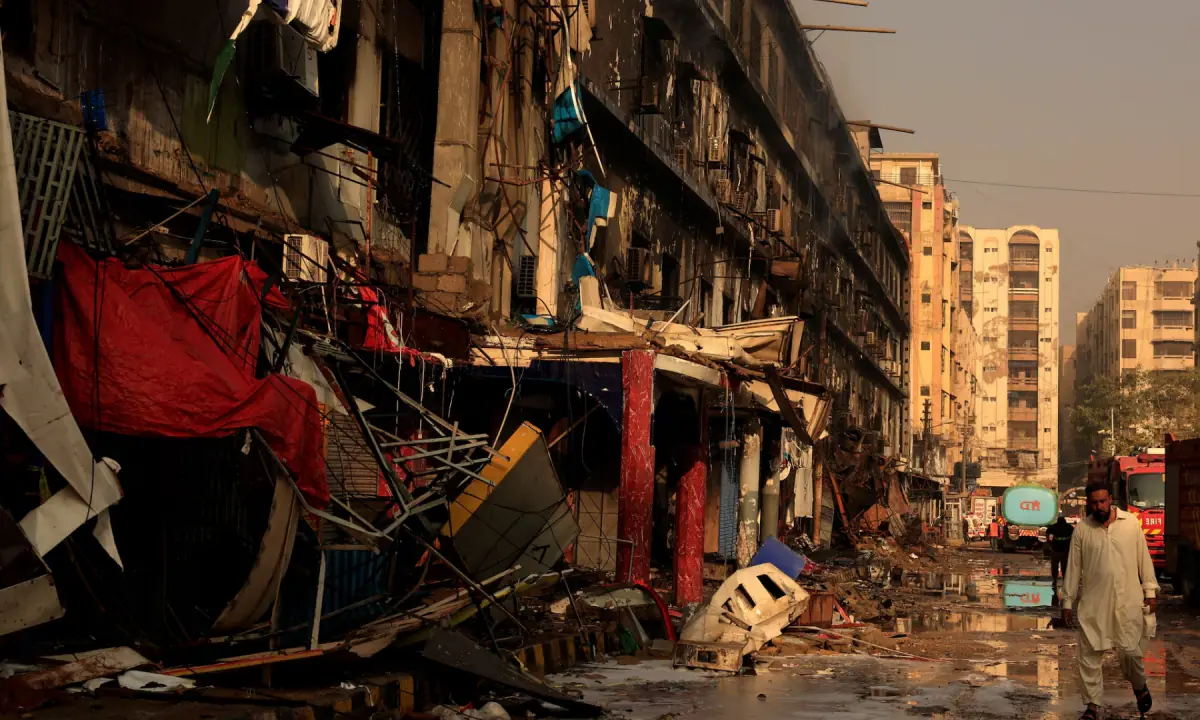
Header image: A man moves past debris following a massive fire that broke out in the Gul Plaza Shopping Centre in Karachi, Pakistan, January 19, 2026. Reuters/Akhtar Soomro


