





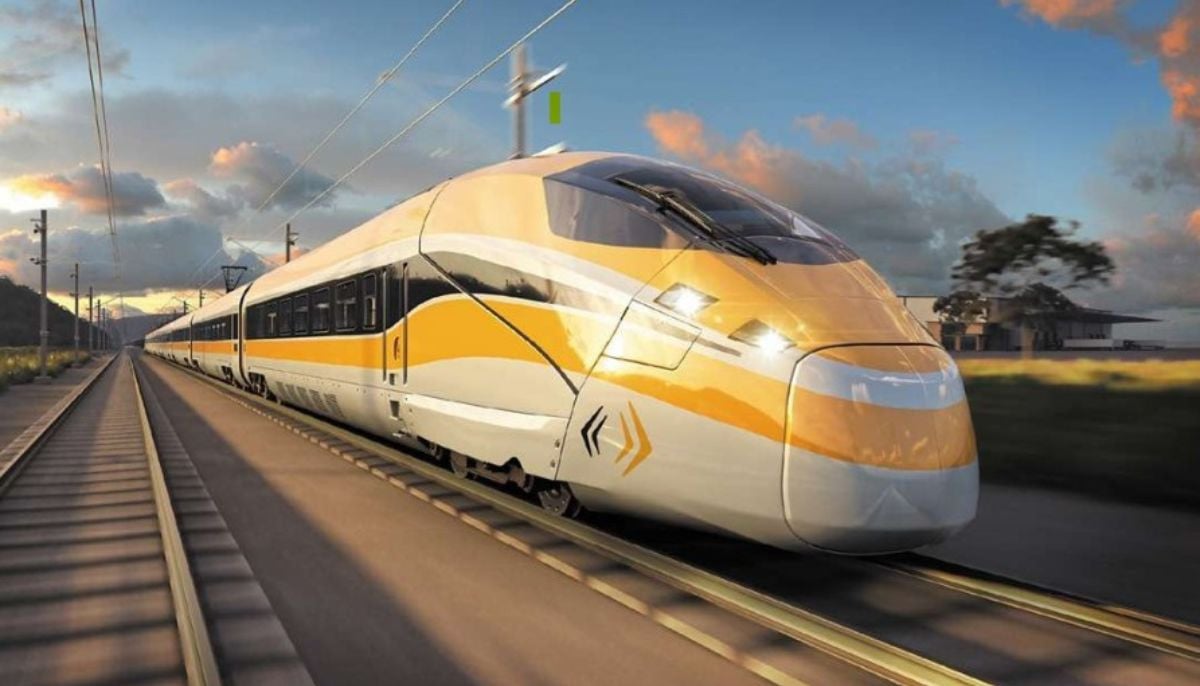
More than 50 years later, the federal government has announced construction of a bullet train line from Sydney to Newcastle will begin in two years.
“A second airport for Sydney has to be connected to Sydney by both an expressway and a railway or perhaps some rapid transport system … a high-speed rail could be constructed,” the late Liberal MP for Mackellar, Bill Wentworth, said in 1971.
As informed by the infrastructure minister, Catherine King, on Tuesday, February 24, 2026, the planned high-speed rail will “change the way people live, work, and travel in Australia’s most populous region.”
Up to 16 million people a year could end up using it by 2041, while it will also contribute to the government’s net zero emissions by 2050 target.

Once it’s up and running, commuters will be able to travel between Newcastle and Sydney in an hour (for $31), instead of more than 2.5 hours, and from Gosford on the Central Coast to Sydney in 30 minutes, down from 90.

King has pledged another $230m for detailed design work, taking the spend in the development phase to $659.6m.
The Sydney to Newcastle stage will cost $61.2bn overall, and the bill goes up to $93bn once the line goes all the way to the new Western Sydney international airport.

The government is looking for private sector investors to pick up part of the tab.
The world’s first high-speed train, the Shinkansen, started operating in Japan in 1964, not long before Wentworth proposed a system for Australia. But despite multiple announcements since then, it has not yet happened.
The plan is to link the cities with 140km of track for trains that can go up to 320km/h.
King said the spending announced on Tuesday was for very detailed design work.
“It is a costly and expensive project, but we’ve got to get it started.
“We don’t want to be one of the few populated countries in the world that does not have a high-speed rail network.
Key reasons behind the high-speed bullet train’s delayed plan:
There have been multiple iterations of the visions for high-speed trains, but so far they have all been derailed.
In 1984, the CSIRO took a proposal for a very fast train (VFT) from Sydney to Melbourne via Canberra to Bob Hawke’s federal government, as well as the state governments of NSW and Victoria.
In 1998 the then prime minister, John Howard, announced a proposed Canberra to Sydney route, but it proved too expensive.
In 2008 Anthony Albanese, then the infrastructure minister, talked up the merits of a VFT between Sydney and Canberra.
In 2011, the Gillard government announced a feasibility study for a high-speed rail line for the east coast.
The HSRA refers to the 2013 east coast high speed rail study, which found high-speed rail was technically feasible, would have a positive economic benefit and would have “a transformational effect on how most Australians live, work and travel”.
In 2013, Kevin Rudd pledged $52m towards a multibillion-dollar high-speed rail line between Sydney and Melbourne to be delivered by 2035.
That same year, Albanese, by that time a transport minister, unveiled the details of a proposed $144 billion Brisbane to Melbourne train.
“Since then, Australia has seen population growth and changing settlement patterns on the east coast and new ways of working as a result of the Covid-19 pandemic and the impact of a changing climate,” it says on its website, adding that other rail infrastructure investment has seen the creation of a construction skills base.
King has now also released a business case, which found the project will generate more than $250 billion in economic activity, almost 100,000 jobs, and see up to 160,000 homes built in the Sydney-Newcastle corridor.
Albanese said on Wednesday he accepted that he “will not be the prime minister when high-speed rail is finished.”
“But I am determined to be the prime minister who starts it.”
The train between Newcastle and Sydney currently takes more than two hours and 40 minutes. The line was originally planned for steam trains and has “barely changed” since its completion in 1899, according to the business case.


