





When nine-year-old Kainat Khalil finished ahead of adult runners on Pakistan’s road-running circuit, her performance should have been recognised as an extraordinary display of talent. Instead, it ignited a controversy that has exposed deep inconsistencies in sports governance, weak child-safeguarding mechanisms and the selective enforcement of age-eligibility rules.
Kainat was recently stopped from officially competing in the 21-kilometre half marathon at the recent BYD Karachi Marathon 2026, despite having been registered and allowed to start the race.
Although she recorded one of the strongest times on the course, organisers later declared her ineligible, awarding her an honorary prize instead and publicly criticising her coach for entering a child in a long-distance event.
The incident followed an earlier episode at the National Games 2025, where Kainat was barred from competing in the 5,000-metre race after having already won a bronze medal in the 10,000 metres. In both instances, intervention came only after the child had competed — and succeeded.

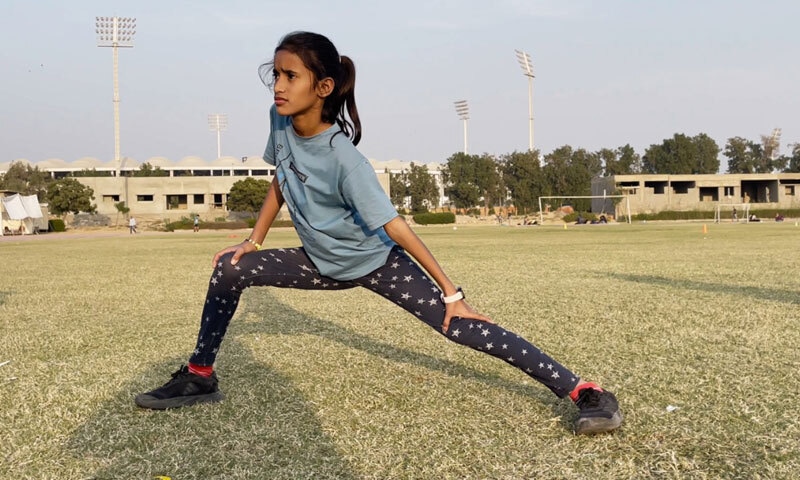
Kainat Khalil recently won a half-marathon but was not awarded a medal. She also won a bronze in a 10,000m event but was stopped from competing in the 5,000m event. The reason: she is only nine years old. Why are sports rules being enforced only once a child wins?


AN EMERGING ATHLETE
A third-grade student, Kainat has been running competitively for just over a year. In that time, she has participated in several high-profile events, finishing third in the 5km race at the Governor House Karachi Marathon and securing podium positions at the Green Karachi Marathon, the Pakistan Day Marathon, the Maarka-i-Haq Marathon and the Shuhada Run.

Most controversially, she completed and won a 21km half marathon — a distance typically reserved for fully developed adult athletes.
“I want to win a gold medal for Pakistan,” Kainat says briefly, reflecting the ambition driving her rapid rise.
Her performances drew widespread attention and media coverage. They also attracted scrutiny — but only after she began outperforming established runners.
RULES APPLIED AFTER THE FINISH LINE
According to Kainat’s coach, Abu Bakar, objections surfaced only when the child defeated institutional teams.
“She won bronze in the 10,000 metres against runners from Wapda, Navy and Army,” he says. “That is when questions about her age suddenly became an issue.”
Despite being cleared during trials, Kainat was subsequently barred from the 5,000-metre race. Officials cited age restrictions and health concerns — rules that, critics note, had long existed.
“Young children take part in trials regularly,” Mr Bakar said. “No one raises objections until a child wins.”
Several athletics officials, speaking privately, acknowledged that age-eligibility rules are applied inconsistently. Kainat had competed in multiple races without objection, including events where significant prize money was awarded.
This inconsistency raises a critical question: are regulations being enforced to protect children, or to preserve competitive hierarchies?
GENDER, CLASS AND MEDICAL RISK
Kainat’s father, Khalil Ahmed, a driver earning approximately 30,000 rupees per month, believes social attitudes may also have shaped how his daughter’s case was handled.
“We were told many times to focus on a son instead of a daughter,” he says. “I asked them, if a son has rights, does a daughter not?”
Sports analysts note that children from lower-income backgrounds — particularly girls — often lack institutional backing, sponsorship and access to elite training environments that might otherwise offer protection or guidance.
Sports medicine experts, however, caution against romanticising early success in endurance sports. Dr Ucksy Mallick, a sports medicine specialist, explains that children under 12 are biologically unprepared for long-distance competition.
“They have open growth plates, immature cardiovascular systems and limited heat regulation,” he says. “Events such as 10,000 metres or half marathons carry serious health risks at this age, regardless of performance.”
These risks include growth plate injuries, chronic overuse damage, heat illness and cardiac strain. Medical clearance, he stresses, cannot substitute for age-appropriate competition structures. “Physical ability does not mean biological readiness,” Dr Mallick says.
However, experts emphasise that these concerns highlight administrative failure rather than justifying post-race disqualification.
A SYSTEM THAT INTERVENES TOO LATE
By allowing a child to register, compete and finish — and then intervening publicly — authorities failed to protect the athlete at the point where protection mattered most.
Psychologists warn that repeated disqualifications after competition can cause confusion, anxiety and emotional distress in young athletes, particularly when they do not understand why success results in punishment.
Kainat’s case reflects not over-regulation, but delayed and selective intervention.
Following the controversies, her coach says Kainat’s future participation will be limited to shorter distances, with a focus on long-term junior development. Medical experts, however, caution that even 10,000 metres may be excessive at her age — underscoring the absence of clear, nationally enforced youth-distance guidelines.
Ultimately, Kainat Khalil’s case is about more than one gifted child. It exposes systemic weaknesses in Pakistan’s athletics ecosystem: inconsistent rule enforcement, lack of child-centred policy, weak medical oversight and persistent gender and class disparities.
If age rules exist to protect children, critics ask, why are they enforced only after a child wins?
Until that question is answered — through transparent eligibility checks, consistent enforcement and robust safeguarding — Pakistan risks failing both its most-talented young athletes and its fundamental responsibility to protect them.
The writer is a sports journalist and digital content creator. X: @Amirot7Jahan
Published in Dawn, EOS, February 8th, 2026


