


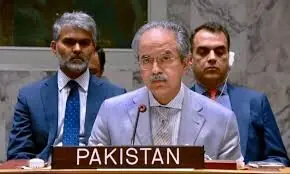
Pakistan has told the UN Security Council that the realisation of Palestinian statehood through a credible, time-bound political process remains the central objective of international efforts.
Speaking at a Security Council open debate on the Palestinian question on Wednesday, Pakistan emphasised that the establishment of “an independent, sovereign, and contiguous state of Palestine based on pre-1967 borders with Al-Quds Al-Sharif as its capital” is the ultimate goal supported by the international community and essential for regional stability.
Pakistan’s Permanent Representative to the United Nations, Ambassador Asim Iftikhar Ahmad, said the unresolved Palestinian question lies at the heart of Middle East instability. He highlighted decades of Israeli occupation marked by dispossession, repression, and the denial of Palestinians’ inalienable rights, including self-determination.

Referring to continued Israeli aggression in Gaza, Ahmad noted that over the past two years, the crisis has escalated to an unprecedented scale, causing widespread civilian casualties, mass displacement, near-total destruction of infrastructure, and severe humanitarian deprivation. He stressed that humanitarian needs are growing rapidly.
The ambassador welcomed renewed diplomatic engagement, including the High-Level Conference on the Peaceful Settlement of the Question of Palestine and President Donald Trump’s Peace Plan, endorsed by Security Council resolution 2803.

He said the second phase of the plan should help consolidate the ceasefire, secure a permanent cessation of hostilities, facilitate transitional arrangements, and enable recovery and reconstruction, while providing humanitarian assistance at scale and preparing the ground for a credible political process toward Palestinian self-determination.
Pakistan, along with other Arab and Islamic countries in the Group of Eight, supports the Board of Peace under resolution 2803, which is intended as a transitional mechanism to consolidate a permanent ceasefire, aid reconstruction in Gaza, and advance a just and lasting peace.
Pakistan has also expressed willingness to participate in the proposed Gaza Stabilisation Force, a US-led multinational initiative to stabilize the territory following the ceasefire.
At the same time, Islamabad has voiced deep concern over continuing tensions. Ambassador Ahmad warned that ceasefire violations persist, civilian lives remain at risk, and pressure on humanitarian organizations impedes aid and protection.
He strongly condemned Israeli actions against UN facilities, including the recent demolition of a UN compound in Sheikh Jarrah, stressing that such acts undermine stabilization efforts and threaten limited progress. He underlined that UNRWA’s operations remain essential and must be safeguarded.
Outlining Pakistan’s priorities, Ahmad called for full respect for the ceasefire, recovery and reconstruction in Gaza without delay, and the prevention of annexation, forced displacement, or any alteration of the territorial unity of Palestinian territories.
He urged an immediate end to illegal settlement activity, settler violence, and attempts to alter the demographic, legal, or historical character of the occupied territory, including holy sites, emphasizing that accountability is indispensable for durable peace.
Pakistan has long supported Palestinian self-determination and statehood, consistently advocating a two-state solution in line with UN resolutions and international law.
Concluding his statement, Ambassador Ahmad reaffirmed that Pakistan’s solidarity with the Palestinian people “remains firm and unwavering” and called on the Security Council to ensure diplomatic efforts deliver concrete, measurable results for the betterment of Palestinians.


