





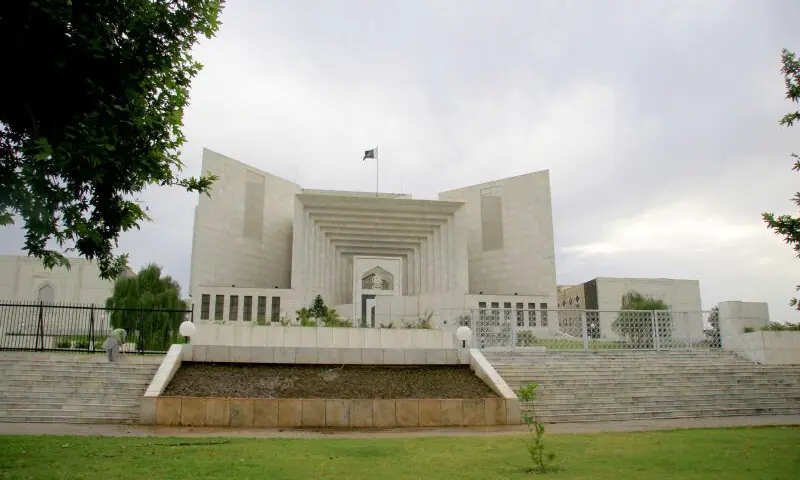
• SC bench disapproves of using judicial proceedings as instrument of coercion, harassment; imposes Rs1m in costs
• Emphasises that dignity of person is inviolable, enjoys constitutional protection under Article 14
• Observes paramount consideration remains welfare and best interests of child
ISLAMABAD: The Supreme Court on Thursday rejected an appeal moved by an individual seeking to establish a marriage with his niece and imposed exemplary costs of Rs1 million for what it termed ‘frivolous and vexatious’ litigation aimed at coercing and intimidating a young woman.
Headed by Chief Justice of Pakistan Yahya Afridi and also comprising Justice Shahid Bilal Hassan and Justice Shakeel Ahmad, the SC bench also disapproved of the use of judicial proceedings as an instrument of coercion and harassment.
Authored by Justice Hassan, the judgement regretted that the present litigation disclosed a sorrowful pattern in which the petitioner, Muhammad Shahzad, despite having failed to establish the alleged Nikah before three forums, persisted in invoking the process of law to pressure and morally intimidate the respondent.

“The record reflects that the respondent, a young woman, has been compelled to undergo repeated, invasive and demeaning scrutiny through a defence which has been concurrently found to be unsubstantiated,” regretted the seven-page judgement.

Muhammad Shahzad had moved the appeal for jactitation of marriage, whereas he instituted a connected suit for restitution of conjugal rights, asserting that a Nikah in accordance with Sharia [Islamic laws] had been solemnised between the parties on April 3, 2020.
Both suits were consolidated and decided through a consolidated judgement dated April 17, 2023, whereby the suit for jactitation of marriage was decreed and the petitioner’s suit for restitution of conjugal rights was dismissed.

Nikah controversy
The appeal preferred by the petitioner was also dismissed. The controversy, in essence, revolved around whether any valid Nikah had in fact been solemnised between the parties and whether the petitioner could establish such marriage through legally admissible and confidence-inspiring evidence.
The high court, while exercising constitutional jurisdiction, examined the record and maintained the findings, thereby dismissing the petitioner’s petition.
“It is evident from the record that the petitioner was declared to be the biological father of a minor child born to the respondent. In any event, even if the petitioner’s version of marriage is discarded, as it has been concurrently by the courts below, the petitioner cannot be permitted to evade the consequences of his own conduct,” the SC judgement stated.
“The minor child is an innocent life and cannot be left unprotected,” it observed, adding that the law did not permit a child to be deprived of sustenance, dignity and lawful support merely because the relationship between the parents was disputed, unlawful or the subject matter of criminal proceedings.
“It must also be emphasised that the dignity of a person is inviolable and enjoys constitutional protection under Article 14 of the Constitution,” the judgement said, adding that the courts could not be passive venues for the perpetuation of social prejudice, nor could they permit their process to become a means of inflicting secondary victimisation upon women who approach the courts for vindication of their lawful rights.
Paramount consideration
“Frivolous allegations and contrived pleas, particularly those aimed at undermining the identity, character and dignity of a woman, cannot be countenanced in any civilised system of justice,” Justice Hassan observed, emphasising that in matters concerning children, the paramount consideration remained the welfare and best interests of the child.
This approach is also consistent with Pakistan’s constitutional obligations under Articles 9, 14, 25 and 35 of the Constitution, as well as Pakistan’s international commitments under the Convention on the Rights of the Child (CRC), which mandate the protection of children without discrimination.
“Equally, it needs to be reiterated that the welfare and rights of a minor child cannot be made hostage to the unlawful conduct, disputes or defences of adults. Even where the child is alleged to have been born outside wedlock, the law does not permit such a child to be treated as a person without entitlement,” the judgement read.
“The right to maintenance and protection is a right vested in the child, and once biological paternity is established in accordance with law, the corresponding obligation of maintenance follows as a legal and moral consequence,” it added.
“The stigma of illegitimacy cannot be permitted to become a shield for a biological father to evade responsibility, nor can it justify the deprivation of an innocent child,” it stated.
Published in Dawn, February 20th, 2026


