

In ‘restricted meeting’ with Saudi crown prince, PM Shehbaz assures him of Pakistan’s ‘full solidarity, support’ – World



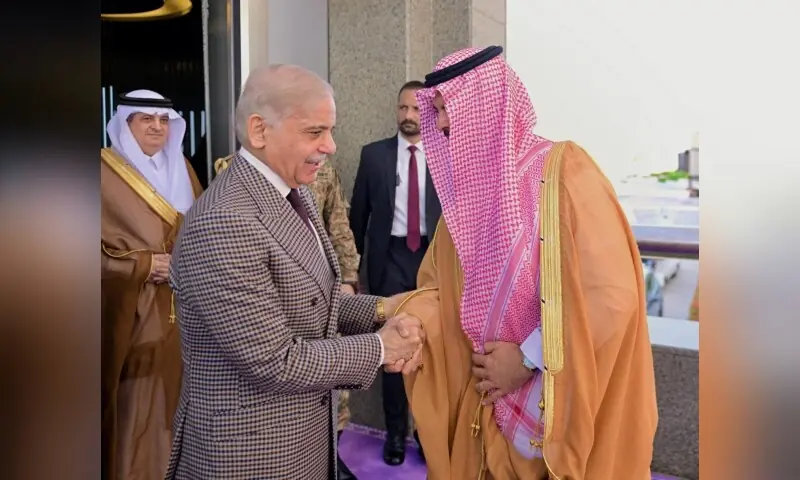
Prime Minister Shehbaz Sharif held a “restricted meeting” with Saudi Crown Prince Mohammed bin Salman on Thursday, PM’s spokesperson for foreign media Mosharraf Zaidi said in a post on X after the premier landed in Jeddah.
The statement said the premier expressed Pakistan “full solidarity and support” for Saudi Arabia “in these challenging times”, and agreed to work together for regional peace and stability.
The prime minister’s visit comes amid intense hostilities in the Middle East, where Gulf countries — including Saudi Arabia — are facing Iranian attacks, which Tehran says are aimed at US and Israeli sites in response to the latter’s deadly large-scale strikes.
The statement shared by Zaidi said Deputy Prime Minister and Foreign Minister Ishaq Dar and Chief of Army Staff and Chief of Defence Forces Field Marshal Asim Munir were also present on the occasion.

“At the outset, the prime minister conveyed his respectful regards and best wishes to the custodian of the two Holy Mosques, King Salman bin Abdulaziz Al Saud, and expressed profound appreciation for the kingdom’s longstanding support to Pakistan,” the statement read.

It added that the prime minister expressed Pakistan’s “full solidarity and support for the kingdom of Saudi Arabia in these challenging times”.
“Both leaders had an in depth exchange of views on the recent developments in the region and agreed to work together for regional peace and stability,” it further stated, adding that PM Shehbaz assured the Saudi crown prince that Pakistan would always stand firmly with Saudi Arabia and strive for their mutual desire for peace in the region.

Earlier, state-run PTV News repoted that the premier was received at the Royal Terminal of Jeddah’s King Abdulaziz International Airport by Deputy Governor of Makkah Region Prince Saud bin Mishal bin Abdulaziz, Pakistan’s Ambassador to Saudi Arabia Ahmad Farooq, Pakistan’s Consul General in Jeddah Syed Mustafa Rabani and other diplomatic staff.
It said that the visit would only last for a few hours, where PM Shehbaz would meet Saudi Crown Prince Mohammed bin Salman.
Previously, the Prime Minister’s Office (PMO) said the premier was undertaking the visit at the invitation of the Saudi crown prince.
It added that the prime minister and the Saudi crown prince would “exchange views on the ongoing tensions in the region, the regional security situation and bilateral relations between the two countries”.
“This visit is highlighting Pakistan’s positive role in the diplomatic arena, and Pakistan will continue to play this role,” the PMO affirmed.
Addressing a weekly press briefing, FO Spokesperson Tahir Andrabi stressed PM Shehbaz’s visit should “also be seen in the broader context of Pakistan’s efforts to advocate and facilitate an early cessation of hostilities and violence in the region, with the aim of paving the way for dialogue and diplomacy”.
He noted that throughout the current wave of conflict, Pakistan has “been urging three points to our interlocutors”.
One of them being “respect for the sovereignty and territorial integrity and a commitment to refrain from use of force within each other’s sovereign territory”, the FO spokesperson said.
“[Secondly,] upholding international law and the principles enshrined in the UN charter and the third point is resuming dialogue, engagement to pursue a peaceful, negotiated resolution to the crisis,” he added.
On Wednesday, Zaidi said that Pakistan would be there for Saudi Arabia “before it is needed”.
On March 7, a week after the war erupted with US-Israeli strikes on Iran, Field Marshal Asim Munir visited Saudi Arabia to meet with Defence Minister Khalid bin Salman Al Saud.
The two “discussed the gravity of the security situation accruing from Iranian drone and missile attacks on the Kingdom”, the military’s media affairs wing said.
They also discussed joint measures needed to halt such attacks within the framework of the “Strategic Mutual Defence Agreement” signed by Pakistan and Saudi Arabia last year.
Days before the CDF’s visit, Deputy PM and Foreign Minister Ishaq Dar disclosed that Pakistan’s diplomatic intervention helped deter heavier Iranian strikes on Saudi Arabia.
‘Don’t like our friends getting into quarrels’
In an interview with Bloomberg TV, the premier’s spokesperson was asked about whether Pakistan would come to Saudi Arabia’s aid “militarily or otherwise” amid war in the Middle East.
Zaidi replied: “The question is not whether Pakistan might come to Saudi Arabia’s aid. Both countries, even before the strategic mutual defence agreement, have operated on a principle of being there for the other before they need the other.
“So, there is no question that we might; we will. No matter what, no matter when.”
He stressed that Pakistan was striving to ensure that things did not escalate to a point where “any of its closest partners are further embroiled in a conflict that potentially undermines stability and prosperity”.
Responding to a question about Pakistan’s engagements with Iran, Zaidi had underscored that Islamabad was “very conscious of its responsibility as a close ally and friend” to the countries involved.
“We don’t like our friends getting into quarrels with each other, and we certainly don’t like innocent people dying needlessly,” Zaidi said.
Asked how close Pakistan was to “providing military aid to Saudi Arabia”, Zaidi said that it would be “speculative and irresponsible” to comment on that.
“As I said to you right at the top, there is no question of if and when. Whatever is needed from Pakistan vis-à-vis Saudi Arabia, Pakistan will be there before it is needed [and] similarly for Saudi Arabia,” he said.


