




• Prices of petrol and diesel increased by Rs55 per litre
• Levy on petrol raised, diesel lowered by Rs20 each
• ‘Highest-ever hike’ announced mere hours after govt assured adequate fuel stocks
• Move comes as crude prices drift closer to psychological barrier of $100 per barrel on international market
• Proposed fuel conservation plan, including ‘work from home’ and online learning, deferred
• PM asks provincial govts to crack down on hoarding of petroleum products
ISLAMABAD: Pakistan felt the first direct economic impacts of the US-Israel war on Iran in a big way on Friday, as the government announced a Rs55 per litre increase in petrol and high-speed diesel prices, mere hours after PM Shehbaz Sharif and Finance Minister Muhammad Aurangzeb assured the nation that petroleum reserves were sufficient and the situation remained under control.
Earlier on Friday, the government shelved a proposed national action plan that envisaged work from home and distance learning measures in response to a potential fuel crisis, and instead decided to keep normal activities unchanged for at least a week.
The ‘highest-ever’ such hike was announced by Petroleum Minister Ali Pervaiz Malik at a press conference alongside Deputy Prime Minister and Foreign Minister Ishaq Dar and Mr Aurangzeb, though the announcement was not followed by any questions from the media.

Mr Dar said the revised fuel prices would come into effect today (Saturday).

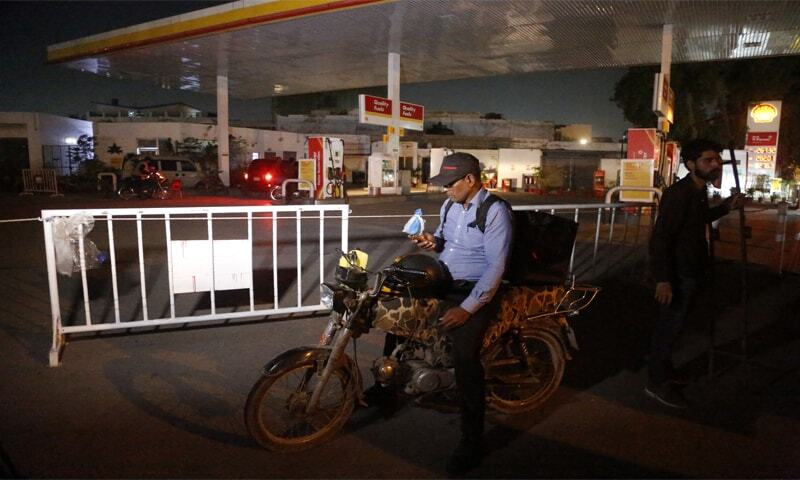
Ahead of the midnight implementation of the price hike, long queues formed at petrol pumps across several cities as motorists rushed to fill their tanks before the new rates took effect. Reports from different parts of the country suggested that some fuel stations temporarily closed their pumps, apparently to avoid selling fuel at the old prices.
The government has increased the petroleum development levy (PDL) on petrol by Rs20 to about Rs105 per litre to offset what would otherwise have been a higher increase in diesel prices. Meanwhile, the levy on high-speed diesel was reduced to Rs57 per litre from Rs77.

As a result, the ex-depot price of high-speed diesel was fixed at Rs335.86 per litre for the coming week, up by about 20pc from Rs280.86 per litre. Likewise, the ex-depot price of petrol was revised to Rs321.17 per litre from Rs266.17 per litre, reflecting an increase of around 17pc.
Speaking at the press conference, Mr Malik said the conflict that began in a neighbouring country had now engulfed the entire region, creating uncertainty in global energy markets.
“The fire that started in a neighbouring country has spread across the entire region. We do not know how long this crisis will continue, and there is no clear timeline for its end,” the petroleum minister said.
He warned that the government would take strict action against hoarding and artificial shortages of petroleum products in the country.
Mr Malik said Pakistan relied heavily on oil supplies passing through the Strait of Hormuz, which has been severely affected by the ongoing conflict.
However, he said two vessels of the Pakistan National Shipping Corporation (PNSC) were currently en route via Yanbu and Fujairah, bypassing the Strait of Hormuz to ensure continued fuel supplies.
The petroleum minister said international oil prices had surged sharply in recent days.
According to Reuters, US crude oil futures climbed more than 12pc on Friday, above $90 per barrel, while international Brent rose about 8pc to $92 per barrel, quickly approaching the $100 psychological barrier that alarms markets.
Mr Malik said the government would now review petroleum prices on a weekly basis in view of the volatile international market. “As soon as the situation improves internationally, we will reduce prices at the same speed,” he added.
Earlier, Mr Dar said global oil prices had increased by 50 to 70 per cent due to the crisis. “In many countries, prices increase automatically, but we tried to pass on the minimum possible impact to consumers and find a balanced solution,” he said.
Finance Minister Muhammad Aurangzeb reiterated that Pakistan currently has comfortable petroleum reserves, and that the country’s economic situation remains stable, adding that the government would closely monitor the impact of rising fuel prices on exports and imports.
However, he stressed that policymakers would remain vigilant.
Fuel conservation plan ‘put on hold’
Earlier, the decision to defer a proposed national action plan, including ‘work from home’ and distance learning measures, was taken at a high-level meeting on petroleum product reserves, chaired by PM Shehbaz.
“The meeting decided that the plan for work from home and distance learning should be deferred for at least a week as current petroleum reserves are adequate to meet the country’s needs,” a source privy to the meeting told Dawn.
A day earlier, the government had in principle decided to begin weekly petroleum price revisions from March 8 and to implement fuel conservation measures, such as distance learning and work-from-home arrangements, amid possible supply disruptions due to the Middle East crisis.
The action plan was finalised in consultation with the provinces at a meeting of the cabinet committee formed by the prime minister to monitor petrol prices in view of the regional situation.
It was presented to the prime minister on Friday, but was deferred and not sent to the Economic Coordination Committee (ECC) of the cabinet for formal approval and implementation. Sources said the contingency measures had also been discussed with the International Monetary Fund (IMF).
According to a statement issued by the Prime Minister’s Office (PMO), the Ministry of Petroleum briefed the meeting on the country’s fuel stocks and regional developments. The meeting was informed that sufficient reserves were available to meet national demand.
The prime minister directed provincial governments to take strict action against hoarding. Any petrol pump found creating an artificial shortage would be immediately sealed, its licence cancelled and legal proceedings initiated, the statement said.
The prime minister also directed the creation of a dashboard to monitor the movement of petroleum products, enabling real-time data sharing with provinces and monitoring of fuel transportation.
Punjab orders crackdown on hoarding
Meanwhile, the Punjab government on Friday directed all deputy commissioners across the province to launch an immediate crackdown against the hoarding of petroleum products, following instructions from the federal government.
The directives were issued during a meeting chaired by Chief Secretary Zahid Akhtar Zaman at the Civil Secretariat, which reviewed the availability and prices of essential commodities.
Deputy commissioners were instructed to take strict legal action against those involved in illegal hoarding of petroleum products.
The chief secretary said such practices would not be tolerated and directed district administrations to ensure strict enforcement of relevant laws.
Mansoor Malik in Lahore also contributed to this report
Published in Dawn, March 7th, 2026


