



The war that began six days ago as a concentrated blow against Iran’s leadership and military is now starting to resemble something more open-ended.
By the sixth day of the war, the conflict that Israel and the United States had initially framed as a concentrated campaign against Iran’s strategic infrastructure had started to assume a different character.
The airspace over Iran continued to be dominated by the US and Israel, and both sides were still trading missiles. But noticeably, the battlefield was quietly widening, and the war’s logic was shifting from decisive blows to cumulative pressure.
If the first five days were about shock and counter-shock, the sixth day looked increasingly like the deepening of an attrition contest. Events over the past 24 hours illustrated that shift with unusual clarity.

The lateral spread
The most visible sign of geographic expansion came not inside Iran or Israel but in the South Caucasus. Two kamikaze drones struck separate locations at the airport in Nakhchivan, the Azerbaijani exclave wedged between Iran, Armenia and Turkiye. Videos circulating on regional channels showed the distinctive engine tone associated with the Shahed family of Iranian drones.

Azerbaijani authorities said two people were injured and condemned the attack, saying it had originated from Iranian territory. Baku also added a warning that it reserved the right to respond, which was a clear diplomatic signal. Therefore, despite being modest in military terms, the strike carried more political weight.

Earlier in the war, Israeli aircraft had used Azerbaijani airspace corridors during the opening strike packages against Tehran. That detail had circulated widely in Persian and Arabic commentary even before the drone strike. Now, on the sixth day of fighting, Iran appeared to be signalling that states facilitating Israeli operations might not remain insulated from the consequences.
This widening of the theatre coincided with a dramatic escalation at sea. Thousands of kilometres away in the Indian Ocean, a US submarine torpedoed the Iranian frigate IRIS Dena near Sri Lanka while it was returning from a naval deployment. Iranian authorities said about 80 sailors perished. Iran’s Foreign Minister Abbas Araghchi condemned the strike as an atrocity at sea and warned that “the United States will come to bitterly regret the precedent it has set.”
Another set of attempted strikes appeared aimed at energy infrastructure further west. Drones and missiles were reportedly directed toward vectors linked to the Baku–Tbilisi–Ceyhan oil pipeline and the Ceyhan export terminal on the Turkish Mediterranean coast. No confirmed hits have been recorded so far.
Intelligence assessments circulating in Washington suggest these attempts may have been demonstrative rather than destructive. The point may have been to show capability rather than to actually halt oil flows. As a result, energy corridors carrying Caspian crude to world markets suddenly became part of the war’s mental map.
The maritime dimension was also showing signs of danger. An oil tanker transiting regional waters was reportedly targeted during the past 24 hours, underscoring how commercial shipping is increasingly exposed as the conflict spreads outward from its original battlefield.
The war inside Iran
Inside Iran, meanwhile, the conflict was emphasising a troubling reality about the nature of targets. It was not only military installations that were being hit. Israeli strikes overnight struck the Azadi Stadium complex in Tehran, a 12,000-seat venue and one of the capital’s most recognisable sporting landmarks.
This added to a growing list of civilian locations that have been hit since the war began. On the first day of the campaign, a US strike hit a school in which 165 schoolgirls lost their lives. Since then, a hospital and a historic heritage site in Tehran have also come under attack.
This targeting pattern has hardened the perception in Persian and Arabic commentary that the war is not sparing civilian and cultural symbols. That perception will matter politically.
Iranian state messaging has leaned heavily on these images, presenting the war less as a confrontation between governments and more as a campaign against the Iranian population itself. Iranian domestic reaction is already showing the effect as it has strengthened rather than weakened the sense of national solidarity that US and Israeli planners had hoped to fracture.
Iran’s change of tactics
While the strikes on Tehran dominated the visual narrative, the operational developments of the sixth day were unfolding elsewhere.
Air combat also intensified. Iranian air defences reportedly shot down an F-15 fighter jet inside Iranian territory during one of the strike waves. Neither the US nor Israeli authorities confirmed the loss, but Iranian media circulated footage that it said showed the wreckage of the aircraft. The pilot was rescued by a recovery team based in one of the neighbouring countries and was said to be undergoing treatment at a base in Saudi Arabia.
At roughly the same time, an unusual incident unfolded further south in the Gulf. Qatari air defences shot down two Iranian aircraft that had entered its airspace after unusual manoeuvres and were said to be minutes away from hitting the targets.
For the first time since the war began, Iran and Hezbollah carried out a fully synchronised attack on central Israel. Iranian ballistic missiles were launched toward Tel Aviv while Hezbollah drones crossed from Lebanon at roughly the same time. The result was an extraordinary burst of air raid alerts. Israeli civil defence systems registered 161 simultaneous warnings across multiple cities, sending nearly six million people into shelters.
The coordination was not accidental. By pairing ballistic missiles with swarms of lower-cost drones, Iranian planners forced Israel’s layered missile defence network to engage multiple types of threats at once. Arrow interceptors designed for high-altitude ballistic targets had to operate alongside Iron Dome systems intended for rockets and drones.
In the early days of the war, Israel’s interception rates were high. But the emerging pattern suggests that Tehran is now less concerned with breaking through completely than with gradually exhausting the interceptor inventory which would not be too easy to replenish.
This is nothing but a classic asymmetric calculation. A drone that costs tens of thousands of dollars can compel an interceptor worth hundreds of thousands or more. Over time, the economics alone can become a strategic lever.
Religious dynamics
The sixth day also revealed the first signs of a religious mobilisation dynamic building in Iraq.
Grand Ayatollah Ali al-Sistani, the most senior Shia cleric in the country, issued a carefully worded statement condemning the assassination of Iran’s supreme leader earlier in the conflict. But he stopped short of calling for armed mobilisation.
Hours later, a relatively junior but influential voice stepped forward. Sayyid Hashem al-Haidari, a hard-line Shia figure associated with factions of the Popular Mobilisation Forces, issued an explicit call for jihad against what he described as the “Epstein coalition,” a term circulating among pro-Iranian groups for the United States and Israel.
The fatwa framed the conflict not merely as a geopolitical struggle but as an attack on the Shia religious order itself.
And such perceptions are not limited to Iran and Muslim populations. Some American segments too believe that the war is more than geo-political. US Senator Lindsey Graham, a close ally of Trump, has said “This is a religious war, and we will determine the course of the Middle East for a thousand years.”
The contrast between the two statements by Shia clerics was striking. Sistani’s caution appeared designed to avoid unleashing a wave of uncontrolled militia action inside Iraq. Haidari’s language, by contrast, was openly mobilising.
The pattern suggests a calibrated escalation path. Tehran can increase pressure through allied networks while still keeping the most powerful clerical authority at arm’s length from the conflict.
In Bahrain, where analysts had expected possible unrest because of the island’s Shia majority population, demonstrations continued but remained limited, with protesters throwing Molotov cocktails in some areas and security forces responding with arrests. So far, there has been no sign of a coordinated proxy campaign there.
At the same time, thousands of Iraqi Kurds reportedly launched a ground offensive in Iran, Reuters quoted a US official telling Fox News.
Kurdish Iranian dissident groups based in northern Iraq were preparing for a potential cross-border military operation in Iran, and the US has asked Iraqi Kurds to support them, Kurdish officials told The Associated Press.
On the other hand, Iran’s Revolutionary Guards carried out missile and drone strikes against Kurdish militant positions near Sulaymaniyah and other locations inside Iraqi Kurdistan while reinforcing deployments along Iran’s western provinces over the past 24 hours. Iraq too reportedly sent in reinforcements along the border.
Where to next?
Taken together, these developments reveal the direction in which the war is moving.
The US-Israel coalition still holds the advantage in conventional air power. Israeli and American aircraft continue to strike targets across Iran with relative freedom, particularly infrastructure connected to missile production and military logistics.
But those hits no longer define the character of the conflict. Instead of seeking immediate battlefield parity, Tehran appears intent on stretching the conflict across geography, politics and economics.
Evidence of that shift is also appearing inside the American military posture. Officials at the United States Central Command have quietly requested extended intelligence support for operations linked to the conflict through at least September, according to briefings circulating in Washington. That timeline suggests the early expectation of a short campaign has faded.
The financial cost reflects the same reality. Current internal estimates put the operational burn rate at roughly one billion dollars a day when missile defence, naval deployments and strike operations are combined. Interceptor stockpiles are also becoming a subject of growing attention on Capitol Hill.
The war that began six days ago as a concentrated blow against Iran’s leadership and military is now starting to resemble something more open-ended. The more crucial part is that neither side has been able to deliver the decisive shock that would end the fight quickly.
And with each passing day, the conflict is slowly pulling new geographies and new actors into its orbit.
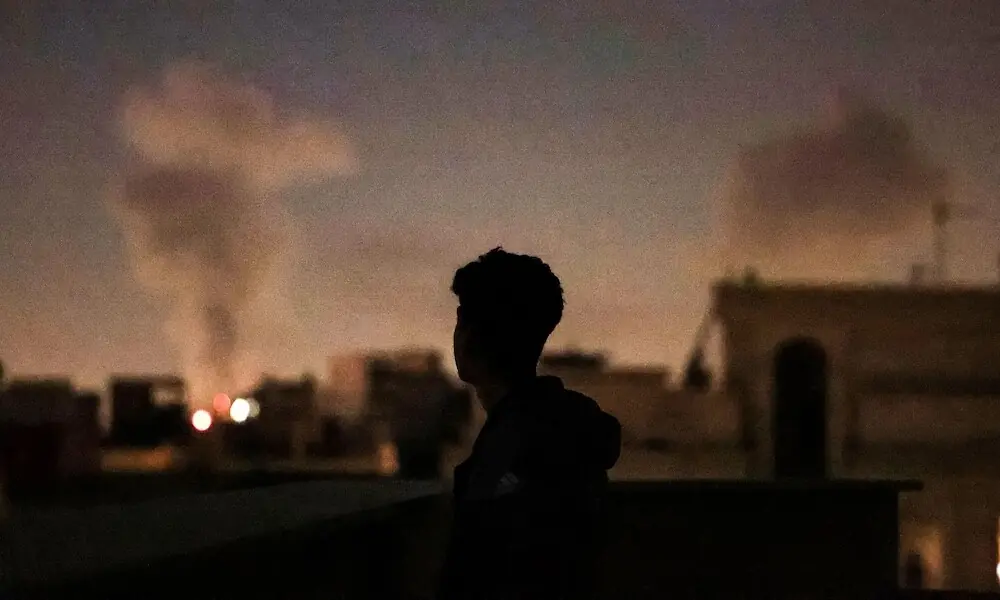
Header image: A plume of smoke rises after a strike on Tehran on March 4, 2026. — AFP


