

Govt to translate impact of rising global oil prices to consumers under existing fortnightly mechanism – Pakistan



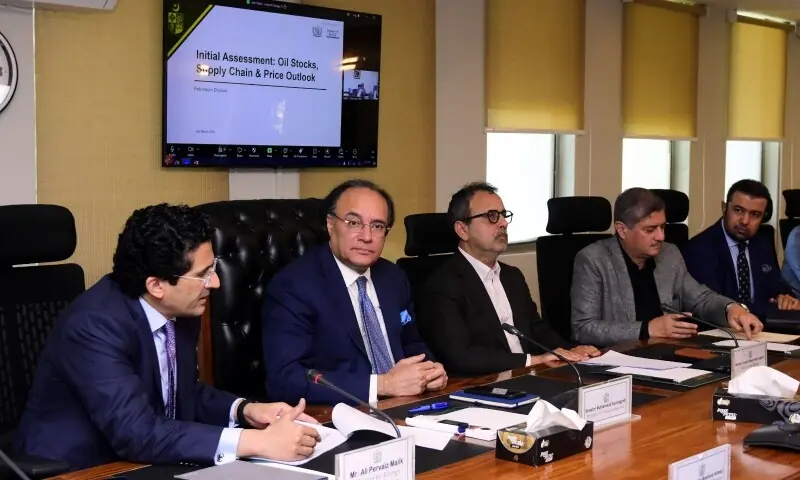
ISLAMABAD: Amid disruption to LNG imports from Qatar, the government on Monday decided to keep translating the impact of rising global oil prices to consumers under the existing fortnightly pass-through mechanism to avoid a fiscal bulge amid close monitoring of supplies.
A meeting of the newly created 18-member cabinet committee, constituted by Prime Minister Shehbaz Sharif to monitor petroleum prices in the wake of the emerging situation in the region, was told that petrol and diesel stocks in the country were sufficient for almost a 30-day cover but Qatar Gas had closed its liquefied natural gas (LNG) facility after it came under Iranian attack.
Official communication from Doha about the latest situation was, however, still awaited. LNG supplies would nevertheless not be available beyond a few cargoes that had already crossed the Strait of Hormuz towards Karachi.
The 18-member cabinet body constituted by the prime minister included the ministers for petroleum and power; the State Bank of Pakistan governor; the secretaries of petroleum, power and finance; the chairman of the Oil and Gas Regulatory Authority; the managing director of Pakistan Refinery Limited; and representatives of Inter-Services Intelligence and the Intelligence Bureau, among others.
The meeting focused on the impact of the closure of the Strait of Hormuz and authorities concerned were directed to explore alternate supply routes.

It was reported that while there was no emergent situation, Saudi supplies of finished products could be routed through the Red Sea, while UAE imports through Fujairah were beyond the troubled route.
According to an official handout, the committee also undertook a comprehensive stocktaking exercise and deliberated on all matters within its mandate.

Members reviewed trends in forward and futures prices of petroleum products, assessed the resilience of regional and international supply chains amid the evolving geopolitical environment, examined potential short and medium-term foreign exchange implications of price volatility, and evaluated measures to prevent supply disruptions while ensuring uninterrupted domestic availability of petroleum products.
The possible fiscal impact of a prolonged conflict was also considered, but there was a lack of visibility due to uncertainties.
A detailed assessment of global oil market conditions was presented, including movements in international benchmarks, freight and insurance costs, shipping route dynamics, and alternative sourcing options.
Various supply and pricing scenarios were evaluated to ensure preparedness under different contingencies. It was, however, noted that these costs would become clear once the London market started business and would show the latest trends which could be discussed later this week as the committee would be meeting regularly.
The committee was informed that national stocks of petroleum products were presently at comfortable levels.
According to the handout, the finance minister was quoted as saying that there was no immediate supply stress and that maintaining market confidence and orderly conditions remained essential.
While acknowledging that the international environment was fluid and evolving, he noted that Pakistan’s energy supply chain remained stable and fully functional.
The committee also noted that closure of the Strait of Hormuz and tensions around the Bab-el-Mandeb Strait were major challenges for global energy security. “If the situation persists, then it may have implications for Pakistan’s energy supply chain,” the handout said.
It further quoted Aurangzeb as saying that the committee would operate as a strategic governance forum to continuously monitor developments and undertake structured scenario planning.
“He underscored that ensuring the availability of energy supplies across the country was the government’s primary objective and would remain the central driver of all decisions,” the statement said.
He directed all relevant entities to intensify coordination, validate physical stock positions, closely track shipments and storage, and remain fully prepared to respond to emerging developments.
He further emphasised that any decisions taken by the committee would be implemented with clarity and transparency.
“Pricing implications arising from international market movements, where unavoidable, will be addressed through established mechanisms in a predictable and orderly manner to avoid distortions or abrupt adjustments,” the statement said.
The meeting also reviewed LNG and liquefied petroleum gas (LPG) supply positions, shipment schedules, terminal operations, and line-pack considerations.
According to the statement, the relevant ministries were tasked with refining comparative scenario assessments, including economic and fiscal trade-offs associated with alternative fuel utilisation and demand management options.
To ensure continuous oversight and institutional readiness, it was decided that the committee would convene daily, with structured data consolidation followed by formal review, it added.
“This mechanism will enable real-time monitoring of international price movements, domestic stock levels, foreign exchange exposure, and supply chain developments,” the statement said.
Concluding the meeting, Aurangzeb reaffirmed that the government was closely monitoring the situation at the highest level and that proactive measures were firmly in place. He assured the public and market participants that there was no cause for concern.
“Energy supplies remain stable, governance mechanisms are fully operational, and comprehensive contingency planning is actively underway to safeguard national interests,” he was quoted as saying.
The cabinet committee is required to determine the foreign exchange implications of oil price volatility for the short and medium term and suggest measures to ensure uninterrupted supplies of oil products and markets stay adequately supplied.
It is also tasked with carrying out a detailed analysis of the fiscal impact in the event of a prolonged conflict and reviewing the broader effects of the war on Pakistan’s economy. It will submit its regular reports to the prime minister.
