





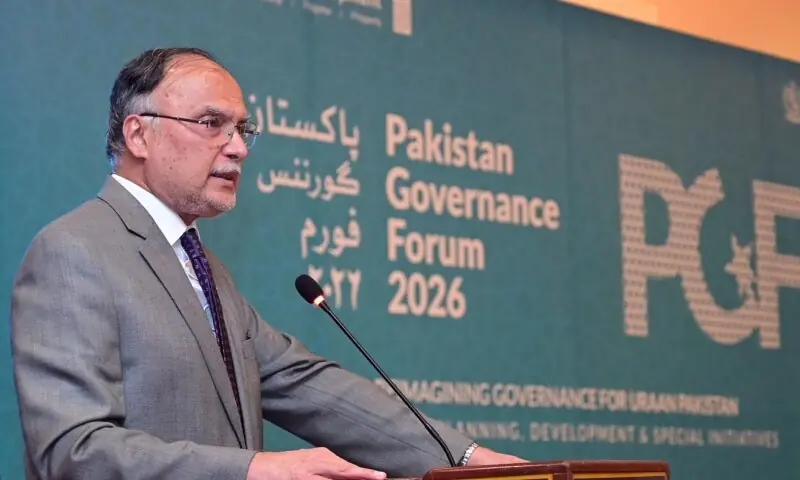
• Planning minister advocates measures to incentivise poverty reduction, sustainability, population stabilisation
• Punjab minister for protecting rights of smaller provinces
ISLAMABAD: Federal Minister for Planning and Development Ahsan Iqbal on Thursday highlighted structural fiscal challenges being faced by the federal government and called for comprehensive and forward-looking reforms in the National Finance Commission (NFC) Award.
Speaking at the concluding session of the Pakistan Governance Forum, the minister, however, clarified that the constitutional vertical distribution of resources between the federation and provinces was not under review.
Mr Iqbal noted that from approximately Rs14 trillion in federal tax revenue and Rs5 trillion in non-tax revenue, around Rs8.2 trillion was transferred to the provinces under the NFC Award. After these transfers, he said, the federal government retained fiscal space of approximately Rs11.07tr against total expenditures of nearly Rs17.5tr.

“Nearly 50 per cent of federal expenditure goes toward debt servicing and approximately 25pc toward defence,” he explained. “After meeting these obligations, the federation must finance pensions, salaries, running expenses, development, grants, and social protection largely through borrowing. This equation is not sustainable.”

He further noted that despite social welfare being a provincial subject following the 18th Amendment, the federal government continued to fund major national social protection initiatives, such as the Benazir Income Support Programme (BISP), currently costing approximately Rs716bn. Additionally, he said, the federation bears financial responsibilities for Azad Kashmir, Gilgit-Baltistan and Islamabad Capital Territory (ICT).
Turning to the NFC formula, the minister said with 82pc weightage assigned to population, there was little fiscal incentive for provinces to pursue population stabilisation.

“Similarly, with 10pc weightage linked to poverty, provinces may inadvertently benefit from remaining poor rather than being rewarded for reducing poverty,” he said, proposing recalibrating the formula to incentivise poverty reduction, human development improvements, climate resilience and environmental sustainability, and population stabilisation.
Call for ‘true partnership’
Senior Punjab Minister Marriyum Aurangzeb, who participated in the event via video link from Lahore, presented a comprehensive analysis of the objectives, challenges and current fiscal realities of the NFC Award while emphasising the need to protect the rights of smaller provinces.
She said the NFC should operate as a true partnership between the federal government and the provinces ensuring transparency, fairness and cooperation in all fiscal matters.
She noted that any future NFC framework must begin with a realistic assessment of national debt servicing obligations, defence financing requirements, climate vulnerability and water security challenges, which collectively place significant pressure on the federation’s fiscal space.
Ms Aurangzeb highlighted that expanding the tax base, improving the tax-to-GDP ratio, encouraging provincial revenue generation and promoting economic growth were essential to ensuring long-term fiscal stability.
Published in Dawn, February 27th, 2026


