





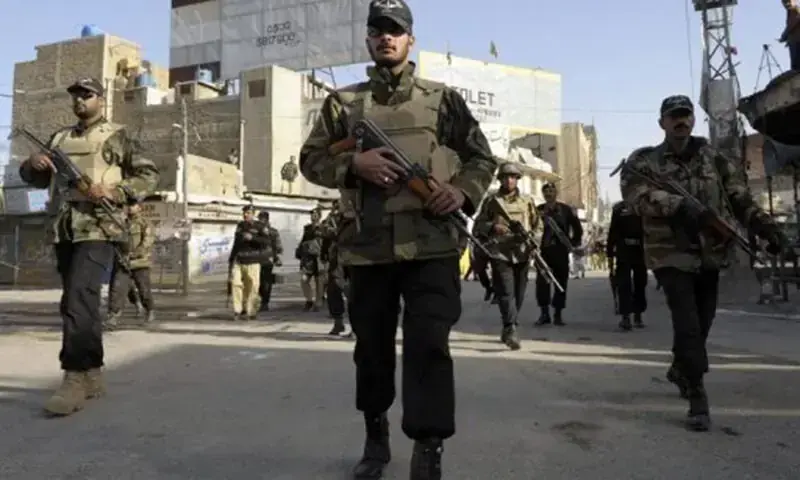
WITHIN hours of the bombing of an Islamabad Imambargah on Feb 6, Pakistani intelligence and law enforcement zeroed in on a home in Hakimabad, Nowshera, 49km east of Peshawar.
“It was a race against time. Sifting through technical data, establishing coordinates and isolating the target,” a senior security official said. “It didn’t take long before we knew the location.”
By late evening, they had already laid siege to the residence, taken up position and called out those inside to come out, hands raised, and surrender.
For a moment, there was no movement. But then, someone showed a raised hand from behind the door, indicating their willingness to surrender. Except that he didn’t.

Aiming a 9mm gun straight at the security cordon, the lone gunman fired straight shots, hitting an assistant sub inspector of the police right in the chest, killing him on the spot, and injuring two intelligence officers.

The exchange of fire didn’t last long, though.
Within minutes, the gunman, said to be in his mid-thirties, was shot and killed. But the brief distraction offered by the gun battle gave those inside the house sufficient time to destroy cellphones and any other evidence of communication that could possibly betray them.

The gunman turned out to be a high-value target — identified as Yousaf alias Qasim aka Idrees — the leader of the militant Islamic State-Khorasan (IS-K) group in the Bajaur region, and the main handler of the Imambargah suicide bomber, carrying a reward of Rs12 million.
What followed was more startling, as the counter-terrorism department dug further into this cell’s activities. The gang, it turned out, had been involved in a series of assassinations and suicide bombings before stepping out of the tribal district to relocate to Gujranwala, Lahore and finally to Nowshera’s Hakimabad.
Investigators now have enough evidence to link them to the targeted assassination of all 20 men involved in the lynching to death of an IS-K operative, out to kill a local JUI-F leader for issuing a scathing attack against it.
They were also linked to the assassination of senior JUI-F figure Mufti Sultan Mahmood in Bajaur in October 2019, a suicide bombing at the party’s convention on July 30, 2021 that left more than 54 dead and over a hundred wounded, and the bombing and assassination of ANP leader Maulana Khanzeb on July 10, 2025.
Additionally, investigators say, the group was involved in the killings of at least 15 policemen, as well as the murder of the Nawagai assistant commissioner in a bombing on July 2, 2025.
Investigators say that Idrees — a tailor by profession — had been on their radar for some time, but had managed to evade capture by changing locations, moving with women and children, and avoiding staying at one location for longer periods.
“Pretty much living like nomads, leaving whatever little they had behind before moving onto the next location without notifying the landlord,” was how one official described his movements.
What surprised investigators the most was the role of the women in the group. Investigators have now established that not only did the suicide bomber travel to Afghanistan’s Kunar in May 2025, the women had also crossed the border using tampered passports.
Not only that, but one of the women had carried the suicide vest from Bajaur to Islamabad, and handed it over to another woman in the group. “They are all indoctrinated. The whole family is radicalised,” a senior investigator said.
As investigators dig deeper into the working and operations of IS-Khorasan, there is a realisation that its network is far bigger and more spread out than previously thought — from the Middle East to Central Asian Republics, and onwards into Afghanistan and Pakistan.
They use cryptocurrency for money transfer and employ encrypted communication apps, making their communications very hard to break.
Based on what they have learned, investigators now consider IS-Khorasan a much bigger threat than the outlawed Tehreek-i-Taliban Pakistan in terms of its capability for mass killing, compartmentalisation, commitment to ideology, resources and the sophistication of their operations.
Published in Dawn, February 26th, 2026


