





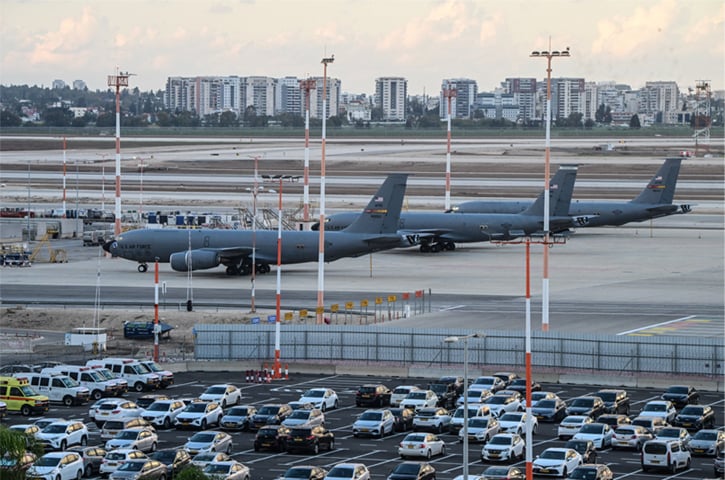
• CSIS report terms current convergence of US military hardware largest since 2003 Iraq war, but smaller than 1991’s ‘Desert Storm’
• Ahead of Geneva talks, Iran says it is ready to take any steps towards a nuclear deal
WASHINGTON: As the world’s largest aircraft carrier sails to join a massive military build-up in the Middle East, a new study reveals that the deployment looks to be structured for “limited action” rather than a “large-scale war”.
The assessment comes as US President Donald Trump’s reported consideration of a short, coercive strike to pressure Tehran into accepting his demands has triggered intense debate in Washington and beyond over the likelihood of conflict, the definition of objectives, and the danger of a wider regional war.
In the meantime, oil prices are hovering near seven-month highs, with traders assessing risks to supply from any military escalation as another round of US-Iran nuclear talks looms.

Ahead of Thursday’s planned nuclear talks between Iran and the US, Iranian Deputy Foreign Minister Majid Takht-Ravanchi said on Tuesday that his country was ready to take any necessary steps to reach a deal with the United States.

The talks are set to take place on Thursday in Geneva.
We are ready to reach an agreement as soon as possible. We will do whatever it takes to make this happen. We will enter the negotiating room in Geneva with complete honesty and good faith,” Takht-Ravanchi said in comments carried by state media.

White House Press Secretary Karoline Leavitt said on Tuesday that US President Donald Trump’s first option was always diplomacy but that he was willing to use lethal force if necessary.
“If there is an attack or aggression against Iran, we will respond according to our defence plans… A US attack on Iran is a real gamble,” Takht-Ravanchi added.
Trump confident US can easily beat Iran
President Donald Trump on Monday denied reports that the top US military officer had flagged the risks of a major operation against Iran, saying Washington would “easily” beat Tehran in any war.
US media reported that General Dan Caine, the chairman of the joint chiefs of staff, had warned of various risks associated with strikes against Iran including a long-term entanglement.
But Trump said on his Truth Social network that it was “100 percent incorrect” that Caine was “against us going to war with Iran.”
“General Caine, like all of us, would like not to see War but, if a decision is made on going against Iran at a Military level, it is his opinion that it will be something easily won,” Trump wrote.
“He has not spoken of not doing Iran, or even the fake limited strikes that I have been reading about, he only knows one thing, how to WIN and, if he is told to do so, he will be leading the pack.”
The US president, however, accused the media outlets of writing “incorrectly, and purposefully so.” “I am the one that makes the decision, I would rather have a Deal than not but, if we don’t make a Deal, it will be a very bad day for that Country and, very sadly, its people,” Trump added.
In response to a separate report in The New York Times suggesting that Trump is weighing a near-term limited strike — with the possibility of a broader campaign later — Middle Eastern scholar Vali Nasr wrote: “Trump is signaling Iranians via New York Times. He is trying to force a deal by threatening war.”
Nasr cautioned that continued pressure, even after a deal, could push Tehran toward confrontation, quoting Middle East analyst Ali Hashem as saying: “Washington assumes military pressure buys diplomatic leverage. Tehran sees a challenge to ideological survival.”
Build-up
The USS Gerald R. Ford, meanwhile, has reached the US naval base of Souda Bay on Crete, en route to the Persian Gulf.
US Naval Support Activity Souda Bay is home to approximately 1,000 people, including active duty military, US civilian employees, local national employees, contractors, and family members.
Washington currently has more than a dozen warships in the Middle East: one aircraft carrier — the USS Abraham Lincoln — nine destroyers and three littoral combat ships.
It is rare for there to be two US aircraft carriers — which carry dozens of warplanes and are crewed by thousands of sailors — in the Middle East.
However, a recent study by the Centre for Strategic and International Studies (CSIS) provides a detailed picture of what current US deployments can and cannot do.
It notes that the naval “armada” in the Middle East and eastern Mediterranean is the largest US maritime presence in the region since five carrier strike groups were assembled at the start of the 2003 Iraq war. The force is sufficient for targeted strikes and for defending US allies and partners.
However, it lacks Marine units, special operations forces for raids or ground missions, and the logistics required for a prolonged air campaign.
The study also stresses that the current deployment is far smaller than the forces used in the 1991 Gulf War and the 2003 invasion of Iraq, when the US conducted major combat operations and regime change.
A surge in cargo aircraft and aerial refueling tankers does not indicate the movement of ground combat units, the report says, making scenarios such as capturing or killing Iran’s leadership unrealistic — particularly given the distance from likely launch points to Tehran.
The available force package is also deemed insufficient for regime change, and the report argues that even a decapitation strike would be unlikely to destabilise Iran’s political system, which has shown resilience under pressure.
For a sustained, multi-week air campaign, CSIS concludes, Washington would need a much larger logistical buildup that would take additional time.
Published in Dawn, February 25th, 2026


