



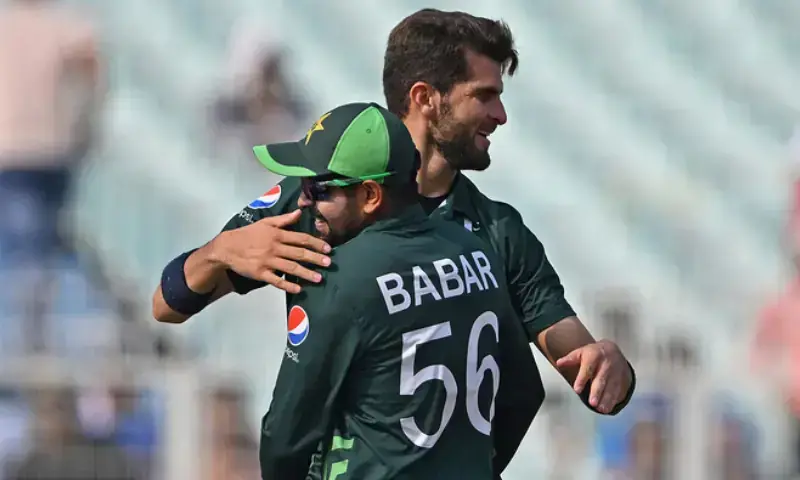
COLOMBO: The struggles of stalwarts Babar Azam and Shaheen Shah Afridi have come under the spotlight as Pakistan eye a winning start to their T20 World Cup Super Eight campaign against New Zealand at the R. Premadasa Stadium here on Saturday.
While Babar failed to deliver in his newly-assumed number four role — barring a decent outing against the USA — during the group stage, Shaheen has emerged as one of Pakistan’s weaker links throughout the tournament so far.
The duo may well take a back seat against the BlackCaps, with the less experienced yet promising Khawaja Nafay and Salman Mirza expected to be entrusted with middle-order batting and new-ball bowling duties, respectively.
On the eve of the fixture, Pakistan head coach Mike Hesson laid bare Babar’s vulnerabilities with the bat and hinted the former skipper could contribute only in a specific role, providing context as to why he was not sent in during the last group game against Namibia.

“We think he’s a fine player through the middle, if required, in terms of if we’re in a little bit of trouble, or as we saw against the USA, once he gets himself set, he can increase his strike rate at that point,” said the coach.

“So, we brought Babar back in for a specific role post the Asia Cup. We wanted some batsmanship through the middle, and he certainly brings that for us.
“And he did in many games throughout the last 10. So, the other day we got to the 12th over mark and at that point, Babar Azam is not the best person to come in.”

Instead of Babar, Nafay was promoted to bat at four. Although the right-hander did not shine on his World Cup debut, it signalled that Pakistan had made significant adjustments to their initial plans.
“We’ve got plenty of other options who can come in and perform that role towards the end,” Hesson said.
For Shaheen, who was rushed back into the side following an injury two months ago, the T20 World Cup has been unforgiving. The left-armer, who once struck fear into opening batters, has conceded 11.22 runs per over during the showpiece, having bowled only nine overs in total.
Salman, in contrast, has conceded six runs per over in the two matches he has bowled. The left-arm medium-pacer was dropped after a decent showing against the Netherlands, and missed the following two matches before replacing Shaheen in the Namibia fixture.
The former, however, is likely to be Pakistan’s first choice in the upcoming games.
“We made a call that Salman Mirza was coming in for Shaheen,” Hesson said. “He bowled incredibly well. To be fair, he was probably really unlucky not to be playing the second and third games.
“His record since he started playing for Pakistan is exceptional.”
Hesson said Pakistan would continue to back their spin-heavy strategy, at least in Colombo, even if that meant fielding a side packed with all-rounders.
“[Mohammad] Nawaz is one of the best performing spinners in the world in T20 cricket,” said the New Zealander. “Since Shadab Khan came back, his figures have been exceptional.
“Saim Ayub is already in the side and obviously has the ability to bowl the carrom ball. The fact that Usman Tariq has been able to bowl the tough overs through the middle and at the death has been a real advantage for us.”
For New Zealand, meanwhile, the Super Eight stage will test their adaptability, with the side having played all their group matches in India.
Pace, bounce and spin in Colombo are likely to differ markedly from conditions in Chennai and Ahmedabad, but batter Mark Chapman said the players were well aware of the variations in pitches.
“I think guys understand what they need to do on slower wickets after playing in India where pitches were batting friendly,” said the middle-order player. “So, we’re pretty confident that we’ll face up to whatever conditions are in front of us.
“A lot of the guys have played a lot of cricket here before.”
Pakistan have played all four of their matches in Sri Lanka and possess a potent spin attack.
Chapman was confident New Zealand could cope with Pakistan’s spinners, including the unorthodox Usman, who pauses in his delivery stride and employs deceptive variations, including side-arm releases.
“Obviously, Tariq has a pretty unique action with the way that he stops at the crease and that’s something to factor in,” Chapman said. “But each of the Pakistan spinners poses their own threat.”
Published in Dawn, February 21st, 2026
