



In a latest update, Democrats revel in the Supreme Court decision curbing Trump’s tariff spree.
The U.S. Supreme Court struck down Donald Trump’s sweeping tariffs that he pursued under a law meant for use in national emergencies, handing a stinging defeat to the Republican president in a landmark opinion on Friday with major implications for the global economy.
The Senate minority leader, Chuck Schumer, said, ‘Overreach failed,’ after the court ruled the president cannot bypass Congress’s power to tax.
As reported by Fox News, the justices, in a 6-3 ruling authored by conservative Chief Justice John Roberts, upheld a lower court’s decision that Trump’s use of this 1977 law exceeded his authority.

The justices ruled that the law at issue—the International Emergency Economic Powers Act, or IEEPA—did not grant Trump the power he claimed to impose tariffs.

“Our task today is to decide only whether the power to “regulate … importation,” as granted to the president in IEEPA, embraces the power to impose tariffs. It does not,” Roberts wrote in the ruling, quoting the statute’s text that Trump claimed had justified his sweeping tariffs.
Trump has leveraged tariffs—taxes on imported goods—as a key economic and foreign policy tool. They have been central to a global trade war that Trump initiated after he began his second term as president, one that has alienated trading partners, affected financial markets, and caused global economic uncertainty.

Roberts, citing a prior Supreme Court ruling, wrote that “the president must ‘point to clear congressional authorization’ to justify his extraordinary assertion of the power to impose tariffs,” adding: “He cannot.”
Democrats and various industry groups hailed the ruling. Many business groups expressed concern that the decision will lead to months of additional uncertainty as the administration pursues new tariffs through other legal authorities.
The ruling did not address the issue of the government refunding tariffs that were struck down.
The ruling sent U.S. stock indexes, long buffeted by Trump’s unpredictable moves on tariffs, up by the most in more than two weeks and weakened the dollar. Treasury yields edged higher.
At an event in Georgia on Thursday on the eve of the ruling, Trump said, “Without tariffs … everybody would be bankrupt. Everybody. The whole country would be bankrupt. … And the language is clear that I have the right to do it as president. I have the right to put tariffs on for national security purposes.”
The White House had no immediate comment on the ruling.
It was “telling” that “no president has invoked the statute to impose any tariffs—let alone tariffs of this magnitude and scope,” Roberts added.
The Supreme Court reached its conclusion in a legal challenge by businesses affected by the tariffs and 12 U.S. states, most of them Democratic-governed, against Trump’s unprecedented use of this law to unilaterally impose the import taxes.
Trump’s tariffs were forecast to generate over the next decade trillions of dollars in revenue for the United States, which possesses the world’s largest economy.
Trump described the tariffs as vital for U.S. economic security, predicting that the country would be defenseless and ruined without them.
Trump in November told reporters that without his tariffs, “the rest of the world would laugh at us because they’ve used tariffs against us for years and took advantage of us.” Trump said the United States was abused by other countries, including China, the second-largest economy.
Treasury Secretary Scott Bessent and other administration officials said the United States would invoke other legal justifications to retain as many of Trump’s tariffs as possible.
Among others, these include a statutory provision that permits tariffs on imported goods that threaten U.S. national security and another that allows retaliatory actions including tariffs against trading partners that the Office of the U.S. Trade Representative determines have used unfair trade practices against American exporters.
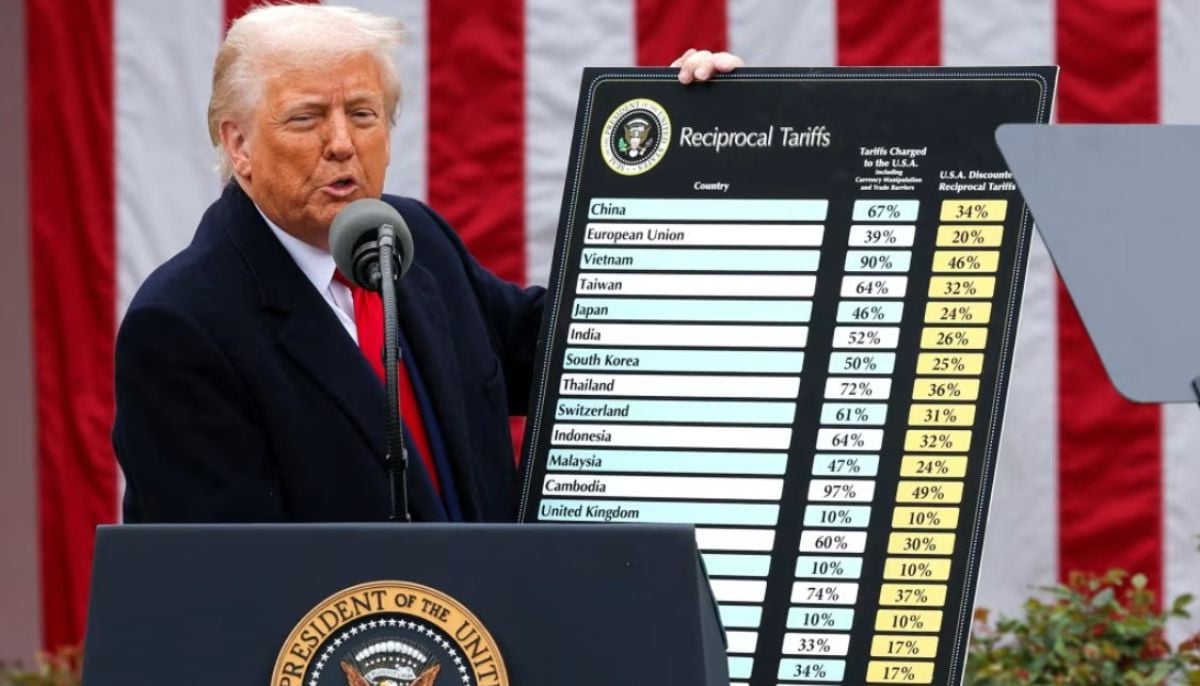
On April 2 on a date Trump labeled “Liberation Day,” the president announced what he called “reciprocal” tariffs on goods imported from most U.S. trading partners, invoking IEEPA to address what he called a national emergency related to U.S. trade deficits, though the United States already had run trade deficits for decades.
In February and March of 2025, Trump invoked IEEPA to impose tariffs on China, Canada and Mexico, citing the trafficking of the often-abused painkiller fentanyl and illicit drugs into the United States as a national emergency.
Additionally, the cases on tariffs before the justices involved three lawsuits.
The Washington-based U.S. Court of Appeals for the Federal Circuit sided with five small businesses that import goods in one challenge and the states of Arizona, Colorado, Connecticut, Delaware, Illinois, Maine, Minnesota, Nevada, New Mexico, New York, Oregon, and Vermont in another.
