



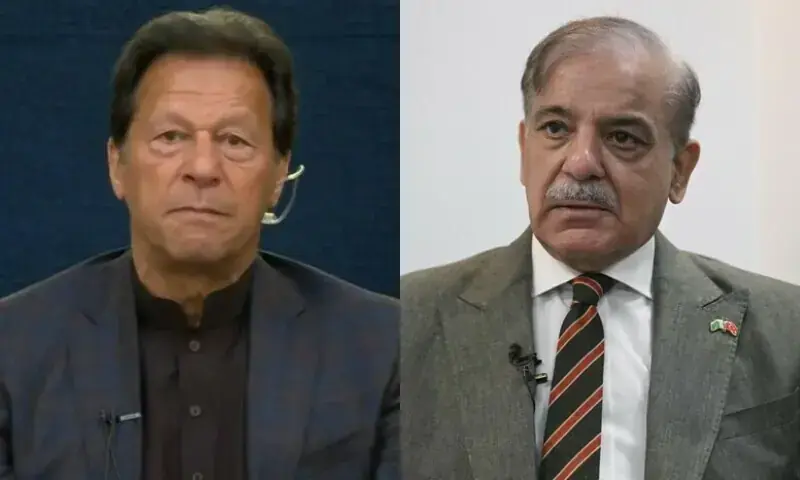
ISLAMABAD: The Supreme Court (SC) stayed on Friday a trial by the court of an additional district judge in Lahore in a RS10 billion defamation suit filed by Prime Minister Shehbaz Sharif against PTI founder Imran Khan.
In his suit filed in 2017, PM Shehbaz said Imran levelled baseless allegations against him. He sought a decree for the recovery of Rs10bn as compensation from the defendant for the publication of defamatory content.
The defamation suit said Imran wrongly accused PM Shehbaz of offering Rs10bn to the latter through a common friend in exchange for withdrawing the Panama Papers case.
The PTI founder had contended in his reply that he had disclosed the alleged incident for the consumption of the public at large, and an act in the interest of the public good did not constitute any defamation. He maintained that he did not specifically attribute any statement to the PM Shehbaz while narrating the incident.

A three-judge SC bench, headed by Justice Ayesha A Malik and including Justices Muhammad Hashim Khan Kakar and Ishtiaq Ibrahim, took up a set of review petitions filed by Imran in the case.

The court also issued a notice to the respondent as no one was present on behalf of PM Shehbaz and directed the court office to fix the case for a hearing at the earliest.
Senator Barrister Ali Zafar, who was representing Imran, argued before the SC that his client could not appear before the trial court as he was injured after being shot in the leg, referring to an assassination attempt on the former premier in November 2022.

Zafar said the trial court had closed the right to defend despite previously acknowledging the PTI founder’s injury.
Now, a trial court has commenced recording evidence and testimonies of witnesses in the case, the counsel said.
At that, Justice Malik wondered how the trial court had “terminated the right to defence” after acknowledging that Imran had been injured.
Subsequently, the SC issued a notice to the respondent and directed the court office fix the review petitions for hearing at the earliest.
Imran had filed review petitions in the case after the trial court had close the right to defence — a decision that was upheld by the Lahore High Court (LHC) and endorsed by the SC on February 21, 2023.
The trial court, through its order on October 20, 2022, had dismissed Imran’s objections in the case over the rejection of PM Shehbaz’s interrogatories — a set of written questions served by one party to the other — and directed the PTI founder to submit his answers.
Later, through a subsequent order of November 24, 2022, the trial court struck off the right of defence due to the non-submission of answers to the interrogatories.
Previously, the SC had held in a 2-1 majority judgment in the case that Imran had been “wilfully contumacious and disobedient” throughout the trial court proceedings and that the trial court had not committed any “illegality or material irregularity” in the exercise of its jurisdiction through its orders of closing the right to defend.
The LHC had also rightly declined to interfere in its revisional jurisdiction, former judge Syed Mansoor Ali Shah had observed at the time in the judgement authored by him.
The had made these observations as it heard an appeal moved by Imran challenging the December 7, 2022 LHC order of upholding the sessions court’s closure of Imran’s right to defend.
Justice Malik, who was also a member of that bench, had dissented from the majority judgement. She had held that in a case plagued by adjournments since 2017, the court must weigh the balance between a fair trial and the legitimate grounds for the request for adjournment.
She had observed that Imran’s public shooting and subsequent injury at a political rally justified the grant of an adjournment for a reasonable time under the circumstances, adding that the right to defence could not be struck off without considering all relevant factors.
Justice Malik had further stated that the trial court’s order sheet showed it had proceeded in a “mechanical manner” and granted numerous adjournments without so much as imposing costs so as to discourage the same.
“No doubt the courts are overburdened with work, and judges are faced with the daunting task of handling a vast number of cases every day; nevertheless, it is the court’s responsibility to manage each case before it diligently by applying the provisions of the procedural law,” she had observed.
She added that the striking off of the petitioner’s right to defence at that stage, while ignoring the legitimate factors in play, would be a “gross injustice”.
The balancing act of justice must be upheld, and under these circumstances, the right to a fair defence must prevail, Justice Malik had observed while setting aside the trial court order and remanding the matter again to the trial court to grant a reasonable opportunity to the petitioner to file answers to the interrogatories.
On the other hand, Justice Shah had observed that Imran’s conduct disentitled him from the indulgence of this court in its discretionary jurisdiction under Article 185(3) of the Constitution.
He added that his appeal was without substance on merits.
He had observed that interrogatories served as a useful tool to shorten litigation and reduce expenses. However, he added that the process of interrogatories had unfortunately been “abused in the present case and, in fact, misused to prolong the trial”.
The former SC judge had said that such “abuse of the process of interrogatories has to be curbed with a heavy hand”.
The fair use of the process of interrogatories should be encouraged, for it would result in saving considerable time and money, and would thus be beneficial to the parties of the case as well as to the administration of justice in general, Justice Shah had observed.
