



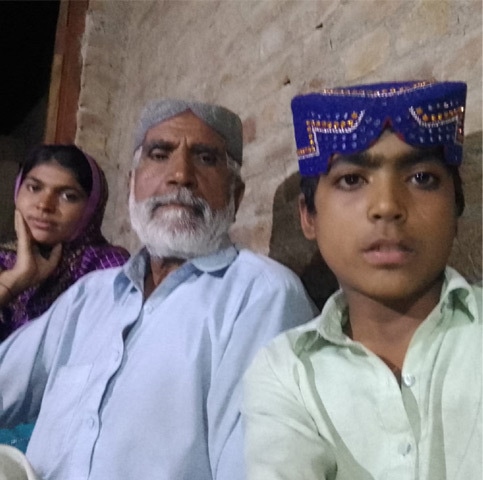
Ten-year-old Ashfaq lives in a bustling household of ten siblings in Sindh’s Ghotki district, some 540 kilometres north of Karachi. Two and a half years ago, when he was just eight, Ashfaq’s world had narrowed to the confines of a bed, his body ravaged by a mysterious, relentless illness.
A second-grade student at that time, Ashfaq arrived at the National Institute of Child Health (NICH) in Karachi in June 2023, cradled by his father and his 25-year-old sister. He was febrile and gasping for air, his skin ghost-white from severe anaemia. Most heartbreaking for the family was Ashfaq’s inability to walk; the very bones that should have carried him through childhood were now sources of agonising pain.
Ashfaq was brought to the paediatric oncology department, run by the medical charity Child Aid Association under the public-private partnership model. As the head of paediatric oncology, I examined Ashfaq and the grim reality became clear: he had been suffering in silence for 10 long weeks and the signs were pointing towards a childhood cancer illness.

Every year, 8,000 Pakistani children are diagnosed with cancer. Less than half receive proper treatment. While childhood cancer survival rates exceed 80 percent in wealthy nations, they plummet below 30 percent in Pakistan. On International Childhood Cancer Day, a doctor reveals how a historic pledge could lead to hope for families across the nation…

ONE CHILD AMONG THOUSANDS
Ashfaq’s story, though tragic, is not unique. It is the hauntingly familiar narrative of countless children who arrive at our centre, their young lives pushed to the brink by delayed diagnosis and systemic hardship.

Childhood cancer, a devastating health concern, affects approximately 400,000 children each year globally, according to World Health Organisation (WHO) estimates issued in February 2025. While survival rates in high-income countries exceed 80 percent, they plummet to under 30 percent in low- and middle-income regions, the WHO notes.
According to non-profit Pakistan Society of Paediatric Oncology (PSPO), around 10,000 children are diagnosed with cancer annually in Pakistan. But less than half receive proper diagnosis and treatment, because of the limited number of paediatric oncology centres and cancer registries. Currently, there are eight paediatric oncology departments across Pakistan. Two cancer registries exist — one in Karachi and the other in Lahore — but both track adult and child patients together.
In October 2025, PSPO launched a national paediatric cancer registration programme, involving multiple hospitals across Pakistan. It aims to maintain accurate and comprehensive records, in order to improve diagnosis, treatment and survival rates for children battling cancer.
Among the most common types of childhood cancers, leukaemia leads with nearly 30 percent of cases. Acute lymphoblastic leukaemia (ALL), a specific, aggressive type of blood cancer, has a high cure rate with contemporary treatments — as high as 80 percent among children, according to the US National Library of Health — yet access remains a challenge.
THE JOURNEY TO SURVIVAL
Following Ashfaq’s arrival at the NICH in 2023, my team quickly worked to diagnose and stabilise him, running blood tests and imaging studies, providing blood transfusions and medications over the next few hours. The results, confirmed the next day by a bone marrow test, revealed a diagnosis of ALL. The family was completely shocked, as they had never imagined a child could have cancer.
Following many hours of counselling, my oncology social workers and I worked to convince the family to arrange accommodation in Karachi. This was crucial because the child needed a long course of chemotherapy and, being immunocompromised, would not have been able to travel back and forth from home.
Ashfaq’s family initially refused, having already depleted their savings on the journey to Karachi. After two or three more sessions, we managed to convince the father — a farmhand — to give the child a fighting chance. I also emphasised that the disease has a good chance of a cure, provided the child receives the complete, necessary sessions of chemotherapy. The family ultimately agreed to stay and begin treatment for their child, full of hope for recovery.
FROM BEDRIDDEN TO THE PLAYGROUND
Today, on International Childhood Cancer Day, Ashfaq’s story represents both tragedy and triumph. After completing his rigorous chemotherapy regimen, he is now in remission — a joyous outcome for his family and our medical team. He returned home to Ghotki, joyfully reuniting with his family
Life began to resume its normal rhythm as he eagerly went back to his studies, embracing the future with renewed vigour. The family was grateful to the medical team for their care and the hospital for providing the child’s complete treatment free of cost, transforming a time of hardship into one of celebration and relief.
Without financial support, the same treatment would have cost at least Rs1 million over the course of treatment — a sum beyond what the family could afford. Given this financial barrier, his recovery demonstrates the power of comprehensive care and community support.
But Ashfaq’s access to such care is the exception, not the rule.
CLOSING THE GAP
Unfortunately, paediatric cancer treatment outcomes in low- and middle-income countries (LMICs) significantly lag behind those in high-income countries. One reason for this disparity is accessibility to cancer care services for children with cancer.
Another major reason is high treatment abandonment rates — failure to start or complete curative-intent therapy after a cancer diagnosis. Broadly, lack of financial resources, medical facilities, and social support services contribute to the poor outcome rates we see in LMICs. Each of these barriers to treatment intersects and exacerbates the others.
In July 2025, Pakistan became the second country in the WHO-designated Eastern Mediterranean Region to join the Global Platform for Access to Childhood Cancer Medicines, co-founded by WHO and St Jude’s Children Research Hospital in Tennessee, USA. The platform aims to address the lack of treatment affecting at least 50 percent of paediatric patients and to increase their survival rate from 30 percent to 60 percent by 2030.
This is made possible thanks to the pledge of the government of Pakistan, the professional commitment of the Pakistan Society of Paediatric Oncology and the dedication of national stakeholders to standardise childhood cancer care and establish training and build research infrastructure in the country, thereby tackling low survival rates due to access issues.
Today, Ashfaq runs and plays with his siblings in Ghotki — a simple joy that seemed impossible when he arrived at our doors unable to walk. But for every child like him who makes it home, there are countless others who never reach us at all.
The question isn’t whether we can save these children. We know we can. The question is whether we will reach them in time.
The writer is head of the paediatric oncology department at NICH, Karachi, and chief oncologist of the medical charity Child Aid Association
Published in Dawn, EOS, February 15th, 2026


