



On the banks of Manchhar Lake, near Jhangara, stands the dargah [shrine] of Ghaaib Pir, a saint whose name evokes disappearance, invisibility and passage into the unseen. In Sindhi and South Asian Sufi traditions, ghaaib does not simply mean absence, it refers to that which has slipped beyond human perception, into a realm that exists but is no longer accessible.
Saints associated with the ghaaib phenomenon are believed not to have died in the conventional sense, but to have withdrawn quietly and mysteriously from the material world. Manchhar Lake itself is now in the process of becoming ghaaib and, consequently, so are the Mohanna people who live on it.
Once Pakistan’s largest freshwater lake and a shimmering expanse of sustenance and song, Manchhar Lake’s waters expanded and contracted with the seasons, swelling to over 250 square kilometres during the monsoon and retreating in the drier months. Fed by hill torrents from the Kirthar range and freshwater flows from the Indus, the lake functioned as a natural reservoir that sustained fish, birds, reeds and people. But now, its waters are increasingly saline and toxic, no longer signifying abundance.
“This lake raised us,” says Mai Jindan, a Mohanna woman seated on the edge of her houseboat. “Our mothers washed babies in its water. Our fathers cast their nets at dawn. Now we tell our children not to touch it.”

Once a pristine freshwater lake, home to the thriving Mohanna fishing community and their houseboats, Manchhar Lake is now polluted and toxic due to decades of state neglect. As the lake grows increasingly inhospitable, the dwindling Mohanna culture of the lake creeps closer and closer towards extinction. While efforts, such as those by NED’s Heritage Cell, are underway to preserve the Mohanna way of life, can the lake that sustains it still be saved?

For generations, the Mohannas lived not beside Manchhar but within it. Their houseboats, known as galiyo, approximately 38 feet long and 10 feet wide, formed floating villages that drifted with the seasons, clustering and dispersing according to water levels, fish movements and the wind. Children learned to swim before they learned to walk properly, because water was their first language. For these indigenous fisherfolk, the boats were homes, workplaces and social spaces.
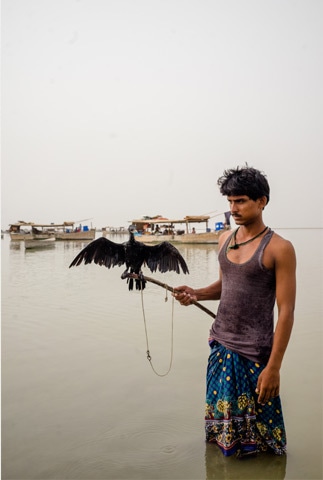
The Mohanna life has long been centred around three seasons: sawan (monsoon: July-September), machhi maran (fishing season: October-March) and sukkal (dry season: April-June). Oral historians among the Mohannas, often referred to as the “Bird People”, recall ancestral fishing grounds by name, particular bends in the lake where certain fish would gather, or seasons when birds arrived so densely that the sky itself appeared to darken.

Manchhar was a cultural landscape, shaped through intimate knowledge and reciprocal care. Over 200 species of freshwater fish were recorded here in the mid-20th century. Tens of thousands of migratory birds — pelicans, ducks, cormorants and egrets— arrived each winter. Reeds grew thick along the edges, providing material for mats, shelters and boats. Fishing techniques were refined over generations, sometimes involving trained birds. Time itself was organised not by calendars but by water levels, fish migrations and monsoon winds.
The lake taught the Mohannas where to move, when to wait and when to leave. In this way, Manchhar functioned as both classroom and archive, holding generations of ecological intelligence that never entered official records. “The lake was our market, our school, our mosque,” recalls Ghulam Mustafa Mirbahar, a Mohanna elder. “Everything we needed came from it.”
But now, due to Manchhar Lake’s reduced freshwater inflows and increased toxicity, the Mohannas are under threat — much like the lake itself. In an article titled ‘How a Polluted Lake is Endangering Life in and Around It’ published in Dawn’s Herald magazine in September 2018, Namrah Zafar Moti quotes a Mohanna fisherman who recalled that, around 14 years earlier (circa 2004), there were nearly 2,000 houseboats on the lake. The Mohannas, whose lives were inseparable from the water, are now disappearing from it, pushed ashore by necessity rather than choice.
At present, around 375 people, comprising 65 families, continue to live on Manchhar Lake. The number of galiyos has now dwindled to just 44. Migratory birds also still arrive, but in fewer numbers. “When ecosystems collapse,” one Mohanna elder observes, “even flight changes.” This is a slow disappearance that has been unfolding over decades. And, like Ghaaib Pir’s disappearance, it is happening in plain sight.
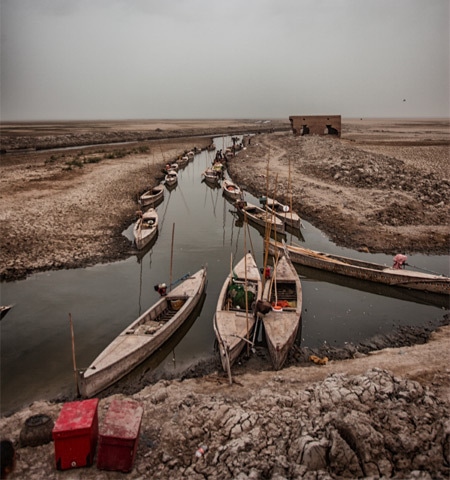
MANCHHAR LAKE’S HISTORY OF NEGLECT
Located about 18 kilometres west of Sehwan Sharif in Sindh, Manchhar Lake spreads to the foot of the Kirthar mountain range. Historically, Manchhar’s health depended on regular freshwater inflows from the Indus River and hill torrents. This natural flushing kept salinity low and ecosystems resilient. But over the last two centuries, a series of interventions began to sever these lifelines.
Following the introduction and expansion of the railway system during British rule in the Subcontinent, there was a reduced reliance on river navigation, diminishing the traditional role of the Mohannas as riverine transporters.
Later on, the building of the Sukkur Barrage in 1923 and the Kotri Barrage in 1955 across the Indus obstructed natural river routes, making navigation difficult and disrupting traditional water-based livelihoods. While these projects expanded agriculture elsewhere through their tightly controlled irrigation channels, they reduced the freshwater reaching Manchhar, altering its chemistry and seasonal rhythms.
Yet, the most devastating blow came with the introduction of large-scale drainage schemes intended to carry saline and wastewater away from agricultural lands and urban centres. The Right Bank Outfall Drain (RBOD), started in 1980, was designed to divert polluted water safely to the sea. Instead, due to chronic delays, incomplete infrastructure and poor regulation, it began disgorging untreated industrial effluent, municipal sewage, pesticides and fertilisers directly into Manchhar Lake.
As freshwater inflows declined and toxic discharges increased, Manchhar’s natural flushing mechanisms failed. Salinity increased, fish died, bird populations collapsed or altered their migratory routes altogether and water once drinkable became hazardous to touch.
“The water was sweet before,” says the Mohanna Allah Dino Mallah. “You could drink it straight from your hands. But today, even the fish cannot survive in the water.”
Sedimentation carried by the drains further reduced the lake’s depth and storage capacity, concentrating pollutants and shrinking habitats. What had once been a vast, dynamic ecosystem became a stagnant basin of contamination. Peeran Mallah, a Mohanna fisherman, says, “We know when the lake is sick. The smell tells us before the tests do.”
The damage unfolded incrementally, making it easy to normalise, difficult to reverse and almost impossible to attribute to any single authority. Each intervention framed itself as development while, collectively, they dismantled the lake’s capacity to sustain life.
![An aerial view of a floating houseboat village on Manchhar Lake: at present, around 65 families continue to live on Manchhar Lake and the number of galiyos [houseboats] has now dwindled to just 44 | Heritage Cell-DAPNED](https://i.dawn.com/primary/2026/02/6990fc26dcc5e.jpg)
THE MOHANNAS UNDER THREAT
For the Mohannas, the consequences were immediate and brutal. Fishing yields fell from thousands of tonnes annually to a fraction of that. Health problems multiplied: skin diseases, respiratory illnesses and waterborne infections became common. With no access to clean water, sanitation, healthcare or consistent schooling, survival itself grew uncertain.
Fish, formerly both food and currency, became scarce, small and, often, unsafe to eat. The Mohanna woman Zarina Mallah notes, “When the fish died, everything else followed.” As a result, many families were forced to abandon their floating homes and move ashore, often into informal settlements, where they were neither recognised as landowners nor supported as displaced communities. Hence, cultural identity eroded alongside ecological collapse.
Women bore a disproportionate share of this rupture. With declining fish stocks and worsening water quality, domestic labour intensified. Water had to be sourced from farther away, illnesses cared for without medical access, children kept safe in increasingly hostile conditions. For the youngest Mohannas, born into a lake already poisoned, the idea of water as a sustainer rather than a threat is no longer intuitive.
Drying fish was once a seasonal rhythm tied to surplus. But now, “the dried fish goes to Karachi and Hyderabad to be turned into poultry feed,” explains Abdul Wahab. “The catch is mostly small fish. This is not what we used to eat.” The disappearance here is incremental — fish by fish, boat by boat, family by family.
Among the most fragile survivors of this collapse are the galiyo. Each galiyo is an archive of vernacular design, adaptive architecture and environmental intelligence. Built from local wood and reeds, these boats respond to changing water levels, winds and seasonal temperatures. Their interiors encode social organisation, gendered spaces and everyday rituals. To lose them is not merely to lose shelter but to lose an entire philosophy of dwelling on water.
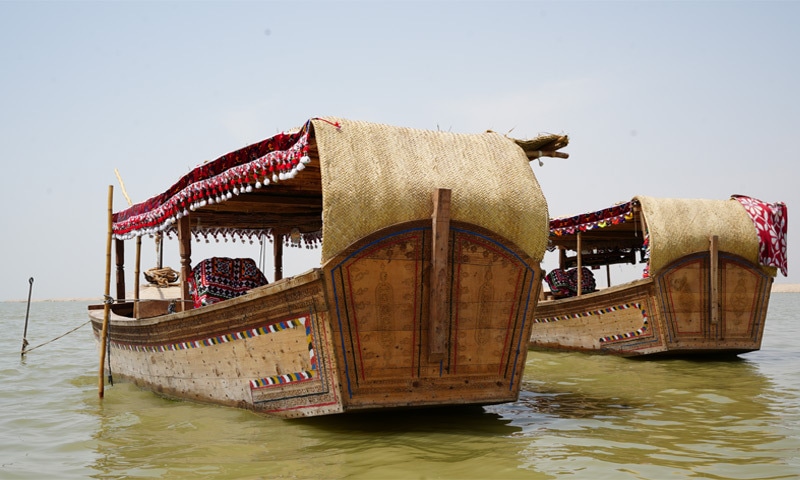
In architectural terms, the galiyo represent a rare example of climate-responsive design, developed outside formal institutions. Their low freeboard and flexible joints allowed them to adapt to fluctuating water levels long before resilience entered professional vocabulary. To let them disappear would be to erase evidence that sustainable futures can emerge from vernacular knowledge rather than imported models.
This very knowledge and way of life is under threat.
“Government people come,” says the Mohanna fisherman Sain Bakhsh Mallah. “They take photos and write reports, but the water stays the same.” He says that children still listen to elders recount information and stories about routes, seasons and signs, but many already imagine their lives elsewhere.
But, without any formal training or education, what will the lives of the Mohanna youth look like elsewhere? When the Mohannas are displaced on to land, their skills become unreadable to policy, irrelevant to markets and invisible to planning frameworks. What makes this disappearance particularly devastating is that it has unfolded through decisions made elsewhere due to engineering choices, bureaucratic delays and institutional indifference.
So what can be done to safeguard the Mohanna community?
TRYING TO PRESERVE A WAY OF LIFE
The 2024 launch of the UK-Pakistan Cultural Protection Fund (CPF) pilot was an attempt at a holistic intervention that combined the restoration of Manchhar’s remaining houseboats with a deeper commitment to the survival of the community itself.
The project ‘Manchhar Lake Mohannas — Safeguarding the Last Surviving Houseboat Village from Extinction’, led by Professor Dr Anila Naeem and Farida Abdul Ghaffar, assistant professor at the Department of Architecture and Planning of Karachi’s NED University (DAPNED), sought to document, conserve and reimagine these floating structures as cultural heritage. Professor Naeem is the chairperson of DAPNED and a heritage conservation specialist.
During the first phase of the project, undertaken on an exacting 10-month timeline (April 2024-January 2025), NED’s Heritage Cell team helped repair 44 severely deteriorated houseboats. After undertaking a detailed assessment of the houseboats, a plan for repairs was made. Locals were engaged in boat-building techniques, repairs and maintenance, as the project placed architectural research in dialogue with community knowledge, conservation ethics and environmental advocacy. It was also important to facilitate the community with drinking water and toilet facilities. Skill development and tourism initiatives were piloted to create sustainable income opportunities.
Many of these houseboats were close to collapse, with rotting bases and compromised structures that made daily life unsafe. Repairs extended their lifespan by decades, allowing families to remain on water rather than being forced ashore. “If the boats had gone,” one elder says, “we would have gone with them.”
A pilot restoration of Muhammad Ashraf’s houseboat, for example, involved sourcing local wood, carefully cutting it and transporting it to Manchhar Lake under gruelling weather conditions, with temperatures soaring above 40 degrees. A rotting base was also replaced, and the houseboat was relaunched with the collective effort of over 50 community members, after a month of painstaking labour and experimentation. This first success restored not only the structure but also community confidence and faith in the project’s promise.
Beyond housing, the intervention also addressed urgent health needs. A mobile water filtration unit provided access to safe drinking water in a place where the lake itself had become toxic. Eco-toilets improved sanitation in a community that had long lived without such infrastructure. Solar-powered systems reduced dependence on fuel and external supply lines.
Fishing, the economic backbone of Mohanna life, was also supported through the construction of new fishing boats [hurro], replacing those lost to decay. While fish stocks remain depleted, mobility restored some measure of agency, allowing families to continue working rather than abandoning the lake altogether.
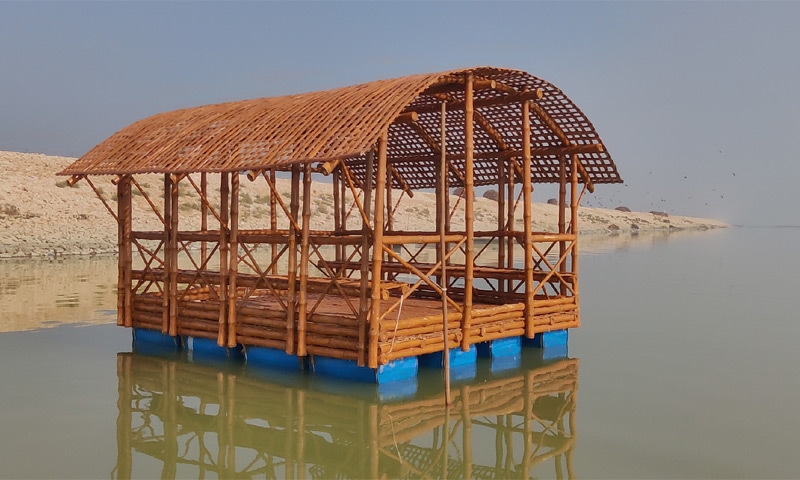
Children, too, were drawn into the orbit of learning. A temporary learning centre was established, initially operated on newly repaired houseboats, and later shifting to a floating bamboo structure that doubled as a communal space. For families accustomed to displacement, the sight of education taking place on water carries symbolic weight.
The second phase of the project (April 2025-January 2026) involved a series of community interactive activities, including tours, workshops and a five-day art residency. It culminated in a performative-curatorial event, ‘Manchhar Lake Mohannas – Sailing Towards Revival’, which framed Manchhar not as a closed chapter but as an unfolding story, foregrounding dialogue and visual narratives from the Mohanna community’s lived realities.
Yet even as these changes took hold, their limits were clear.
No number of repaired boats or community programmes can neutralise untreated sewage. No water filter can compensate for a lake that no longer flushes itself clean. Tree saplings planted along the Manchhar Bund and a bamboo pavilion offer shade to visitors, but they cannot alter the lake’s chemistry. Heritage tourism pilots create momentary income and visibility, but they remain fragile, dependent on conditions beyond local control. Ultimately, these efforts were holding ground and buying time in a landscape where time has been running out.
CAN MANCHHAR BE BROUGHT BACK FROM THE BRINK?
The question that hangs over Manchhar now is no longer whether it has been damaged — that reality is visible, measurable and lived daily — but whether it can still be saved. Restoration, in Manchhar’s case, requires a return to first principles: water that moves, water that cleans itself and governance that treats ecological systems as living entities rather than as disposal sites.
At the heart of Manchhar’s decline lies the severing of freshwater inflows. For centuries, the lake remained viable because it was periodically flushed by clean water from the Indus and hill torrents. This dilution kept salinity in check and allowed pollutants to disperse. Once that flow was throttled, first by barrages, then by diversions, Manchhar became a terminal basin, receiving waste but unable to release it. Stopping the poisoning, therefore, begins upstream.
Untreated industrial effluent and municipal sewage entering the lake through the RBOD and the Main Nara Valley Drain must be intercepted and treated before reaching Manchhar. This is not a technological mystery, as wastewater treatment systems exist and have existed for decades. What has been missing is enforcement, maintenance and political will. Without functional treatment plants and strict regulation of industrial discharge, every other intervention remains cosmetic.
Freshwater inflows must also be restored. Environmental flow, water released specifically to sustain ecosystems, is a measurable requirement. Without it, salinity will continue to rise, fish will fail to reproduce and birds will not return in meaningful numbers. Restoring this flow will require coordination between provincial and federal authorities, irrigation departments and environmental agencies — a level of cooperation that has historically been elusive.
Sedimentation presents another challenge. Decades of accumulated silt have reduced Manchhar’s depth and storage capacity, intensifying pollution and shrinking habitats. Dredging, combined with the creation of wetlands and sediment traps upstream, could help restore the lake’s ability to hold and cleanse water. Nature-based solutions, such as planting aquatic vegetation that absorb pollutants, offer additional pathways, but only if water quality improves enough to support life.
It was hence a welcome sight that, in 2025, the Sindh government partnered with WWF-Pakistan for an $8 million Manchar Lake revival initiative, aimed at combatting rising salinity and pollution in the lake, restoring its ecological balance, reducing environmental threats and uplifting the livelihoods of local communities impacted by the lake’s decline. However, whether or not this endeavour succeeds remains to be seen. Earlier efforts, such as the Supreme Court’s directive in 2017, calling on provincial authorities to ensure regular monitoring and revival of water filtration plants, disposal of solid waste and efforts to control the pollution level in Manchhar Lake, fell on deaf ears.
Of course, no meaningful change can be brought without the participation of the people who know the lake best. Community-led monitoring, where Mohanna observations are treated as important data rather than anecdotes, could transform how the lake is managed. Their knowledge of seasonal changes, fish behaviour and water conditions represents an archive of environmental intelligence that no satellite image can replace.
SAILING INTO AN UNCERTAIN FUTURE
Manchhar’s crisis is not an isolated failure. Across Sindh, other water bodies are showing the same early symptoms of reduced inflows, untreated waste, creeping salinity and ecological thinning.
Haleji Lake and Keenjhar Lake, both critical sources of drinking water and once-thriving ecosystems, face mounting pressure from pollution and over-extraction. They are displaying warning signs that are similar to what Manchhar Lake has experienced. If lessons are not learned here, they will be repeated — lake by lake, creek by creek — until disappearance becomes the default outcome of water governance.
By extension, Mohanna culture can only be preserved if stringent measures are taken to rehabilitate Manchhar Lake. The reality is that one of Pakistan’s most vibrant indigenous communities has long had a sword dangling over both their means of livelihood and way of life.
If targeted efforts are not made to safeguard the Mohanna community and the well-being of Manchhar Lake, both the lake and the community that resides on it will become another permanent victim of Pakistan’s wounded ecology.
The question, then, is not whether Manchhar will become ghaaib. The question is whether disappearance will once again be explained as inevitability rather than consequence.
Rumana Husain is a writer, artist and educator. She is the author of two coffee-table books on Karachi, and has authored and illustrated 90 children’s books.
Header image: The newly constructed hurro fishing boats: fishing is the economic backbone of Mohanna’s life. — Heritage Cell-DAPNED
Published in Dawn, EOS, February 15th, 2026


1725015980-0/BeFunky-(28)1725015980-0-640x480.webp?w=390&resize=390,220&ssl=1 "14 Arab, Palestinian groups issue urgent appeal to protect Jerusalem, Al-Aqsa Mosque amid Israeli escalation")
