





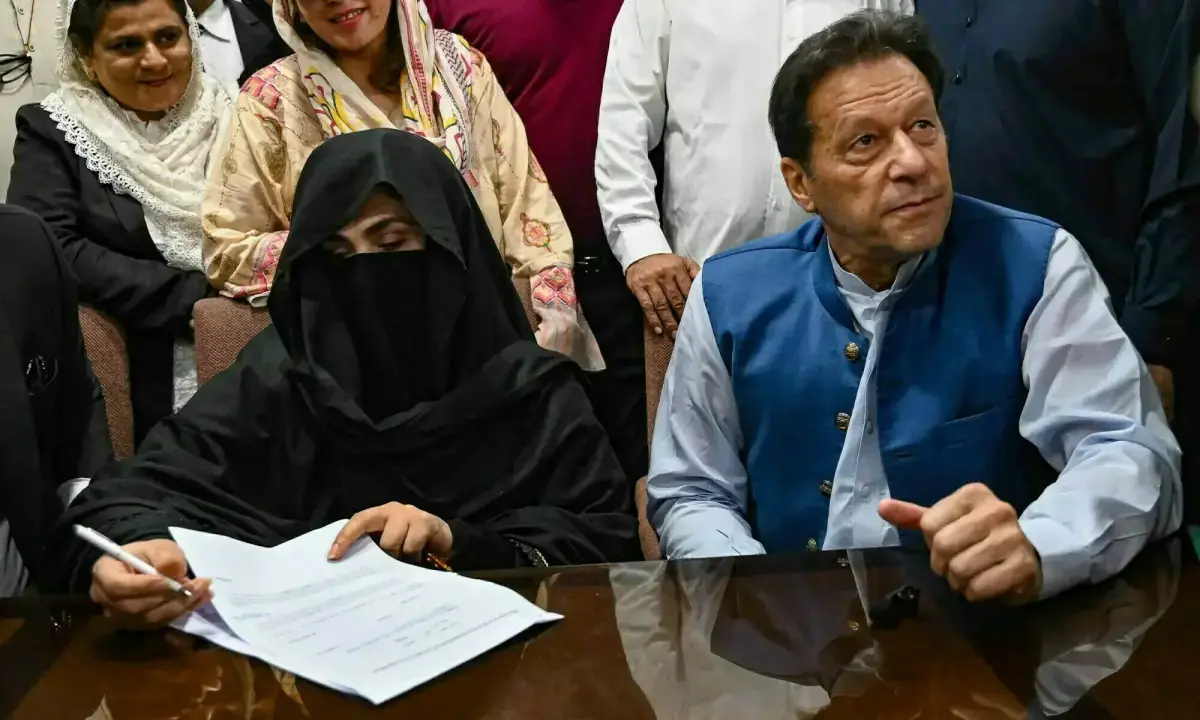
ISLAMABAD: Former prime minister and PTI founder Imran Khan and his wife Bushra Bibi have approached the Islamabad High Court (IHC) seeking suspension of their sentences in the Toshakhana-2 (Bulgari jewellery) case, citing grave medical concerns and what their counsel termed legal infirmities in the trial court verdict.
Advocate Salman Akram Raja, along with Barristers Salman Safdar, Gohar Ali Khan, and Qausain Faisal Mufti, filed the petition under Section 426 read with Section 561-A of the Criminal Procedure Code 1898, praying for the release of the petitioners till the final adjudication of their criminal appeal.
The Special Court Central-I judge, on December 20, 2025, convicted the couple, handing down a 10-year simple imprisonment term under Section 409 PPC (criminal breach of trust by a public servant), along with a fine of Rs16.425 million. Additionally, the Imran and Bushra were sentenced to seven years’ simple imprisonment under Section 5(2) of the Prevention of Corruption Act 1947.
The petition contended that the conviction under two separate enactments for the same alleged act violated the principle of double jeopardy enshrined in Section 26 of the General Clauses Act 1897.

“Such dual conviction for the same alleged act is wholly beyond the mandate of law, as the petitioner could, at best, have been convicted under either of the two provisions, but not under both,” the petition argued.

Medical grounds formed a significant part of the suspension plea. Citing proceedings before the Supreme Court on February 10, 2025, wherein the lead counsel for Imran was appointed as amicus curiae, the petition noted that a medical report submitted by Dr Muhammad Arif of the Pakistan Institute of Medical Sciences (PIMS) revealed severe damage to the Imran’s right eye.
According to the report, a blood clot had left the former prime minister with only 15 per cent vision in the affected eye, with treatment not possible within jail premises.

The petition further argued that the trial court erred in holding Imran to be a “public servant” within the meaning of Section 21 PPC, relying upon PLD 2024 SC 102 and Indian Supreme Court precedent. It was contended that elected holders of public office do not qualify as public servants for the purpose of Section 409 PPC.
Challenging the prosecution’s narrative, the petitioners maintained that gifts received from the Toshakhana were duly deposited and retained after payment of 50 per cent of the value exceeding the basic exemption of Rs30,000, strictly in accordance with the Toshakhana Policy 2018.
The petition also raised objections to the treatment of prosecution witness Sohaib Abbasi as an approver, contending that the mandatory procedure under Section 337 CrPC was not followed.
It was argued that witness Syed Inamullah Shah, being a material participant in the alleged transaction, ought to have been arrayed as an accused rather than examined as a routine prosecution witness, reflecting a “selective approach manifestly demonstrative of mala fide intent”.
The petitioners highlighted that they remained on bail throughout the trial and faithfully complied with all terms and conditions imposed by the trial court.
The accompanying criminal appeal assails the conviction on substantial questions of law and fact, with no likelihood of immediate hearing, necessitating the suspension of sentence to prevent “manifest miscarriage of justice”.
The former PM and his spouse also filed separate petitions for early hearing of £190m corruption case. The registrar office is likely to place this matter before the bench next week.


