





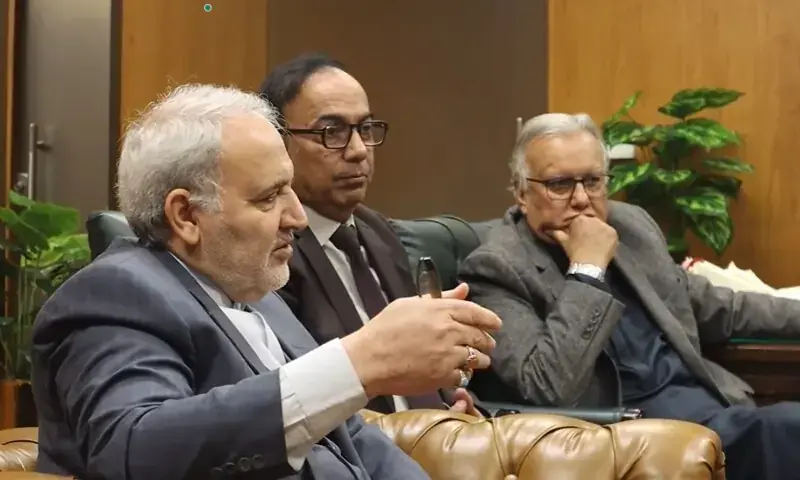
ISLAMABAD: Iranian Ambassador to Pakistan Reza Amiri Moghadam on Friday expressed confidence that there would not be any war against the Islamic Republic in the foreseeable future, but noted that the war of narratives and psychological warfare would continue against his country.
Talking to a select group of media persons in the federal capital, he said that Iran was countering the “Zionist and Western narrative” alongside military aggression, adding that the US and Israel had a history of “deception and backstabbing”.
“But they have seen the response in the recent 12-day conflict, and Israel was almost on its knees when the US intervened,” the envoy said. He added that wars were not fought merely with weapons but with national determination and the resilience of the whole society.
He said that the West had used all its cards in the June 2025 attack by the Zionist regime and the recent conspiracy when riots were held, and acknowledged that the resistance movements in Lebanon, Yemen and Syria had been weakened.

Moghadam urges Muslim unity, lauds Islamabad’s support for Tehran during 12-day war with Israel


“While there are ups and downs in wars and broader conflicts, the US, Israel and others have seen the advanced military capabilities as well as the strength of the Iranian nation — it is less likely there will be a war soon,” Mr Moghadam said.
‘War may affect region’

“If, God forbid, war breaks out, regional countries will have to make their own decisions, as such a war would affect the entire region,” he added.
He stressed that Iran had always called for greater unity and cooperation among Muslim countries since the Islamic revolution.
He said that all the Muslim nations were targets on their list but the priority was different. “Today it is Iran and tomorrow it will be Saudi Arabia,” he added.
Referring to the “12-day war” with Israel last year, he lauded Pakistan for supporting Iran and said that despite strong propaganda and huge networks, the Western narrative had weakened over the decades and resistance to the policies of Zionism was visible globally.
He also lauded Pakistan’s stance at regional and international forums, claiming Islamabad had supported Iran diplomatically during the recent conflict. “There is a clear understanding in Pakistan that any harm to Iran is harm to Pakistan,” he added.
The ambassador said that US President Donald Trump’s Peace Plan for Gaza was a mockery, as all the funding for the restructuring of the Palestinian territory would be in the hands of the American president, “who has no credibility”.
“Whereas the establishment of the [international stabilisation]force [for Gaza] was a dangerous move as its target was to disarm the resistance group Hamas through Muslim countries,” he added. “Pakistan’s decision to distance itself from this force is encouraging.”
Balochistan
Speaking on common issues, he expressed concern over terrorism in Balochistan province and said that it was a bilateral matter between the two countries.
He observed that there was a need to look into the root causes of the problems faced by Pakistan’s Balochistan province and Iran’s adjoining Sistan province. He said that militant activities could not be countered through the use of force alone.
“Lack of opportunities and discontent among the people of Pakistan’s Balochistan and Iran’s Sistan-Baluchestan provinces has to be addressed through economic development and cooperation to neutralise the hostile designs of the common enemies of both countries,” he added.
Women empowerment
Responding to a question on the status of women in Iran, the envoy said that while Iran had laws regarding the hijab, there was no coercion in public spaces, and women continued to play a prominent role in education and professional sectors.
He said that recent rallies on the occasion of the 47th anniversary of the revolution held across Iran witnessed participation by both veiled and unveiled women.
“There is a law regarding the hijab in our country, and that is enforced in government offices, but there is no strictness in public gatherings,” he said, adding that similar social variations were visible in other Muslim societies, including Pakistan.
He clarified that certain dress codes applied within government institutions, as was the case in many countries, but only Iran was targeted by the Western media.
“Western media never showed the progress made in this regard, as women’s participation in Iran’s higher education is huge. There are more female students in Iranian universities than male students, and women are scientists and hold senior posts even in highly technical projects,” he said.
“But nobody compares the representation of women across professions in Iran with other Islamic countries, or with what it was before the Islamic revolution,” Mr Moghadam added.
“Nobody among us would like to see the status of women as commercial products or be named in those notorious file[s of late US convicted sex offender Jeffrey Epstein],” the envoy maintained, and concluded that the status of women should be seen in the context of Iran’s social laws and societal norms.
Published in Dawn, February 14th, 2026


