





• Orders Power Division to file review petition to protect existing contract holders
• Nepra approves Rs132bn fixed charges for 28.5m households
• Decision applied retrospectively; lowest slabs to face up to 75pc jump
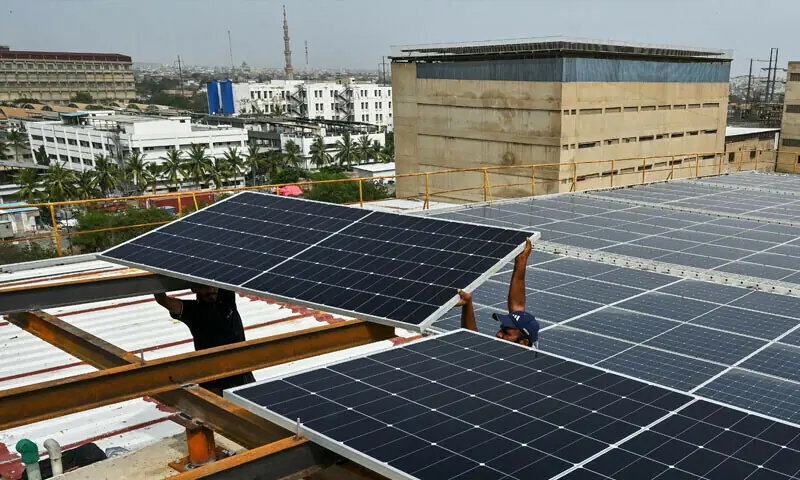
ISLAMABAD: Prime Minister Shehbaz Sharif stepped in on Wednesday to seek a review of Nepra’s revised rules for rooftop solar users, while the power regulator simultaneously rubber-stamped a government plan to impose hefty fixed charges on residential consumers.
The premier also directed the Power Division to file a review petition against the regulator’s move regarding new solar regulations.
On Monday, the National Electric Power Regulatory Authority (Nepra) revised the terms for all existing and future net-metered solar consumers — known as prosumers — on the pretext of rising solar penetration and the need to protect an expensive and inefficient state-run power network. The notification effectively ended the net-metering regime and shifted prosumers to net billing.

A statement issued by the Prime Minister’s Office said the premier had taken “immediate notice” of the matter, following criticism in the Senate from lawmakers across party lines, including ruling ally PPP and opposition PTI.


The PMO quoted the prime minister as directing the Power Division to file a review petition before Nepra “to ensure every possible safeguard of the existing consumer contracts”.
He was of the view that the “burden of 466,000 users benefitting from solar should not be put on 37.6 million domestic consumers” receiving electricity directly from the national grid. “Power Division should chalk out a comprehensive strategy in this regard,” he said.
The directives were issued during a high-level meeting chaired by the prime minister on the new Nepra regulations. The meeting was attended by Deputy Prime Minister Ishaq Dar, Power Minister Awais Leghari, Economic Affairs Minister Ahad Cheema, Information Minister Attaullah Tarar, Minister of State for Finance Bilal Azhar Kiyani and the prime minister’s adviser Muhammad Ali.
Speaking in the Senate on Tuesday, Mr Leghari defended Nepra’s move, saying it was aimed at easing the burden on consumers. “Changing regulations according to the law and the Constitution is a regulator’s job,” he said, adding that he would not step back. “This is not policy; there should be clarity on that,” he maintained.
Stakeholders and policy experts have warned that the proposed Prosumer Regulations 2025 could undermine a decade of citizen-led expansion in clean energy.
Under the new regulations, registered prosumers will be immediately shifted to net billing in place of net metering, and their exported units will be credited for one month instead of the current three months. Other terms will remain unchanged until their seven-year contracts expire.
Under net billing, electricity generated by a prosumer is purchased by the relevant distribution company (Disco), and the consumer is billed for electricity imported from the grid at about Rs37-55 per unit (depending on the slab) after receiving credit for exports at the National Average Energy Purchase Price (NAEPP) of around Rs10 per unit.
The new rules bar prosumers from installing solar power systems for net metering beyond their originally sanctioned load, effectively reducing the capacity limit by 50 per cent.
Nepra approves fixed charges
Meanwhile, Nepra on Wednesday approved a government decision to impose about Rs132bn in fixed charges on more than 28.5m residential electricity consumers, at rates ranging from Rs200 to Rs675 per kilowatt per month of sanctioned load.
The regulator’s fast-tracked approval of the federal government’s Feb 4 decision will come into retrospective effect from February, increasing the effective unit price by up to 75pc for the lowest strata with a declining scale for higher consumption groups. The Rs132bn fixed charges do not include about Rs24bn general sales tax and other taxes, surcharges and duties.
This will adequately address cross-subsidy on industrial consumers, reducing their average tariff by Rs4.04 per unit as announced by the prime minister to make export products competitive in the global market. For the first time, the burden of cross-subsidy on the industrial sector has come to zero.
Given “the fact that the revised tariff proposed by the federal government is within the determined consolidated revenue requirement of all the XWDISCOs (ex-Wapda distribution companies) and already budgeted tariff differential subsidy (TDS) of Rs249bn for the calendar year 2026, the authority has no objection in approving the motion”, Nepra wrote in its decision to the government for formal publication in the Gazette of Pakistan.
The revised schedule of tariff shows that new fixed charges have been imposed on monthly consumption of up to 300 units, raised for the 400-600 unit slabs and slightly scaled down for higher users to discourage defection from the grid.
As a result, the average power tariff (including energy and capacity components) for both protected and non-protected consumers in the first 100-unit slab has risen by 76pc, or Rs8 per unit, and 73.5pc, or Rs16.5 per unit, respectively, following the imposition of fixed charges at Rs200 and Rs275 per kilowatt of sanctioned load.
More than 22m consumers fall into these two categories. “This is the highest-ever price hike for this consumer category since the creation of separate distribution, generation and transmission companies in the early 1990s,” a senior official told Dawn.
For protected consumers using 101-200 units, the average cost has increased by Rs4 per unit, or 31pc, due to a Rs300-per-kW fixed monthly charge, while the non-protected category in the same slab has seen a rise of Rs6 per unit, or 21pc.
Consumers in the 200-300 unit slab will face a Rs350-per-kW fixed charge per month, lifting their average price by 12.7pc, or Rs4.20 per unit. About 5.6 million consumers fall into this group.
The fixed rate for the 301-400 unit category has been doubled to Rs400 per kW from Rs200, raising average unit rates by 6.5pc, or Rs2.5 per unit, despite a slight downward adjustment in base tariffs. More than two million consumers are in this bracket.
Higher-consumption households will also face increases. The fixed rate for the 401-500 unit slab has been raised to Rs500 per kW from Rs400, and to Rs675 per kW for the 501-600 slab, resulting in a 5.8pc, or Rs2.30-per-unit, rise in average tariffs, even after a Rs1.25-per-unit cut in base rates.
For consumers using 601-700 units a month, the fixed charge has been reduced to Rs675 per kW from Rs800, while those exceeding 700 units will also pay Rs675 per kW instead of Rs1,000. Nevertheless, both groups will still see average-rate increases of Rs2 and Rs1.80 per unit, or about 5pc and 4pc, respectively.
Only time-of-use consumers with sanctioned loads above 5kW will benefit from an average reduction of about 7pc, or Rs3.30 per unit, after the abolition of their Rs1,000-per-kW fixed charge in view of peak rates of Rs47 per unit, excluding taxes and duties. Even they, however, will face a 6pc, or Rs2.5-per-unit, rise during off-peak hours.
An official said the Power Division had estimated that the fixed charges would generate an additional Rs132bn for distribution companies, although another calculation suggested the inflow could exceed Rs250bn because most residential subsidies had been eliminated.
Published in Dawn, February 12th, 2026


