





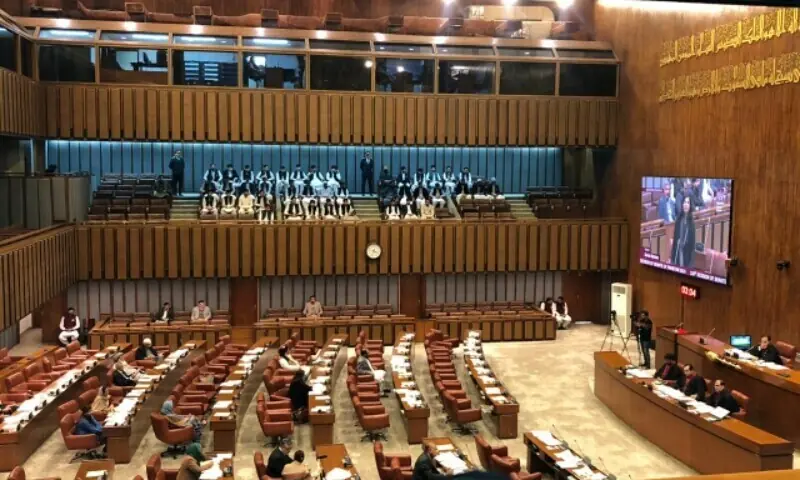
ISLAMABAD: There was an outcry in the upper house of Parliament on Tuesday against changes by the power regulator in the contracts for solar consumers, with the government defending the move.
The National Electric Power Regulatory Authority (Nepra) on Monday drastically changed the terms of contracts for all existing and future net-metered solar consumers — known as prosumers — to contain rising solar energy penetration and protect an expensive and inefficient state-owned power network. The notification effectively terminated the existing net-metering regime and replaced it with net-billing for all.
Speaking on a motion in the Senate on Tuesday, PTI Senator Syed Ali Zafar strongly criticised the government’s decision to withdraw net metering benefits for solar panel consumers, calling it a grave breach of trust and a cruel act against the people of Pakistan.
Senator Zafar stated that a promise, once made, must be honoured and when that promise came from the state, it became sacrosanct. He recalled that the government had assured citizens that if they invested in solar energy, they would be provided net metering on equitable terms.

This policy, he said, was presented not only as a personal financial benefit but as a national cause — reducing dependence on imported fuel, lowering energy costs, and moving Pakistan towards clean and sustainable energy.

He said the government made a solemn commitment to the people, urging them to invest for their own benefit and for the future of Pakistan, while assuring that issues with independent power producers (IPPs) would be addressed as citizens shifted to self-generation through solar power.
Acting on this assurance, people across the country invested heavily in solar panels, he said. He further stated that families diverted their life savings, sold assets, and even took loans, which they were still repaying, to install solar systems.

Senator Zafar said that solar energy was present in nearly every household, commercial building, and agricultural operation. Despite this, the government has abruptly turned around and sought to cancel its commitment retrospectively, he regretted.
He termed retrospective withdrawal and retrospective imposition as a grave injustice. He also pointed out that under established law, the doctrine of promissory estoppel — legal doctrine allowing enforcement of a promise lacking formal consideration to prevent injustice — applied.
Calling the decision “the most cruel act of the government,” Senator Zafar said it was akin to throwing a bomb into the already burdened lives of Pakistani citizens, who are struggling with soaring electricity bills and economic hardship.
He questioned how the government could expect foreign investment when it failed to honour commitments made to its own people.
Addressing the claim that the decision rested with Nepra, supposedly an independent authority, Senator Zafar categorically rejected this assertion.
He said that Nepra did not act independently but followed government directives. Any suggestion to the contrary, he said, would be misleading.
He challenged the government to prove its sincerity by making a clear commitment to ensure that the decision was withdrawn. He warned that the decision was disastrous, undermined public trust, damaged Pakistan’s investment climate, and punished those who acted in good faith for the betterment of the country.
In her remarks, PPP Senator Sherry Rehman said that the decision by Nepra was beyond understanding. She said that the middle class was questioning why the government provided incentives in the first place, if this decision was to be taken.
“How can you do this to your country and citizens who are being affected the most by climate change?” she asked. She said that the problem lay with the distribution system, asking what message was being sent to investors by changing tariffs again and again.
“You have made electricity bills an instrument through which various taxes are being imposed,” she said. She said that instead of setting up artificial intelligence centres like other countries, Pakistan was increasing the power bills of consumers.
“Manufacturing companies and domestic consumers should be provided with cheap electricity,” she said, adding that major manufacturing industries were leaving Pakistan due to heavy taxes and expensive energy.
Jamiat Ulema-i-Islam — Fazl Senator Kamran Murtaza and PTI Senator Zeeshan Khanzada also spoke on similar lines.
However, Power Minister Awais Leghari on Monday defended the move, stating that Nepra was within its remit to do so and that it had been done to take the burden off consumers.
“Changing regulations according to the law and the Constitution is a regulator’s job,” he said, adding that he refused to step back from this.
“This is not policy; there should be clarity on that,” he maintained. “This is a change in regulations, which was conducted according to the Constitution and Pakistan’s laws,” he said.
The minister added that seminars were held involving solar associations, consumers and all other stakeholders, and that matters were settled with them last June.
“The Solar Association of Pakistan — whose bread and butter is installing and investing in these systems — conveyed to us that what the government was doing was not just necessary, but without it, public interests could not be saved,” the minister emphasised.
Leghari added that the solar association warned that up to 95 per cent of people would suffer “greater damages and increased burdens”.
“They said in June, don’t do this now, wait at least five or six months and carry out a proper transition,” he stated.
“Nepra, a regulator with the responsibility of maintaining its consumers’ interests, was formed to watch consumer interest and protect people from increases in electricity prices.”
The minister noted that PTI Senator Ali Zafar spoke about retrospective effects, but said that there were none in this regulation.
“I am proud to say that in this regulation, our regulator did not reverse one clause on these contracts, which used to last seven years,” Leghari said.
He added that Zafar mentioned that these contracts would last 20 years, before assailing the PTI government.
“Under that Imran Niazi, electricity prices were touching the sky and we are trying to deal with it right now,” he added. The minister emphasised that there were no 20-year contracts.
“It was a seven-year contract and until it expires, nobody in this country has dared to insert new terms and conditions in the contract. Nepra has not done this either,” he stated.
He added that of the over 30 million consumers, 466,506 of them had net-metering.
“These 466,506 consumers have put 7,000 megawatts (mW) of electricity on net-metering,” the minister stated. “Other than these 466,000 consumers, there are 30.04m who live in flats or slums, where they cannot install solar systems, or they cannot afford them.
“If Nepra allowed electricity to be bought at these rates, then the 30.04m consumers — who are the true public — would have to shoulder a Rs200 billion burden left by net-metering consumers, which would increase to Rs550bn,” Leghari added.
The minister further said that nothing would happen to the existing contracts of the 466,000 consumers, but that these were regulations for future consumers.
“What we are saying is that we will buy electricity from you based on the average rate of the grid,” he explained. Leghari added that consumer regulations were evolving.
“These are policies formed by innovative thinking which evolve with time, and these aren’t even policies, they are just regulations,” he added. “This is not the first time regulations have been changed, or rates have been revised.”


