





Ramesh Chandra, 44, from Gopalganj district in Bangladesh’s southwest, 127 kilometres from the capital Dhaka, has been making sculptures for over two decades. He is a voter in the Gopalganj-3 constituency, from where former Prime Minister Sheikh Hasina was elected for eight consecutive terms. Chandra has long supported Hasina’s Awami League.
But this time, the situation is different. Following the mass student-led uprising on August 5, 2024, Sheikh Hasina fled to India. On May 10, 2025, the interim government, headed by Nobel Peace Prize laureate Muhammad Yunus, banned the political activities of the Awami League and all its affiliates, under the Anti-Terrorism Act.
The International Crimes Tribunal (ICT) in Bangladesh, a domestic judicial body founded by Hasina in 2010, is currently prosecuting Awami League leaders for “genocide” and “crimes against humanity”, related to the 2024 movement. Ironically, the same tribunal sentenced Hasina to death for ordering a crackdown on the 2024 protesters.
Previously, the tribunal had awarded death sentences to several Jamaat-i-Islami leaders for ‘war crimes’ during the 1971 war and supporting Pakistan, resulting in the execution of Jamaat leader Ali Ahsan Mujahid in 2015 and Jamaat chief Motiur Rahman Nizami in 2016.

Once banned and vilified in Bangladesh, the Jamaat-i-Islami is now polling neck-and-neck with the country’s mainstream opposition. As the country prepares for its first election since the 2024 uprising, voters disillusioned with corruption are turning to an unexpected alternative…


The current government has stated that the Awami League will not be able to resume political activities until the trial is completed. As a result, the Awami League will not participate in the upcoming February 12 elections, the first national polls since the mass uprising. Despite being banned, the Awami League is campaigning against the polls on social media.
When asked if he would be voting this time, Chandra tells Eos, “Why wouldn’t I vote? I will vote and, this time, I will vote for the Jamaat. Everyone has had a chance. This time, Jamaat should be given a chance,” he continues. “Besides, none of them [Jamaat leaders] engage in corruption and extortion,” he claims.

Like Chandra, many other voters are now also leaning towards the Jamaat-i-Islami, reflecting a broader electoral transformation sweeping Bangladesh.
A SURGING POLITICAL FORCE
A December survey by the US-based International Republican Institute (IRI) showed 30 percent of voters backing the party of the late former PM Khaleda Zia, the Bangladesh Nationalist Party (BNP); 26 percent supporting the Jamaat-i-Islami; and six percent supporting the National Citizen Party (NCP), formed by student activists involved in the August 2024 popular uprising.
Another mid-January joint poll by Projection BD, IILD, Jagoron Foundation and NarratiV indicates a tighter race, with BNP at 34.7 percent, Jamaat close behind at 33.6 percent and NCP at 7.1 percent. It’s a remarkable turnaround for both the leading parties, whose leaders had been incarcerated and executed and particularly for the Jamaat, which was banned under the Sheikh Hasina regime.
Analysts say the Jamaat is competing closely with the BNP due to growing public dissatisfaction with corruption and extortion at the grassroots level, following the fall of the Sheikh Hasina government. Jamaat has sought to capitalise on this sentiment by presenting itself as a disciplined alternative. Its initiatives, including digital tools to track extortion complaints and monitor government spending, have drawn widespread attention.
The party’s rising popularity among young voters is also evident. According to Election Commission data from November 2025, Bangladesh has around 127.7 million registered voters, including roughly 45 million aged 18 to 35. In recent student union elections at several universities, including Dhaka University, the Jamaat’s student wing, the Islami Chhatra Shibir, won decisively across contested positions, while the BNP-backed Jatiyatabadi Chhatra Dal failed to secure any significant posts. Many experts believe the student parliament elections could influence the next national polls, though others disagree.
The Jamaat-i-Islami has formed an 11-party electoral alliance for the upcoming elections, including with the NCP, the student-led party. With the Awami League absent, the BNP and the Jamaat-led coalition are poised to be the main contenders.
Nahid Islam, convener of the NCP, tells Eos that the alliance is electoral rather than ideological. “Our political views differ from those of Jamaat-i-Islami, but we align on reform, justice and anti-corruption agendas,” he says. “That is why we formed this alliance.”
Islam is confident that their 11-party coalition will get the votes. “If given the chance to form the government, decisions will be made on common principles and will not be dominated by any single party,” he adds.
The JI chief, or ameer, Dr Shafiqur Rahman tells Eos that his party is receiving “overwhelming support” from across the country, citing independent surveys by, what he termed, credible pollsters.
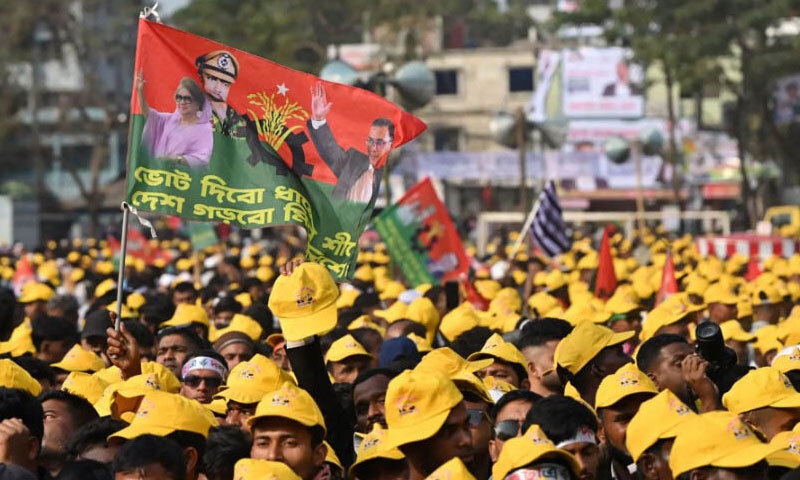
Dr Rahman says that, since the official campaign began on January 22, he has travelled to nearly half of Bangladesh, visiting more than two dozen districts and addressing around 100 public rallies. “At each rally, the crowds were overwhelming,” he says, claiming that large numbers of supporters had turned out in favour of Jamaat candidates. “The country has not witnessed such political euphoria in more than two and a half decades,” believes Dr Rahman.
According to political analysts, the upcoming election, held after the 2024 popular uprising, could be the most important in the party’s history, with it potentially winning more seats than ever before.
Last month, The Washington Post reported that US diplomats were seeking closer engagement with the Jamaat, expecting it to perform strongly. The publication said it has audio recordings that reveal a US diplomat describing the Jamaat as a potential “friend” and stating that it cannot impose Sharia-rule in the country due to Western economic pressure.
The prospect of a Jamaat-led government has raised concerns in India, Bangladesh’s largest neighbour and Sheikh Hasina’s longtime ally. New Delhi views the Jamaat as pro-Pakistan, citing the party’s opposition to Bangladesh’s 1971 war that led to the country’s creation and alleged historical ties to Islamabad. Indian officials worry that the Jamaat coming to power could reorient Bangladesh’s traditionally India-friendly foreign policy.
THE QUESTION OF CAPABILITY
Jamaat chief Dr Rahman is confident that his party is ready to govern. “If Allah wills it and the people give us the mandate on February 12, we are ready,” he tells Eos. “Over the past half-century, Jamaat has built a talented and honest pool of leaders, capable of managing every sector.”
He recalled the 2001 BNP-Jamaat alliance government, noting that ministers such as Motiur Rahman Nizami and Ali Ahsan Mujahid efficiently managed key portfolios, introduced programmes that boosted employment, utilised taxpayers’ money for development, and rooted out corruption.
“Now, after more than 20 years, we are even more confident our leaders will govern effectively across all ministries,” Dr Rahman adds.
Dr Rahman’s thoughts are echoed by one of his party candidates, lawyer Mohammad Shishir Monir. “I alone am capable of running 10 ministries,” he tells Eos. “We have dozens more in our party like me, who are capable of running the country.”
However, Dhaka University professor and political analyst Dr Mohammad Siddiqur Rahman Khan says that, while Jamaat had some experience in the BNP government from 2001 to 2006, they lack the experience of administration and running the government.
Dilara Chowdhury, a former professor and political analyst at Jahangirnagar University, points out that capability and honesty matter more than experience when it comes to running the country. “Currently, Jamaat has more educated and qualified people in its ranks than other parties,” she adds.
An analysis of candidates’ affidavits by Bengali-language daily Prothom Alo shows that, of the 224 candidates contesting under the JI’s scales symbol, 201 are highly educated, including 10 with PhD degrees.
Among the 287 BNP candidates contesting under the rice sheaf symbol, 229 are highly educated, including eight PhDs. The analysis indicates that the percentage of highly educated and PhD-holding candidates among Jamaat’s ranks is slightly higher than that of the BNP.
THE ELEPHANT IN THE ROOM
Jamaat-i-Islami chief Dr Rahman says the party’s goal is to establish a country based on insaaf [justice], where the majority are not ruled by a chosen few, public wealth is not plundered and no one remains above the law. “Is this not the basic tenet of a model Islamic society?,” he asks. “Is this not the demand of Gen Z, who overthrew a corrupt and fascist regime?”
Dr Rahman emphasises that Bangladesh’s multicultural and multi-ethnic population would continue to enjoy equal rights as enshrined in the constitution. “We believe in the rule of law, transparency, accountability, democracy and shura [consultation],” he says. “These principles are already embedded in our constitution and we do not view them as contradictory to Islamic values. You may call it ‘Sharia’ or any other name.”
Dr Rahman adds that any elements contradicting Islamic principles would be addressed through parliament, not by force. “Our opponents often use scare tactics, suggesting that ‘Sharia law’ would force women into strict dress codes or deny them education or careers,” he continues. “We have repeatedly clarified that no such measures will be enforced. Women will enjoy equity and fairness in all spheres of life,” Dr Rahman asserts.
The party chief also addresses concerns over a Jamaat-led government’s adherence to national laws and UN human rights standards. “As a democratic party that has participated in every election since its inception, no one can deny that Jamaat-i-Islami is committed to the people’s mandate,” he says.
Dr Rahman adds that the party sees democratic nations in the West and East as strategic partners and aims to build a stable, pluralistic society based on freedom of expression, rule of law, equity and justice.
The Jamaat chief also points out that, despite attempts by the previous Awami League government to portray the Jamaat as militant, “they were never able to produce a single piece of evidence of Jamaat leaders or workers being involved in terrorism.”
FROM PARIAH TO CONTENDER
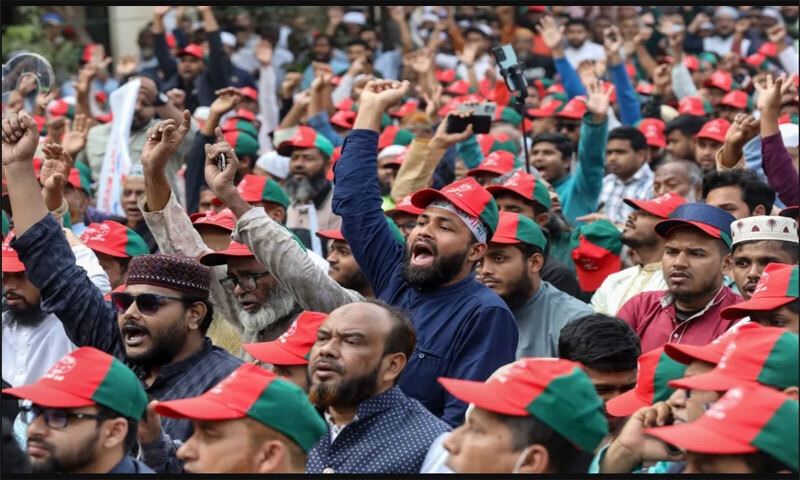
The Jamaat-i-Islami was founded in 1941 in Lahore, British India, by Islamist scholar Abul Ala Maududi. The party advocates Islam as the foundation for the state and society. During the 1971 war, JI opposed Bangladesh’s independence, and its leaders were accused of collaborating with the Pakistani army and committing war crimes. The party was banned after independence, but the ban was lifted following political changes in 1975, and it returned to politics in 1979.
The Jamaat won 18 seats in the 1991 elections, three in 1996, 17 in 2001, and two in 2008 — a modest to poor showing in previous elections. A high court cancelled the party’s registration in 2013, while JI also boycotted the 2014 elections. In 2018, with the party still declared illegal, some of its candidates ran under BNP tickets while others contested as independents. The party remained ineligible for the 2024 election, with the ban only overturned after Hasina’s ouster.
Dr Rahman, its chief, attributes the party’s growing current support to greater public exposure after the student-led July 2024 revolution and wider social media visibility, following decades of what he called “unfair” media portrayal.
Dr Rahman thinks that the party’s suffering under the previous government, including the execution of its leaders and the imprisonment of its members, has earned it public sympathy. Unlike other parties, he claims, the Jamaat has avoided revenge or corruption. Instead, he says, the Jamaat cooperated with the interim government and the judiciary following Hasina’s ouster, demonstrating moral integrity that has won the party public support.
Analysts say another key factor is public frustration with corruption and extortion involving BNP leaders and activists, while the Jamaat has relatively avoided such allegations.
“People are fed up with BNP leaders and activists because of extortion,” says analyst Dilara Chowdhury. She adds that corruption and extortion lie at the root of most crises in Bangladesh and effective curbs could significantly reduce the country’s problems.
Dr Khan of Dhaka University says that, with the marginalisation of the Awami League, the Jamaat has emerged as an alternative for some voters. “Public sympathy for the Jamaat has increased to some extent due to repression over the past 15 years,” he tells Eos.
Like the Jamaat, the BNP is also campaigning on an anti-corruption platform. Speaking at a rally in Chittagong on January 25, BNP Chairman Tarique Rahman said the party would crack down on corruption if elected. Analyst Dilara Chowdhury points out, however, that the public has greater trust in the Jamaat than the BNP on corruption. “During BNP’s time in power from 2001 to 2006, corruption was not reduced. That is why many people do not trust the BNP,” she adds.
The Jamaat has also announced plans to launch a mobile app aimed at tackling extortion. At a recent election rally in Dhaka, Dr Rahman revealed that the app would allow individuals to anonymously file complaints against extortionists.
By contrast, since August 5, 2024, numerous BNP leaders and activists have been implicated in cases relating to extortion and other allegations. Following media reports, the party expelled several thousand members. On September 18, 2025, BNP chairman Tarique Rahman said organisational action had been taken against more than 7,000 party members in response to various allegations.
Analysts also point to internal conflict within BNP, which they say has not been evident within Jamaat. According to an October 2025 report by Dhaka-based Human Rights Support Society (HRSS), at least 85 people were killed and 5,017 were injured in internal BNP clashes between September 2024 and September 2025.
Another factor behind the JI’s growing popularity is the party’s charitable activities, including welfare and social assistance programmes. Through disaster relief, financial support for low-income families, and educational and medical assistance, the party has expanded its engagement at the local level. In addition, institutions associated with the Jamaat, including banks, hospitals, coaching centres, schools and colleges, have helped create employment opportunities for party workers and supporters, while also providing education and healthcare services to the wider public.
It is no surprise, then, that voters such as Gopalganj’s Ramesh Chandra are planning to stamp their vote on the scales symbol in the upcoming elections. But whether the Jamaat can translate polling numbers into actual seats, navigate coalition politics and govern a diverse nation of 170 million remains to be seen.
What is certain is that the February 12 elections will reshape Bangladesh’s political landscape in ways unimaginable just 18 months ago — when Hasina still ruled and Jamaat was still fighting for political survival. For a party that opposed the country’s founding, the possibility of now leading it represents perhaps the most dramatic political reversal in Bangladesh’s history.
The writer is a Bangladeshi investigative journalist whose work has appeared in various publications, including
The New York Times, Reuters and AFP.
He can be contacted at marufhasan57983@gmail.com. X: @the_MarufHasan
Published in Dawn, EOS, February 8th, 2026


