





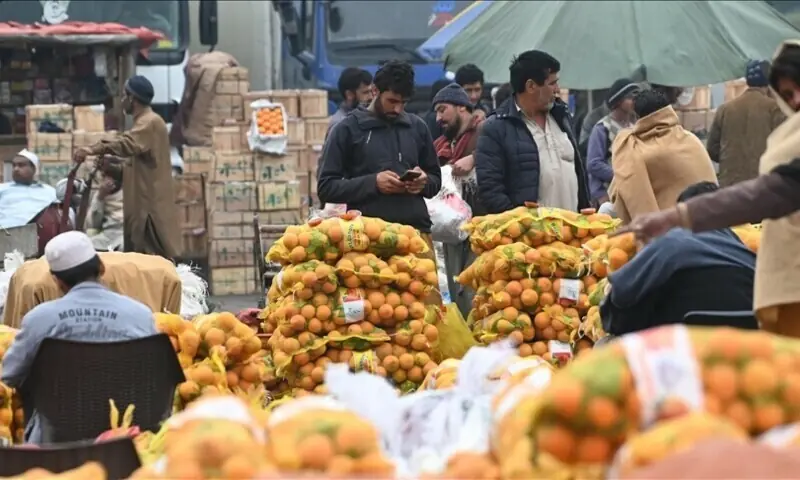
KARACHI: The prices of tomatoes, onions, potatoes, and other vegetables have started creeping up ahead of the start of Ramazan, after hitting rare seasonal lows, thanks to a winter production glut, while prices of flour varieties and fruits have risen.
As the holy month will get underway from the third week of this month, fruit vendors have already started charging higher rates for the most sought-after items like banana, apple and guava. In the flour industry, retailers blame millers for raising rates, while flour millers flatly reject the claim.
As the new Sindh wheat crop will arrive in March, a random market survey ahead of the holy month reveals a price hike in a 20 kg bag of wheat flour to Rs2,500-2,700 from Rs2,400-2,600 two weeks back, followed by a Rs141 per kg increase in fine flour, up from Rs133 per kg.
The Sensitive Price Index ending Feb 4 revealed a slight jump in the price of a 10kg bag of wheat to Rs1,100 from Rs1,050 two weeks back.

Vegetable, fruit and flour prices rise ahead of holy month


Roti makers also complained about a price hike of Rs450 per 50 kg in the fine flour bag, from Rs6,000 to Rs6,450, which may result in a price jump in Roti varieties if the fine flour bag crosses Rs7,000 per 50 kg.
Currently, roti makers have kept the rates of various roti varieties unchanged. Consumers believe that some tandoor operators have reduced the weight of roti varieties while keeping prices unchanged. Naan and Chappati are available at Rs25 and Rs15 per piece, respectively.

Disagreeing over the price rise in flour, Pakistan Flour Mills Association (PFMA), Sindh Zone, Chairman Abdul Junaid Aziz said that the 100kg wheat bag rate has declined to Rs10,900 from Rs11,600. As a result, the ex-mill rate of flour No.2.5 and fine is Rs104 and Rs114 from December 2025.
“There is no price increase or any shortage of wheat or flour varieties in the markets,” he said, claiming that the Association mainly focuses on flour No 2.5 instead of the commercially popular fine and maida (super fine flour) rates.
The Sindh government in December 2025 reduced the wheat issue price to Rs8,000 per 100 kg bag from Rs9,500 to stabilise prices for the consumers and provide grain to the millers and traders.
“Millers are lifting wheat from the open market at the rate of Rs11,600 per 100 kg bag for blending with the government’s wheat of the 2022-2024 crop,” Junaid said, showing some concerns over the government’s wheat quality, as a lack of gluten usually results in low protein and also creates problems in making a soft roti. As a result, millers procure new wheat crops from the open market for blending with old wheat to maintain quality.
On high rates of branded flour, he said the association cannot control the rates charged by branded flour makers, which are very few in number, and that their market share is only 5 per cent.
One of the reasons for the high prices of branded flour is their prime quality and the bag cost alone, which hover between Rs80-100 per bag in 5 kg and 10 kg packs, he said.
Karachi Wholesalers Grocers Association Chairman Rauf Ibrahim said the rates of black gram, Kabuli channa (white gram) and basen is Rs205, Rs310 and Rs205, while in retail markets, they are being sold at Rs250-280, Rs350-400 and Rs350-400 per kg.
Rauf said the rates of masoor, moong and gram pulse have been unchanged at Rs240-300, Rs360-400 and Rs240-280 per kg as against a slight increase in mash pulse to Rs380-460 from Rs360-420 prevailing two weeks back.
Tomato and onions
Potato and onion rates have risen to Rs40-70 and Rs50-80 per kg, respectively, over the last two weeks, as against a sharp rise in tomato prices to Rs70-100 from Rs30-40 two weeks back. Sugar rates, as per SPI data, fell to Rs145-160 per kg from Rs150-170 per kg.
“The city government should focus on the retail side during Ramazan, where consumers face real hardship at the hands of retailers,” Rauf said.
Fruits getting costlier
Various varieties of fruits have become costlier by Rs50-100. Banana rates have surged to Rs150-200 per dozen from Rs100-150.
Fruit vendors are also demanding an extra Rs50-100 per kg on various varieties of apples ahead of Ramazan. Green and red apples are sold at Rs300 and Rs400-500 per kg.
The price of Guava (Larkana, Kasoor and Hyderabad) ranges between Rs200-250 per kg as against Rs150-200 per kg. Good quality Cheeko and Melon are also sold at Rs200-250, up by Rs50 per kg.
After a jump of Rs50-100 per dozen, Kinno’s price ranges from Rs300-500 per dozen, depending on quality and size, while orange (Mosami) is priced at Rs250-300. Fruit vendors said the prices are high because their season is coming to an end.
In meat, live chicken rates have dropped to Rs340-370 per kg from Rs420-460 two weeks back, while retailers have increased veal meat without bones by Rs100 per kg to Rs1,700 from Rs1,600.
Published in Dawn, February 8th, 2026


