





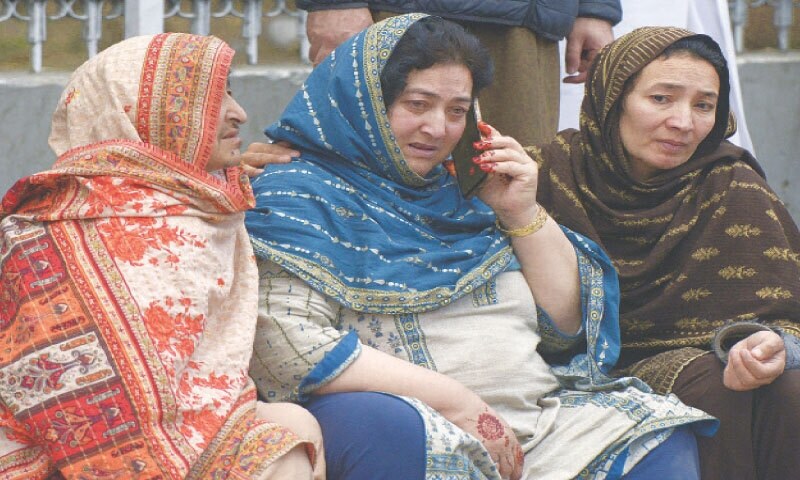
ISLAMABAD: The Friday’s suicide blast at the Tarlai Imambargah is the second major terrorist attack in the federal capital in less than three months despite heightened security measures adopted by the police and the capital administration.
On November 11 last year, a lone suicide bomber blew himself up in front of the main entrance of the Judicial Complex in G-11 after a couple of unsuccessful attempts to enter the premises, killing a dozen people and injuring at least 36 others.
Soon after the incident, a number of police pickets were established on different roads of the capital.
In addition, the Islamabad Traffic Police narrowed some of the busy roads in the capital during rush hours by placing barricades on a daily basis to monitor suspicious activities, causing much difficulties for the commuters.

After the Tarlai Imambargah attack on Friday, some of the grief-stricken people, who had reached Pims hospital to trace their missing relatives, expressed their anger over the alleged failure of the police and the law enforcement agencies in preventing the devastating attack.

However, a senior police officer, when contacted, said the suicide attack had taken place in a rural area located on the outskirts of the capital city whereas the security measures had been put in place in the urban areas and various sectors of Islamabad.
He said the focus of the police was mainly on the government buildings and other sensitive installations, adding the police were also constantly monitoring the movements of the suspicious people within the capital city through the Safe City cameras besides keeping record of visitors staying in hotels and guest houses.

The official said only “human intelligence” was possible to monitor such activities in rural areas which generally served as “safe heavens” for the terrorists.
It may be recalled that talking to the media outside the Judicial Complex after the November 11 attack, Interior Minister Mohsin Naqvi had declared that he had directed that no vehicle be allowed into Islamabad without an e-tag after two weeks.
Later, Minister of State for Interior Senator Talal Chaudhry, while addressing a press conference outside Parliament House alongside Inspector General of Police Syed Ali Nasir Rizvi on November 13, had said it would be declared mandatory for all vehicles in the city to have e-tags.
Authorities installed e-tag readers and cameras at 11 to 14 different points in the capital.
These e-tag readers and cameras were installed under the supervision of the Safe City Authority in Islamabad to read vehicle tags.
The tags and cameras were linked with the Safe City system and were installed on newly erected poles at these points to scan e-tags and vehicle registration plates.
Officials further said that approximately 400,000 to 500,000 vehicles move on the roads of the capital daily, with a large number entering the city from neighbouring areas, including Rawalpindi.
So far, e-tags have been installed on 203,915 vehicles up to February 5, the capital administration said, adding that around 19 points are still operational for installing e-tags on vehicles.
Published in Dawn, February 7th, 2026


