





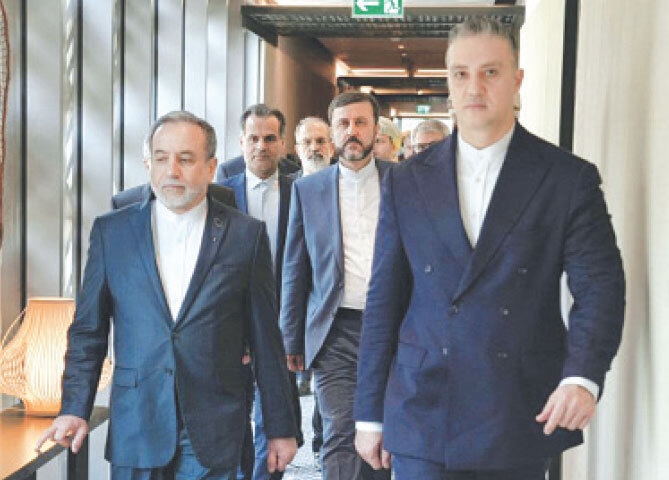
• No public acrimony witnessed as both sides stick to their guns
• Iran ‘sends message’ by testing ballistic missile before meeting
• Washington follows talks with fresh sanctions targeting oil-related entities
• Kremlin urges restraint; US tells its citizens to leave Iran
ISLAMABAD: The indirect talks between the United States and Iran held in Muscat on Friday, did slightly better than many had expected.
While there was no breakdown or public acrimony, the first meeting did not yield any breakthroughs, either. Even the tentative understanding to keep talking was left subject to approval by the respective leaderships in Tehran and Washington, after reviewing what had transpired on Friday.
In remarks following the indirect talks, Iranian Foreign Minister Abbas Araghchi stressed the need to overcome the “wall of mistrust” between the two sides.

“It was a good start to the negotiations. And there is an understanding on continuing the talks. Coordination on how to proceed will be decided in the capitals,” Araghchi told Iranian state TV. “If this process continues, I think we will reach a good framework for an understanding.”

Mediator Badr al-Busaidi, Oman’s foreign minister, said the talks had been “very serious”, with results to be considered carefully in Tehran and Washington.
The context in which the talks took place also did little to ease tensions. Just hours before the meeting began, Iran unveiled the Khorramshahr-4 ballistic missile, a move that was widely read as a pointed message.

“Any dialogue requires refraining from threats and pressure. (Tehran) only discusses its nuclear issue … We do not discuss any other issue with the US,” Araghchi said, referring to earlier American attempts to widen the agenda of the dialogue to cover the country’s missile programme as well.
Expectations going in were low, shaped by months of escalation, a short but intense war last summer, riots in Iran, which Tehran believes were engineered from outside, and growing military pressure.
Against that backdrop, the fact that the process survived its first test was seen by many observers as a limited success.
Indirect contact
The talks themselves followed last minute hiccups and adjustments. Originally planned for Istanbul, the meeting was shifted to Oman at Iran’s request.
Tehran had pushed for Muscat both because of its past role as a discreet channel and because it offered tighter control over format and participation.
The final arrangement for the dialogue was strictly indirect. There were no direct meetings between the American and Iranian delegations, while Omani Foreign Minister Badr Albusaidi acted as the sole conduit, moving between the two sides throughout the day.
The composition of the delegations signified a lot. Iran was represented by Foreign Minister Abbas Araghchi, backed by officials closely linked to the Supreme National Security Council, signaling that the team had a mandate to test ideas within defined limits. On the American side, Special Envoy Steve Witkoff led the talks, but he was joined by Jared Kushner, President Trump’s son in law and adviser, a presence that was widely noted.
Kushner’s participation appeared aimed at addressing long standing Iranian doubts about whether US negotiators carry sufficient authority to sustain any understanding reached at the table.
At the same time, the inclusion of Admiral Brad Cooper, the head of US Central Command, underscored the dual track nature of Washington’s approach. His presence underscored that diplomacy was being pursued alongside, not instead of, military pressure.
The significance of the Muscat talks lies less in what they produced than in what they prevented. A collapse would almost certainly have intensified military calculations at a time when the region is already saturated with forces. Continuation, even in such a tentative form, buys time to explore possibilities for peace.
But any sense of cautious optimism emerging from Muscat was quickly tempered by developments that followed. Within hours of the talks ending, Washington announced fresh sanctions targeting Iranian oil related entities, vessels and individuals reinforcing perceptions in Tehran that negotiations are being conducted under pressure and that sanctions relief, the central Iranian demand, remains distant dream.
Russia urges restraint
The Kremlin, an ally of Iran, said on Friday it hoped the negotiations would yield results and lead to a de-escalation. It urged all sides to show restraint in the meantime.
In a show of defiance, Iran’s state TV said hours before the talks that one of the country’s most advanced long-range ballistic missiles, the Khorramshahr-4, had been deployed at one of the Revolutionary Guards’ vast underground missile cities. Iran demands lifting of sanctions, re-imposed since 2018 when Trump ditched Iran’s 2015 nuclear deal with six powers.
US tells citizens to leave Iran
In a related development, the US Virtual Embassy in Iran issued a security alert early on Friday urging American citizens to “leave Iran now” and make departure plans that do not rely on assistance from the US government, citing heightened risks and the possibility of sudden travel disruptions.
The alert came ahead of scheduled talks between the United States and Iran in Oman on Friday, amid little indication that the two sides have bridged differences over the agenda of the meeting.
“Leave Iran now. Have a plan for departing Iran that does not rely on US government help,” the alert said, warning that flight cancellations and other disruptions could occur with little notice. Americans were advised to check directly with airlines for updates.
With input from Reuters. Anwar Iqbal in Washington also contributed to this report
Published in Dawn, February 7th, 2026


