


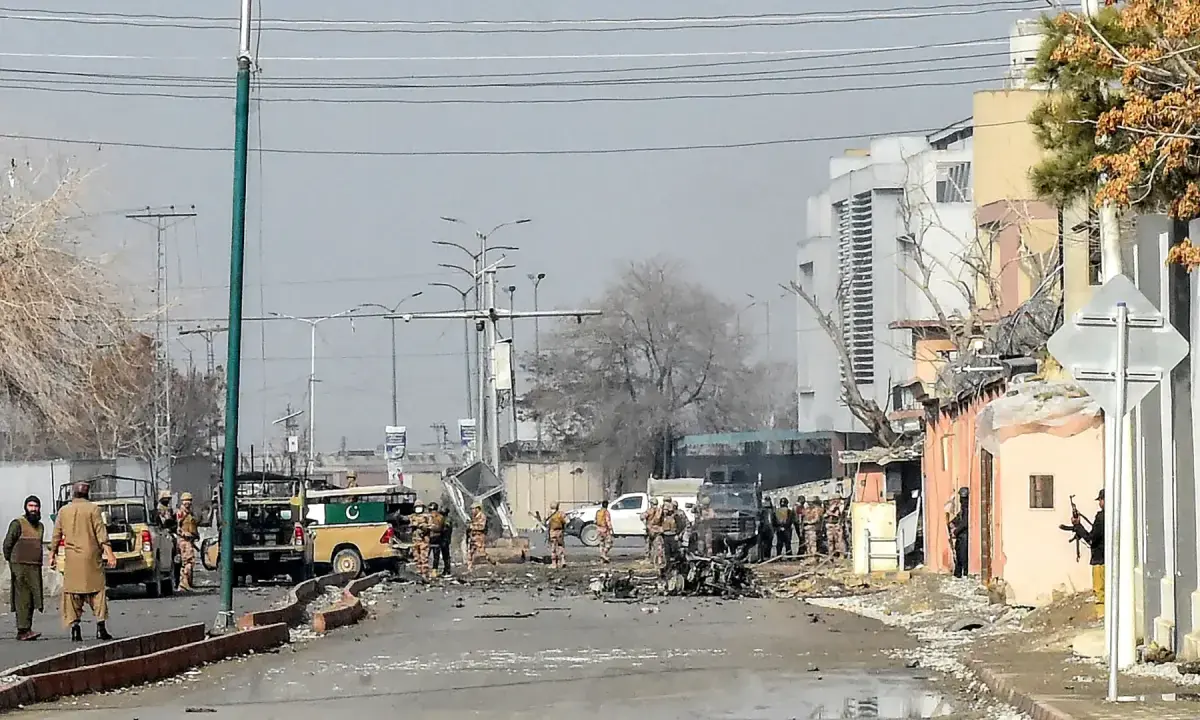
THE seemingly coordinated terrorist attacks across Balochistan on Saturday reinforce the fact that the state must confront the menace of terrorist violence in the province firmly.
As per security sources and official media, terrorists belonging to Fitna al-Hindustan, the term the state uses for Baloch separatists, struck at least 12 cities and towns in the province, including Quetta. A large number of terrorists were killed by the security forces. Security men and civilians have also been martyred in the attacks.
The sophistication of the strikes indicates that the militants had received training, and backs the state’s suspicions that hostile actors in the region are stirring up trouble in Balochistan. Yet it is also a matter of concern that the terrorists were able to hit such a large number of towns, including the provincial capital, which is supposed to be well-protected. The seriousness of the situation can be gauged from the federal interior minister’s dash to Balochistan to take stock of the situation. Were it not for the sacrifices of the police and security forces, the terrorists could have succeeded in causing greater havoc.
Unfortunately, this pattern of violence in Balochistan is not new. Last year’s assault targeting the Jaffar Express, as well as a similar coordinated terror campaign in August 2024, shows that despite the state’s counterterrorism efforts, the problem of militancy remains unresolved in this troubled province.

As per one think tank, there were over 250 terrorist attacks in Balochistan last year, causing over 400 fatalities. Along with KP, the province is the hardest hit by terrorist violence in the country. This atmosphere of violence and uncertainty exacerbates the socioeconomic woes of Balochistan, and slows development.
While the immediate focus should be on sanitisation operations so that all affected areas are declared safe, the administration must think long term in order to bring lasting peace to Balochistan. Firstly, no ideology can justify the murder of innocent people — women and children were also reportedly martyred in Saturday’s attacks — therefore, the state must neutralise all those violent actors responsible for these atrocities.
In the past, Baloch terrorists have also indulged in brutal slayings of ‘non-locals.’ Moreover, the links of the terrorist groups with hostile foreign actors need to be broken, and greater vigilance is needed at the country’s borders to prevent terrorists from entering the country. But while the kinetic element is essential, long-term peace can only come about through a full and unhindered political process in the province. Those estranged elements that renounce violence and pledge to respect the Constitution should be engaged by the rulers. Also, until Balochistan’s natural wealth reaches its people, and alleviates their poverty and suffering, hostile actors will continue to exploit the situation.

Published in Dawn, February 1st, 2026


