


• Erdogan offers to help ease Tehran-Washington tensions
• Trump softens threats, suggests openness to dialogue
• UK PM Starmer, allies working to block Iran’s nuclear ambitions
ISTANBUL: Turkiye intensified a diplomatic push to mediate between Tehran and Washington on Friday as US President Donald Trump appeared to cool his threats of a strike, though Iran warned that its missile capabilities would “never” be on the negotiating table.
Turkish President Recep Tayyip Erdogan and Foreign Minister Hakan Fidan led regional efforts to de-escalate tensions that have soared since the US moved military assets to the Middle East following a deadly crackdown on protests in Iran.
While the Pentagon said the military remained ready, Trump lowered the temperature late on Thursday, stating he hoped to avoid conflict and that talks were possible.

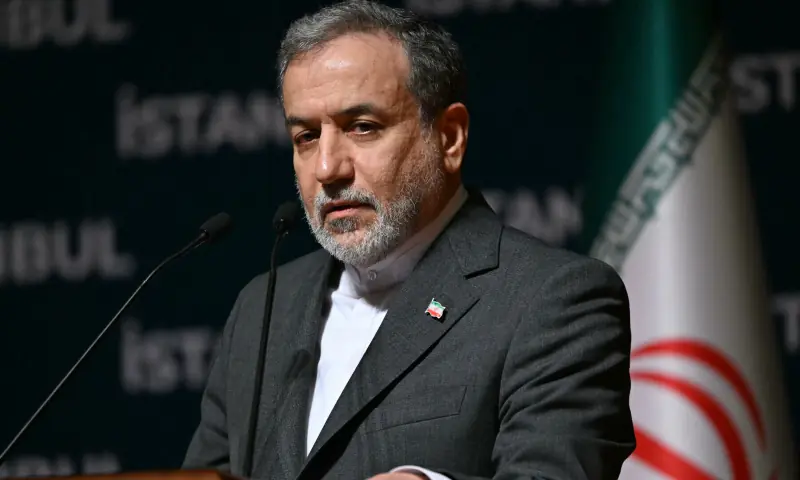
Speaking during a visit to Turkiye, Iranian Foreign Minister Abbas Araghchi welcomed the potential for dialogue but drew a hard line regarding national defence.
“I want to state firmly that Iran’s defensive and missile capabilities will never be subject to negotiation,” Araghchi said, adding that his country had no current plans to meet US officials.
Araghchi emphasised that Tehran was “ready to begin negotiations if they take place on an equal footing, based on mutual interests and mutual respect.”

Erdogan spoke by phone with Iranian President Masoud Pezeshkian on Friday, telling his counterpart that Turkiye was “ready to assume a facilitating role between Iran and the United States to de-escalate the tensions”.
Standing alongside Araghchi at a press conference in Istanbul, Fidan said restarting talks over Iran’s nuclear program was “vital for reducing regional tensions”.
He urged Washington to “act with common sense” and resist pressure from Israel, which he said was pushing for a US attack. Fidan also noted he had held discussions with US special envoy Steve Witkoff and would keep lines open to prevent Iran’s isolation.
Despite the diplomatic overtures, significant hurdles remain. The Axios reported on Monday that US officials said any deal must include a cap on Tehran’s long-range missile stockpile, the removal of enriched uranium, and a ban on independent enrichment. Meanwhile, international pressure on Tehran continues to mount. British Prime Minister Keir Starmer told the BBC on Friday that preventing Tehran from developing nuclear weapons was “hugely important.”
While stopping short of explicitly supporting a US strike, Starmer condemned the “grotesque” repression of demonstrators.
The European Union also urged against military action but condemned the crackdown by designating Iran’s Islamic Revolutionary Guard Corps as a “terrorist organisation”.
Tehran quickly criticised the move. Iran’s judiciary chief called the designation “hostile”, warning that Europe “will suffer the consequences of their foolish act”. Araghchi echoed the sentiment in Istanbul, labelling the designation a mistake and describing Europe as a “continent in decline”.
While diplomatic channels remain active, military readiness continues. Israel’s Ynet news website reported Friday that a US Navy destroyer had docked at the Israeli port of Eilat.
Araghchi told reporters that while Iran has “never sought war,” it remains prepared for any scenario.
“Iran has no problem with negotiations, but negotiations cannot take place under the shadow of threats,” Araghchi said. “They must certainly set aside their threats and change their approach toward a fair and equitable negotiation, as Mr Trump himself said in his post.”
Pezeshkian, in a call with United Arab Emirates President Sheikh Mohamed bin Zayed Al Nahyan, reinforced that success depended on the “abandonment of belligerent and threatening actions,” warning that any aggression against Iran would “receive an immediate and firm response”.
Tensions initially spiked following protests that erupted in late December over economic grievances. The demonstrations faced a severe crackdown that peaked on Jan 8 and Jan 9. Iran has accused the United States and Israel of fuelling a “terrorist operation” that transformed peaceful rallies into “riots”.
The US-based Human Rights Activists News Agency (HRANA) confirmed 6,479 people were killed in the demonstrations, including 6,092 protesters and 118 children. Internet restrictions imposed in early January continue to hinder information access.
While rights groups estimate the toll is in the tens of thousands, Iranian authorities have acknowledged more than 3,000 deaths, claiming the majority were security forces or bystanders killed by rioters.
Published in Dawn, January 31st, 2026


