


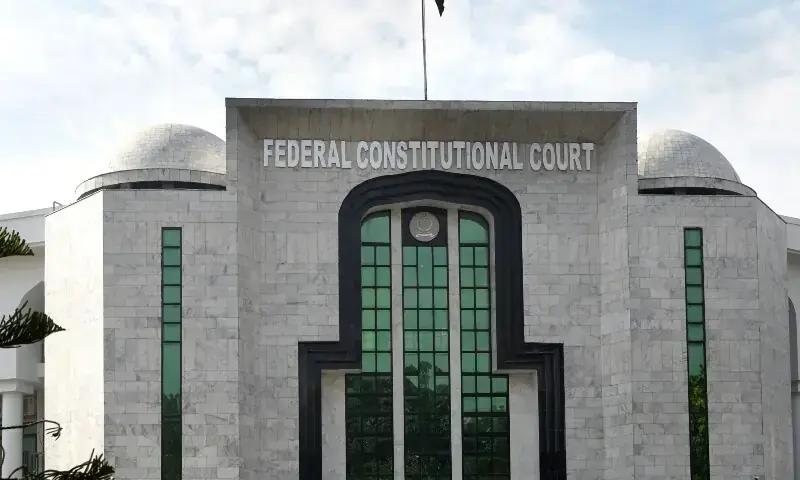
ISLAMABAD: Disposing of a batch of appeals, petitions and transfer cases, the Federal Constitutional Court (FCC) has upheld the vires of the super tax, holding that Sections 4B and 4C of the Income Tax Ordinance (ITO) 2001 are neither discriminatory nor violative of fundamental rights.
In a judgement pronounced on Jan 27 and uploaded on Wednesday, the FCC ruled that Section 4B does not create any unreasonable or hostile classification among persons forming the same class. The court held that parliament was fully competent to impose, abolish, remit, alter or regulate such taxes through a Finance Act as part of a Money Bill under Article 73(2)(a) of the Constitution.
The court observed that the classification introduced under Section 4B is income-based, rests on an intelligible differentia and bears a rational nexus with the object sought to be achieved. The provision, it said, suffers from no lack of legislative competence and does not, on its face, transgress any fundamental right warranting judicial invalidation.
The verdict was delivered by a three-judge bench comprising FCC Chief Justice Aminuddin Khan, Justice Syed Hasan Azhar Rizvi and Justice Syed Arshad Hussain Shah. The judgement noted that any perceived inequities or hardships arising from the operation of Section 4B fall within the legislative domain and do not, by themselves, justify judicial interference in fiscal matters.

Verdict says parliament can enact laws with retrospective or prospective effect, as long as ‘past and closed transactions’ are not disturbed
The FCC held that Section 4B squarely falls within Entry 47 of Part I of the Fourth Schedule to the Constitution, namely “taxes on income”, and was therefore intra vires. It ruled that Section 4B applies as enacted for tax year 2015 and onwards at the rates prescribed in Division IIA, Part I of the First Schedule to the ITO. Consequently, the decisions of various high courts upholding Section 4B as a validly enacted “tax” were declared to represent the correct position of law.
Section 4B was inserted through the Finance Act of 2015 to impose a super tax for the rehabilitation of internally displaced persons on individuals earning more than Rs500 million. Similarly, Section 4C was introduced through the Finance Act, 2022, imposing a super tax on persons earning more than Rs150m from tax year 2022 onwards.

The FCC also declared Section 4C to be intra vires the Constitution and applicable as enacted for tax year 2022 onwards at the rates prescribed in Division IIB, Part I of the First Schedule. The court reaffirmed that the legislature enjoys plenary power to enact laws with retrospective or prospective effect, subject to the caveat that such laws do not disturb past and closed transactions.
The judgement clarified that the closing of accounts for a tax year does not preclude the imposition of a fresh charge where none existed earlier, particularly when returns for tax year 2022 were yet to be filed. Accordingly, the FCC set aside the judgements of the Sindh, Islamabad and Lahore High Courts to the extent they held that Section 4C could not apply retrospectively to tax year 2022.
Rejecting preliminary objections regarding maintainability, the FCC held that it possessed inherent powers to transpose parties for just adjudication. Since the federation was already a respondent, it could be transposed as an appellant. The court also noted that in several pending matters, appeals had been filed by the Federation in addition to the Commissioner Inland Revenue (CIR) and the Federal Board of Revenue (FBR), rendering the appeals maintainable.
The FCC set aside the Islamabad High Court’s Pakistan Oilfields judgement of March 15, 2024, insofar as it held that amended rates under Division IIB could not apply retrospectively to tax year 2023. It held that the definition of “income” under Section 4C, including income from all sources, was validly enacted. Consequently, the IHC’s direction to the FBR to issue a nationwide circular to implement its order was declared to be without jurisdiction.
The court ruled that super tax under Section 4C is a standalone tax on income, independent of the tax levied under Section 4 of the ITO, and therefore applies to capital gains under Section 37A as well. However, in the case of exploration and production (E&P) companies, Sections 4B and 4C will apply only to the extent that they do not exceed the aggregate tax rates stipulated under the Fifth Schedule and relevant petroleum concession agreements.
The FCC held that Section 4C would not apply to E&P companies where it would result in taxation exceeding the threshold prescribed in Rule 4 of the Fifth Schedule, nor would it override exemptions granted to benevolent and provident funds. In the case of banking companies, Section 4C will apply from tax year 2023 onwards at rates amended by the Finance Act, 2023.
Published in Dawn, January 29th, 2026


