


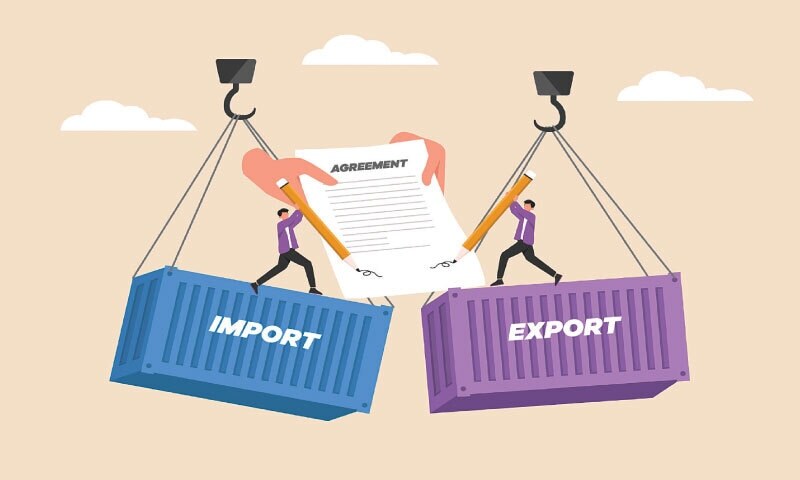
Trade agreements should not be viewed as a symbol of success; rather, they are a crucial component of industrial policy. Unfortunately, Pakistan has often approached market access with insufficient care. The prevailing perception equates the signing of trade agreements with economic achievement, but this is a misjudgment.
Trade agreements serve their purpose only when they enhance access to markets for products that the exporting country can produce competitively and for which there is clear demand in the importing country.
In Pakistan’s case, the absence of comparative advantage has led to underperforming agreements. While Pakistan has opened its markets quickly to imports, the resulting export growth has been modest, frequently limited to basic commodities like raw cotton — products that ideally should be processed into higher-value items domestically. Early export gains have also been eroded as major partners, such as China, extend more favourable terms to trading blocs like the Association of Southeast Asian Nations (Asean).
Trade agreements reward countries with existing competitiveness; they do not serve as a remedy for those lacking it


In contrast with Vietnam
Rather than pursuing trade agreements as diplomatic achievements, Vietnam focused on obtaining market access where there was actual demand, simultaneously working to strengthen its own production capabilities and comparative advantage.
The country negotiated predictable access to some of the world’s largest consumer markets — including the US, the EU, and key Asian economies — for products it was actively developing the capacity to export, such as electronics, machinery, footwear, furniture, and advanced manufactured goods. In Vietnam, trade agreements reinforced a broader industrial strategy centred on exports; they were not used as substitutes for genuine domestic reform.

On the other hand, Pakistan often signs agreements before building a robust industrial base or sound policy. When domestic production is uncompetitive, supply chains are weak, and firms lack compliance capabilities, free trade agreements tend to favour imports over exports, leading to stagnant export growth.
Asymmetry without preparedness
The China–Pakistan Free Trade Agreement exemplifies the challenges faced by Pakistan. By granting market access to the world’s foremost manufacturing economy, Pakistan exposed its own industries without first ensuring they were competitive. Although subsequent revisions improved tariff lines on paper, many concessions were made on products that either China does not import, or Pakistan does not produce or export.
When accounting for such mismatches, the headline figure of duty-free access on 75 per cent of HS lines by 2030 drops to a practical benefit of only 23pc. As such, the elimination of tariffs is meaningless unless it applies to products Pakistan can supply at scale.
Pakistani firms struggle with high energy costs, unpredictable tax policies, fragmented supply chains, weak skills, and inadequate trade facilitation. As a result, improved trade agreements do not translate into sustained export growth, while imports continue to surge, further undermining local industry. The core issue is the lack of synchronisation between trade concessions and domestic reforms, as well as insufficient enforcement of safeguards, rules of origin, and performance benchmarks.
Real imbalance with Malaysia and Indonesia
Similar patterns emerge in Pakistan’s agreements with Malaysia and Indonesia. Concessions have largely focused on palm oil, rather than on areas aligned with Pakistan’s export strengths or the demands of partner countries.
Additionally, both Malaysia and Indonesia are obligated to prioritise Asean members, limiting the scope of genuine market access for Pakistan. Consequently, bilateral trade has grown, but mainly to the benefit of Malaysia and Indonesia. Imports have increased, while Pakistani exports have not kept pace. The reduction in import duties on edible oil, for instance, has led to cheaper imports but diminished incentives for local production.
Limited engagement with Africa
Africa, with its 54 countries, 1.6 billion people, and $3 trillion GDP, represents a major untapped opportunity. Yet, Pakistan has only established a single trade agreement in the region with Mauritius, a country of just 1.3 million people and a $16bn GDP.
In contrast, India has agreements with 17 African nations and maintains a much more significant presence. Mauritius accounts for less than 1pc of Pakistan’s total trade with Africa. Furthermore, India has six agreements with Latin American countries, while Pakistan has none.
While it would be imprudent to pursue agreements without the ability to supply competitively, there is a clear need for policies that actively promote exports.
Türkiye and the risk of repeating mistakes
Türkiye is often described as a close partner, but emotional ties do not alter economic realities. Both countries compete directly in key sectors, particularly textiles and apparel, which are central to Pakistan’s exports. Granting increased access to Turkish value-added goods, without securing meaningful reciprocal benefits, would place additional strain on Pakistan’s industrial base.
The current preferential arrangement remains limited and cautious, reflecting these challenges. Without comprehensive industrial reform and careful sequencing, expanding the agreement risks replicating the import-heavy outcomes seen in other partnerships.
Cautious expectations
Calls for a trade agreement with Vietnam should be tempered by realistic expectations. Vietnam enjoys significant advantages in cost, scale, quality, and product diversity across most manufacturing sectors. There is limited overlap between Pakistan’s export capabilities and Vietnam’s import needs, and where overlap does exist, Pakistan is seldom the more competitive supplier.
Such an agreement might offer marginal gains for niche products, but absent substantial domestic reforms, it would likely benefit Vietnamese exporters more than Pakistani ones. Vietnam’s example demonstrates that trade agreements reward countries with existing competitiveness; they do not serve as a remedy for those lacking it.
A market-access test for Pakistan
Before entering, amending, or expanding any trade agreement, Pakistan should ask: Is the agreement targeting sectors with strong demand for products that Pakistan can scale within three to five years? Have domestic barriers related to cost and compliance been addressed? Are concessions phased, protected, and linked to measurable outcomes? Is there capacity to enforce origin rules and standards effectively? And finally, are agreements periodically reviewed against export performance, with mechanisms for renegotiation if targets are not met?
Trade agreements are policy tools, not achievements in themselves. Pakistan must shift its focus from viewing free trade agreements as headline achievements to treating them as disciplined instruments of industrial policy, targeted at sectors where the country can realistically build and sustain a comparative advantage, rather than relying on perpetual protectionism.
The writer, a former CEO of Unilever Pakistan and of the Pakistan Business Council, serves on the boards of several public companies.
Published in Dawn, The Business and Finance Weekly, January 26th, 2026


