


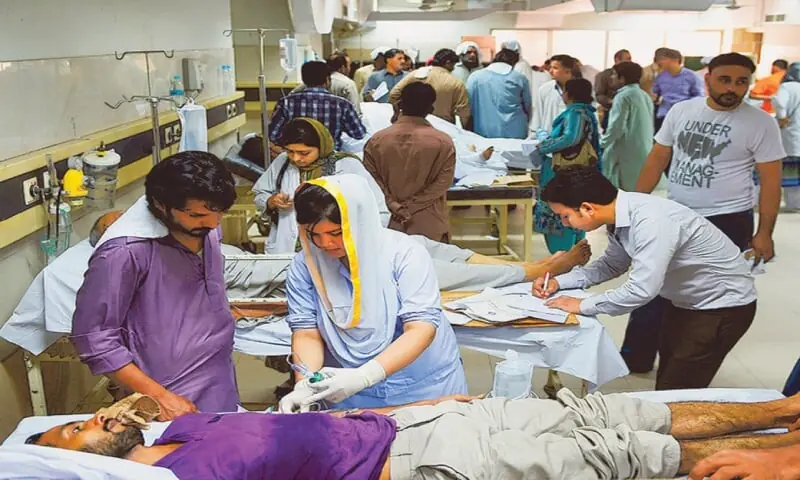
ISLAMABAD: The federal government has decided it will not extend funding for provincial health coverage in any form, including insurance, in strict compliance with the 18th Constitutional Amendment and asked the provinces to consider providing full-fledged health insurance on a contributory basis.
The decision comes in the wake of recent engagements and approvals for extending the Prime Minister’s Sehat Sahulat Programme (SSP), valued at about Rs40 billion, to three federally administered territories: the Islamabad Capital Territory (ICT), Azad Jammu and Kashmir (AJK) and Gilgit-Baltistan (GB), launched earlier this month.
Against this backdrop, internal proposals to include the population of Sindh’s impoverished Tharparkar district under the SSP were not supported.
It was argued during meetings of the Central Development Working Party (CDWP) and the Executive Committee of the National Economic Council (Ecnec), on the recommendation of a special committee constituted by the prime minister, that the inclusion of a single district would open the door for similar demands from other provinces, even though health is a devolved subject, documents seen by Dawn show.

Centre asks provinces to move towards contributory health insurance
At a high-level meeting chaired by the prime minister on Jan 2, the continuation of the programme beyond June 30, 2025, was approved until June 30, 2027 “for AJK, GB and ICT only”, according to a Prime Minister’s Office directive dated Jan 9, 2026.
Subsequently, the modified programme with a revised capital cost of Rs40.2bn was approved by the Ecnec “in light of the prime minister’s directive for the continuity of the programme beyond 30-06-2025 till 30-06-2027 for all permanent resident families of AJK, GB and ICT under universal health coverage (UHC) scope”.

Under an earlier decision of Ecnec of Aug 7, 2025, a special committee led by the planning minister to review the entire SSP since its inception in 2015 and way forward noted that the health programme had completed its life on June 30, 2025, after availing multiple revisions and time extensions. “Therefore, the programme should be shifted to the current budget,” the committee said.
It also directed the Ministry of National Health Services to submit a Project Completion (PC-IV) report and propose a thin structure to sustain activities and provide indoor healthcare services and protection from catastrophic health expenditures for vulnerable populations. The committee said this limited scope was in line with the programme’s original intent at the time of its launch.
The committee said that “provinces, AJK and GB should continue their own social health protection schemes for the vulnerable populations”.
The committee opposed the inclusion of “provincial districts via SSP” due to the fact that health was a devolved subject, and “if we start in one province, then there will be demand from other provinces too. Therefore, the provinces should implement their social health protection programmes for the vulnerable populations through their own budgets”.
It also cited the reduced Public Sector Development Programme (PSDP), which it said was already overstretched and unable to meet even the most critical federal liabilities.
The committee, however, recommended that after conversion of the completed project to the recurrent budget, the health ministry should, with provinces, design a pilot project on an affordable basis through “claim co-payments” on the pattern of Punjab, and a roadmap towards a full-fledged Social Health Insurance (SHI) on a contributory basis should be looked into.
The original SSP was approved on Feb 7, 2018, under the Prime Minister’s National Health Programme Phase-II at a cost of Rs34bn.
It aimed to cover the entire population living below the poverty line, based on a 32.5 Poverty Means Test (PMT) score or an income threshold of $2 per day, using the Benazir Income Support Programme (BISP) database, with provinces contributing the secondary-care premium for their beneficiary families.
The national project expanded in subsequent revisions and extensions. In August 2019, all provinces except Balochistan were excluded from contributing to the priority-care treatment premium, with the federal government citing the spirit of the 18th Amendment under which both the health mandate and budgets were devolved to provinces. The programme ended on June 30, 2025.
Published in Dawn, January 26th, 2026


