


The Digital Heritage Trails Project at TDF MagnifiScience Centre brings to life 5 endangered archaeological sites
A section of the The Lost cities of the Indus Delta exhibition is photographed here. SOURCE: THE EXPRESS TRIBUNE
A striking exhibit is on display at the TDF MagnifiScience Centre in Karachi. Launched today (Saturday), the exhibit sheds light on the ancient maritime civilisation of the Indus Delta and the environmental threats jeopardising its future.
“Lost Cities of the Indus Delta,” the product of a two-year Digital Heritage Trails Project (DHTP), uses 3D modelling, interactive displays, and storytelling to bring to life five endangered archaeological sites that once flourished as global trade hubs.

According to the event management, the exhibition is going to be a permanent installation at the MagnifiScience Centre.

An interactive virtual reality exhibit for Lahiri Bandar, a famous port city located in what is now Mirpur Sakro Taluka, Thatta.

“This project has brought history, science, and learning under one roof,” said Favad Soomro, CEO of The Dawood Foundation, and urged young people to reconnect with the past to become responsible citizens of tomorrow. It provides an invaluable tool to help the public understand the importance of safeguarding heritage, he added.
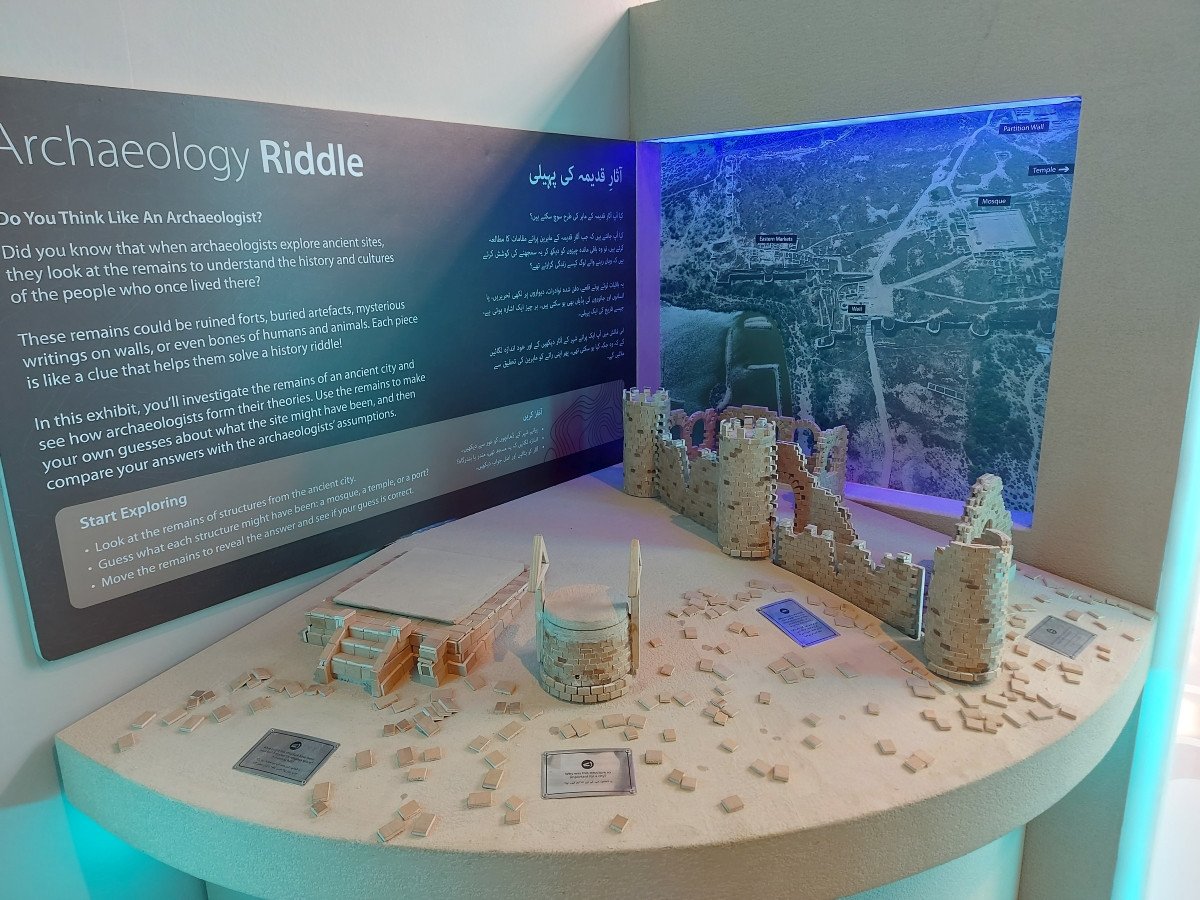
A part of the interactive exhibition showcasing an archaeology riddle
Amer Bazl Khan, Director of Maritime Research and project lead, described the exhibit as the culmination of years of research aimed at transforming complex data into accessible public experiences.
“We’ve documented how the centres of gravity have shifted over the centuries. Before Karachi, it was the Indus Delta,” said Khan, explaining how a port from the 11th century, once the fourth-largest in India, has now diminished dramatically.
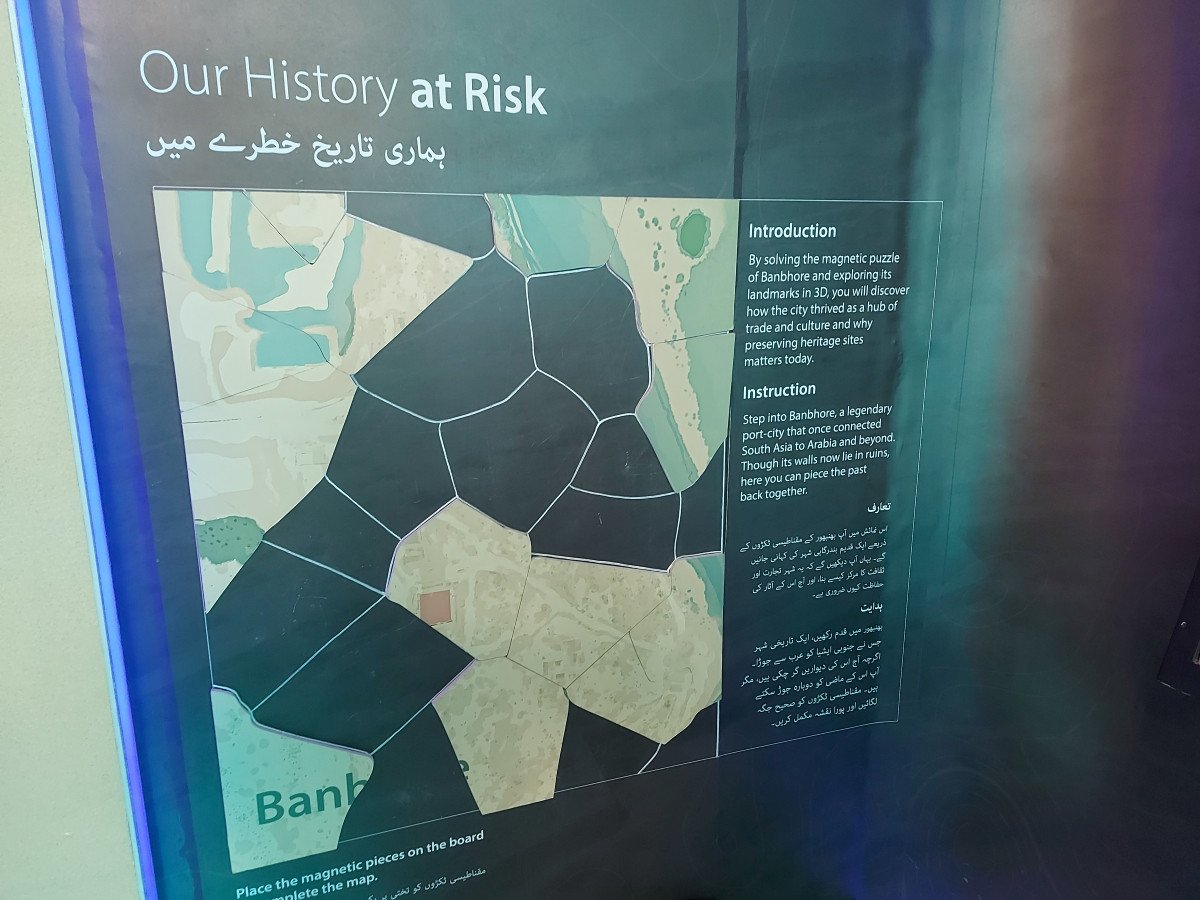
A magnetic map puzzle of Banbhore, a port city that once connected South Asia to Arabia
Merging science with history
Khan further emphasised the human aspect of the exhibition, showcasing the resilience of the people who once thrived in the region. “This project represents years of fieldwork and research, and aims to highlight the Indus Delta’s trade networks, cultures, and everyday maritime life.”
As part of the initiative, high-resolution 3D models of endangered sites and two documentaries, The Lost Cities of the Indus Delta and Cursed Waters, have been produced. These films have been translated into multiple languages, including Pakistan Sign Language, with help from Deaf Reach Karachi, ensuring broader accessibility.
British Deputy High Commissioner Lance Domm said, “It’s important to have exhibits like these, as it gives children something fun to do while also being informative.”
“It is important to have informal learning spaces.” Favad Soomro said, “More of these are absolutely needed in our city”.
The diminishing Delta
The exhibition’s opening coincided with the release of Cursed Waters, a documentary that delves into the environmental decline of the Indus Delta. The documentary reveals alarming statistics about the shrinking borders and devastating effects of water scarcity.
The Indus Delta has been reduced from 13,000 square kilometres in 1833 to just 1,667 square kilometres today. Freshwater flow has plummeted from 150 million acre-feet a century ago to under 10 million today.
Local landowner Gulab Shah encapsulated the crisis, saying, “Our elders used to say we live in a country where the river flows into the sea. Now we say the sea flows into the river,” poisoning the land with salt and leaving it unfarmable.
500,000 to 600,000 people have been displaced due to the lack of drinking water and the loss of agricultural land to rising salt levels. For those displaced to the edges of urban centres like Karachi, the move has eroded their cultural identity and social dignity.
The documentary also shows how the traditional community structures and the privacy once afforded to women in rural villages have vanished in the city, and many children from these displaced families are now forced to beg on the streets.
Watch the Cursed Waters documentary here:
Ahsan Zafar Syed, CEO of Engro Corporation, said, “Despite what we are achieving today, whatever we do will be unsustainable without focus on human development, as Pakistan is currently ranked 168th out of 193 on the human development index.”
British High Commissioner Jane Marriott said at the end of the ceremony that Karachi is facing rising sea levels due to climate change, which is contributing directly to the disappearance of the Delta communities and cultural heritage sites. When speaking about change and whether something can be done to prevent this, she said, “I have to believe that the answer is yes.”


