


UNDER normal circumstances, the journey from Bagh Markaz in Tirah to Bara — on the outskirts of Peshawar — should take no more than three to four hours.
But ever since the authorities asked the people of Tirah to evacuate their homes — in preparation for an operation against terrorist elements who have infiltrated the area — this 110km route is taking several days to navigate.
Although the northern parts of the country are in the grip of a severe cold spell, bringing with it rain and snow, this is not all that is holding up traffic on Bara Road.
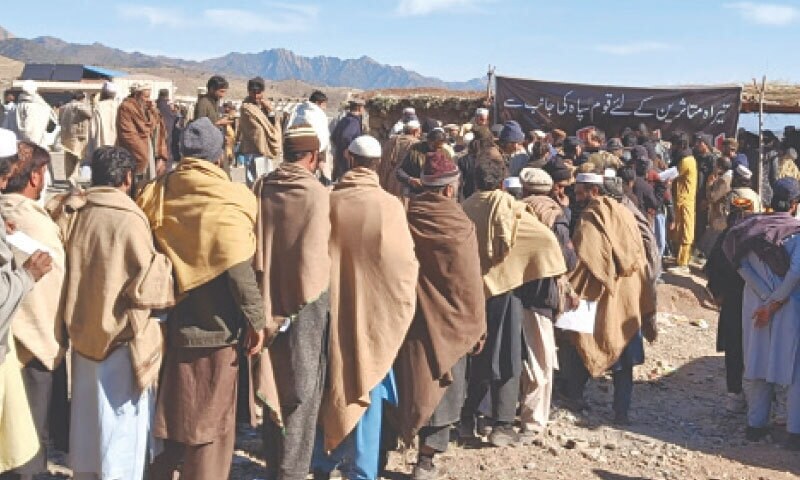
Families leaving the valley have to first register themselves with the authorities at Bara Markaz. From there, they must make their way to Dwa Thoye, where the road forks — with Peshawar in one direction and Afghanistan in the other. Here, they are supposed to be reimbursed for their transportation costs.

After completing this stage, evacuees must then trek to Paindi Cheena and Mandi Kas. Here, they are given mobile phone SIMs and the official grant promised to displaced households.
Inclement weather not the only hurdle, as authorities struggle to facilitate the smooth registration and movement of those who have left their homes
According to those who have been through this lengthy process, the hold-up and long queues at these points are massively delaying their journey — amid inclement weather — to the relative calmer climes of Bara, where most Tirah residents already have winter homes.

Unlike previous displacements carried out ahead of military action in these areas from 2008 to 2012, no camps have been set up for the internally displaced. This time, only those living in Tirah are being uprooted, and since most of the around 30,000 households in this area already have alternative lodgings near Peshawar, most are either staying at their own places, or with their extended families.
But as Nazir Jan explains, the 110km journey from Bagh Maidan to Bara was nothing short of a nightmare for his family. The majority of people left their homes in haste, and faced immense hardships during the long wait to register themselves.
Perhaps authorities did not anticipate the scale of the displacement that would come once military action was announced in the area. Although some families were reluctant to leave their homes, the sudden exodus from the valley has severely taxed authorities’ ability to ensure the smooth registration of those leaving.
The bad weather hasn’t made things any easier, forcing authorities to repeatedly change plans and locations of registration and biometric verification centers in order to control the unruly ever-restless crowds that gather at these points.
On a number of occasions, large groups of dissatisfied people have also blocked the roads and ransacked registration booths; since everyone wants their family to be registered as quickly as possible so they can move on towards their destinations, rather than wait in the open amid freezing temperatures.
As of Thursday, however, the evacuation of families from Tirah was fully suspended, and authorities focused instead on clearing the backlog of families still stranded on the roads.
Although the deadline for evacuating their areas was earlier set at Jan 25, the latest statement issued by Khyber House a day earlier said that the process of evacuation and registration would only restart after the weather improved.
Resistance
Residents of the restive Tirah Valley, which borders Afghanistan, have been holding out for quite some time. The authorities had demanded that they should either ask the militants to leave their area, take up arms against the intruders themselves, or simply leave their homes so the forces can move in to flush out the unwelcome visitors.
The outlaws refused to leave and the locals were reluctant to take up arms. It was a fait accompli; they eventually had to agree to pack up their belongings and reluctantly leave the picturesque valley for the third time since 2015.
The decision was not easy. Most of the inhabitants of Tirah had barely finished piecing their lives together, rebuilding their homes and lives after the last military operation.
Although the government came to their help, initiating projects to improve their lives, the respite was short-lived. In 2022, locals found armed men roaming freely in their fields and knocking at their doors, seeking “food and shelter”.
“We got struck between the devil and the deep sea,” Nazir Jan tells us while waiting in queue at the dusty Mandi Kas center to collect his transport fare.
The miscreants had already started asserting themselves by intensifying attacks on security forces, demanding tax on agriculture produce from poppy and hemp crops, while also establishing parallel courts in some localities.
In the words of Peer Mela resident Noor Habib, none of the nearly 20,000 families who reside in the valley were willing to leave their houses. But living there was becoming more and more difficult, as security forces and terrorists fought duels day after day.
Published in Dawn, January 24th, 2026


