


Barbs fly in Senate as PTI’s Ali Zafar demands probe into ‘institutional overreach, election fraud’


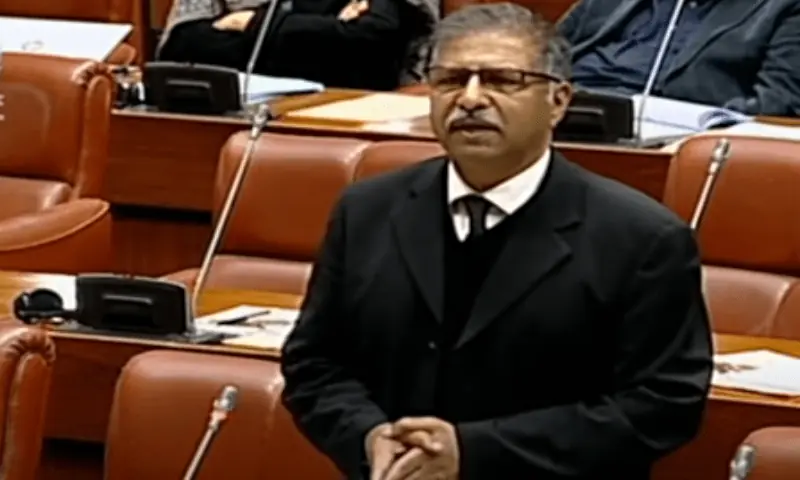
ISLAMABAD: Barbs flew in the Senate on Friday with the opposition taking the government to task over its policies and demanding a parliamentary probe into “institutional overreach” and “election fraud”.
In response, the government accused the opposition of committing “economic terrorism” while also chiding it for the Results Transmission System (RTS) fiasco in the 2018 general polls.
Speaking on a calling-attention notice, PTI’s Ali Zafar, the party’s parliamentary leader in the Senate, said Parliament had been made irrelevant and meaningless.
His speech was interrupted several times by the members of the treasury benches, who loudly objected to his remarks.

“Matters pertaining to the country’s economy, security and foreign policy are not brought before Parliament; [instead] decisions are taken in drawing rooms,” he said, regretting that even agreements linked to the country’s future were signed while keeping Parliament in the dark.
“This is a betrayal of the constitutional concept of civilian supremacy,” he asserted. Noting that all the lawmakers were under oath to protect the Constitution, he called for regaining lost civilian space.
“Will this Senate remain a rubber stamp or will it rise to face the storm? Let us ensure that the law is not merely the law of the powerful but the law of the land,” he remarked.

Zafar said that a full-blown constitutional crisis had occurred after the February 8, 2024 general election.
He said that despite the country’s people giving a clear decision on election day, an “attack” was carried out on democracy.
“The people’s mandate was not only ignored but was systematically destroyed through violence and manipulation,” he said, adding that this struck at the heart of democracy itself.
“This is against the very principle articulated by Quaid-i-Azam Muhammad Ali Jinnah when he addressed the first Constituent Assembly on August 11, 1947 and said, ‘The authority of the government is conditional upon the will and consent of the people’,” he said.
“The same was also stated by our first prime minister, Liaquat Ali Khan, who said, ‘The greatest pillar of democracy is the free will of the people. The will is the foundation of the Constitution’.”
Zafar went on to say that he was not raising the complaint as the representative of a particular political party. “This is the bell [signalling] national danger,” he said.
Zafar stressed that when the mandate of the people was crushed, the government that would be “installed” would lack both legal power and moral authority.
“Such a government cannot take hard decisions, cannot unite the nation, and can not lead the country through a crisis,” he remarked.
He termed the incumbent government a “house built on sand”, saying it was bound to collapse.
The PTI parliamentary leader also raised alarm over what he called the “economic slaughter” of the people of Pakistan.
“Inflation is not a mere statistic or economic indicator. It is a sword hanging over the head of every citizen,” he said. The PTI leader further said that public debt was not just increasing, it was also ensuring that future generations would wear the “shackles of slavery”.
“This government survives only on debt … they are not here to distribute progress, they are here to distribute misery,” he said, pointing out that public debt had risen to Rs80 trillion.
“What is their plan? Is the plan only to tax those who are already burdened with taxes? … What is the vision for increasing exports? What arrangements have been made to create jobs for our youth? Where is the strategy to harness our immense potential in information technology? Where is the support for small and medium enterprises, the backbone of our economy?” he asked.
“This government doesn’t have a policy or governance … only drift, confusion, and the dark clouds of an approaching storm,” he said.
Expressing concern over the ongoing brain drain, he said, the best minds in the country were leaving because they saw no hope, no justice, and no future. He also said industries were relocating, production was decreasing and investment was fleeing the country.
In his speech, Zafar also said that the country’s laws were being weaponised.
“Cases are not being filed, they are being manufactured. A court case has become a punishment itself. This is political victimisation which is destroying the last remnants of public trust in the state,” he asserted.
Zafar said the consequences of this were visible in the country’s foreign policy.
“We have abandoned our principled stance on Kashmir,” he said, pointing out that Pakistan did not have a clear position on Venezuela or Iran.
He said that a new world order was emerging and in the face of this new reality, every nation needed to defend its sovereignty and its “strategic autonomy”.
“Every step we take, we have to think it through. The government will be required Parliament’s guidance at every step; you cannot go forward without Parliament’s guidance,” he said.
However, at the same time, it was important for the government to have the public’s trust. “Without the public’s trust, you cannot take any step. And this you can only get when Imran Khan comes because the nation stands with him,” he said.
Zafar continued that the PTI was not just the opposition but rather an “alternative government”, and had the plans to steer the country out of the economic quagmire.
He demanded that a special parliamentary committee be constituted to investigate the serious allegations of election fraud and “institutional overreach”. He also said the House should pass a resolution rejecting the government’s policies that crush the country’s poor and deepen inequality.
In response to Zafar’s speech, Minister of State for Finance Bilal Azhar Kayani sharply criticised the economic policies pursued by the PTI government between 2018 and 2022, saying repeated policy failures during that period pushed millions of Pakistanis below the poverty line and brought the country to the brink of default.
He said the past PTI-government changed four finance ministers, noting that while an International Monetary Fund (IMF) programme was initially rejected, it was later accepted on weak terms and eventually sabotaged for political reasons.
Kayani alleged that when the PTI- led government realised it was losing power, it deliberately undermined the IMF agreement despite being aware that such actions could push the country towards default.
The minister said the present government, after assuming office, took difficult but necessary decisions to revive the IMF programme, rebuild trust with international partners and avert sovereign default.
Despite resistance and repeated attempts to derail the process, he said, the government succeeded in stabilising the economy.
He said former ministers belonging to the PTI resorted to “economic terrorism” by writing letters to the IMF to derail the programme.
The minister said that the government was committed to ensuring sustainable economic growth, expanding employment opportunities and putting Pakistan on a stable and resilient economic path.
Kayani claimed that the government had successfully steered the country away from default, restored economic stability, and was now focused on achieving sustainable growth and creating jobs.


