


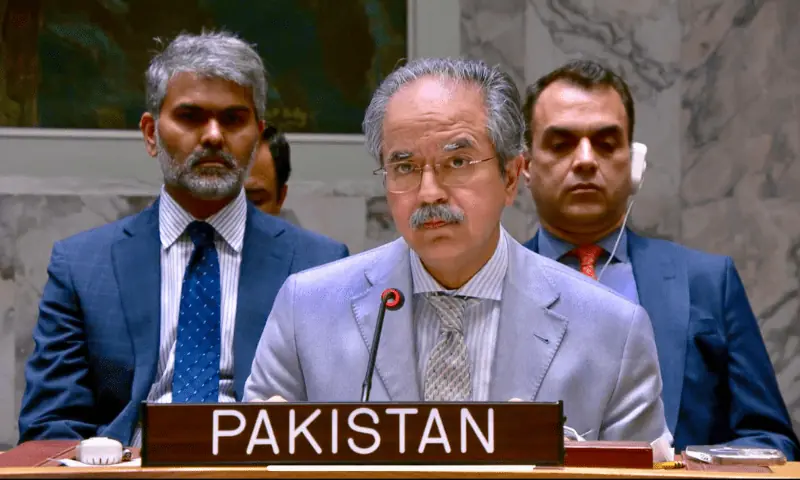
Pakistan has stepped up its call at the United Nations for reinforcing the primacy of international law and reforming the Security Council, warning that selective compliance with treaties and parallel diplomatic initiatives risk weakening the UN at a time of heightened global conflict.
Speaking at the International Law Year in Review 2026 Conference on Thursday, Pakistan’s Permanent Representative to the UN, Ambassador Asim Iftikhar Ahmad, said the erosion of treaty obligations and uneven application of international law were undermining the foundations of collective security built after World War II.
“There must be no space for selective compliance or legal exceptionalism,” the ambassador said, adding that the principles of the UN Charter must be applied “more consistently, more courageously and more faithfully” if the rules-based international order was to survive.

Ambassador Asim linked the debate on international law directly to the functioning of the Security Council, noting that divisions among major powers had increasingly paralysed the body. He cited the unanimous adoption of Resolution 2788 during Pakistan’s presidency of the Council in July last year as an exception that underscored what was still possible within the UN framework.
The resolution, he said, “reaffirms the centrality of peaceful settlement of disputes” and demonstrated that consensus could still be achieved despite geopolitical rivalries.

At the same time, he warned that disregard for binding international agreements posed a direct challenge to the UN system. Referring to India’s unilateral move to place the Indus Waters Treaty in abeyance, Ambassador Asim said such actions reflected a “disturbing trend” that weakened confidence in international law and threatened regional stability.
On the long-stalled issue of Security Council reform, Pakistan reiterated its opposition to models that expand permanent membership or perpetuate veto privileges. Any reform, the ambassador said, should “not exacerbate the fundamental flaws entrenched in permanent membership and veto” but should instead “enhance the relative weight and power of the elected members”, whose voices represented the wider UN membership.
He also drew attention to the growing agenda before the UN related to emerging technologies, arguing that the organisation must play a central role in shaping legal norms on artificial intelligence, cyber operations and autonomous weapons.
Praising the work of the International Court of Justice (ICJ) and the International Law Commission (ILC), he called for the “progressive development of international law” to prevent new domains of conflict from remaining unregulated.
Despite persistent criticism of the UN’s effectiveness, Ambassador Asim said the institution continued to command broad legitimacy. “The vast majority of member states have deep faith in the UN and multilateralism,” he said, stressing that the answer lay in reform and renewal rather than marginalisation of the world body.
Diplomatic discussions at the UN this week have reflected similar concerns, with several delegations privately cautioning against the proliferation of ad hoc mechanisms that operate outside established UN processes, even when presented as complementary.
Earlier on Thursday, Pakistan joined 19 other nations in endorsing the charter of a proposed “Board of Peace”, an initiative led by United States President Donald Trump. While Washington has said the body would work “in conjunction” with the UN, diplomats noted that the proposed group could end up supplementing — or potentially complicating — the UN’s role in maintaining international peace and stability.
For many at the UN, the central question remains whether new initiatives can reinforce — rather than dilute — the authority of the organisation at a moment when conflicts in Gaza, Ukraine and elsewhere have already placed unprecedented strain on the multilateral system.


