


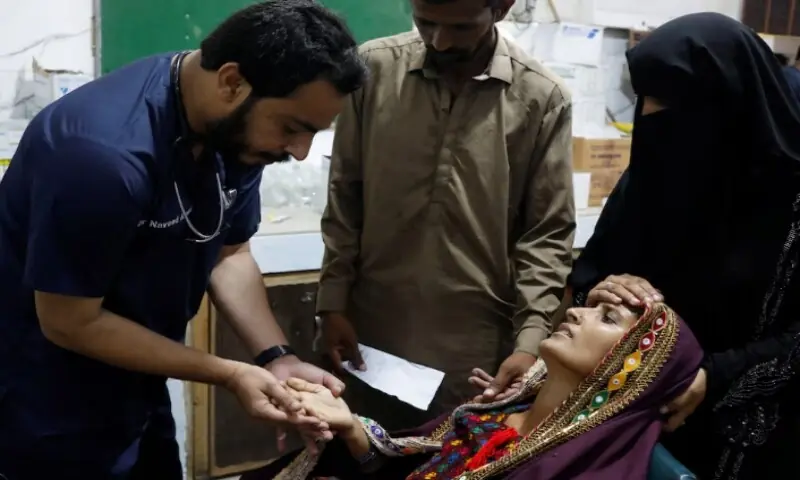
Officials and healthcare workers have raised alarm over the Punjab government’s decision to make body cameras mandatory for hospital staff, warning that the move was imposed without consultation and risks infringing on patients’ fundamental rights, including privacy and dignity, inside healthcare facilities.
Body cameras, or bodycams, are wearable audio and video recording devices used to capture footage of official action for evidence.
Punjab Chief Minister Maryam Nawaz on Friday announced her decision to make bodycams mandatory for nurses, ward boys, security guards, and pharmacy staff, except doctors, upon receiving complaints from the public regarding the behaviour and negligent attitude of hospitals.
Last month, Lahore’s Nishtar Hospital sacked a doctor working as an additional house officer for misbehaving with a patient’s family, a video of which had gone viral on social media. An inquiry committee was also formed to probe the incident.

‘Unbelievable’ move
Officials have taken strong exception to the move, terming it hasty, ill-conceived, and a direct violation of patients’ fundamental rights.
“This is unbelievable. If at all this is decided and practically applied, it will not be a useful technique to improve the health delivery system,” Pakistan Medical Association (PMA) President Dr Izhar Ahmed Chaudhry told Dawn. “It will bounce back and give a bad name to the government.”
He maintained the government had not consulted anyone or any forum at any level and termed the decision “illogical, impractical and insane,” which was “against fundamental rights of patients as well as the health professionals.“

“It violates essential privacy of patients and professional liberty and confidentiality of the health professionals during treatment, which is mandatory and cannot be violated under the law,” he added.
In Chaudhry’s view, instead of taking measures to improve the current deteriorating conditions in the health sector and make it free for all, the government was creating situations and endangering lives and the very existence of health professionals.
He said that the government decided “to sell out the health institutions and deliberately make the working conditions miserable with each passing day.”
‘Useless act’
For Young Doctors Association (YDA) Punjab President Dr Shoaib Niazi, the decision was a “useless act” for which he was “not consulted”.
“I was not consulted at all. This decision came from the higher-ups, and it’s a useless act,” he said, adding that similar decisions, for example, a prohibition on the use of mobile phones on duty was imposed on hospital staff, but it was not implemented.
“This move will compromise patient privacy and confidentiality. For example, in the gynaecology and labour wards. The footage will go to the IT department, and anyone can access it with patients’ consent,” Niazi said.
Raising questions on the source of funding for the bodycams, Niazi said the “security guards have not been paid salaries for the last three months in Mayo Hospital. How will the government provide bodycams? How will they implement such a structure? Where will the money come from?”
He further said that there would be no “honest opinion” because of body cameras, adding that the government had taken the decision without consulting him, and it was expected that the next step would be make bodycams mandatory for doctors.
The YDA Punjab president said he would hold a press conference related to the issue soon, and he would speak in detail about it.
‘Unable to understand use, but will follow orders’
According to the Punjab Young Nurses Association Member and a staffer at Children’s Hospital Lahore, Muqaddas Tasneem, nurses were a major stakeholder in the decision, but none of them were consulted.
“The govt didnt consult us at all and decided on its own. However, we have to follow the orders and act upon the directions,” she said.
Junaid Tariq, the president of Allied Health Sciences — an alliance of ward boys and other staff members, except nurses at the Lahore General Hospital — voiced similar concerns, saying he or other members from the alliance were not informed or consulted at all.
“The govt has not consulted stakeholders. We are unable to understand the purpose of this order. It fits in with the responsibilities of security guards, but it will compromise the privacy of patients. It will compromise the confidentiality of patients’ medical records. The nature of our work does not relate to security,” he said.
‘Inconceivable decision’
Speaking to Dawn, former Punjab caretaker minister for health and ex- vice-chancellor of the University of Health Sciences, Lahore, Dr Javed Akram said he did not have any knowledge of the decision, saying it was “not possible that something like this will happen as it was inconceivable. How will they do it to so many people?”
Dr Akram raised multiple questions on the practical aspect of the decision: “How will they watch or analyse those [healthcare officials] with bodycams? What if the employees with cams have to go to rest rooms? Will they take the cam off each time?”
Worldwide practice limited to security staff
There are very few countries in the world that allow bodycams to be used or trialled for hospital staff, but it’s not widespread and is usually limited to security staff or situations with high risks of violence, not everyday clinical care.
For example, New South Wales (NSW) Health in Australia is running official trials of body‑worn cameras in public hospitals, equipping security staff with them in selected hospitals to record incidents of aggression or violence for safety and deterrence.
In the United Kingdom, some NHS trusts in England, including East Sussex cases like Conquest Hospital and Eastbourne District General Hospital, have trialled body‑worn cameras for staff (mostly security and senior nurses) to deter abuse and violence. However, such a blanket decision has not been announced anywhere in the world.


