



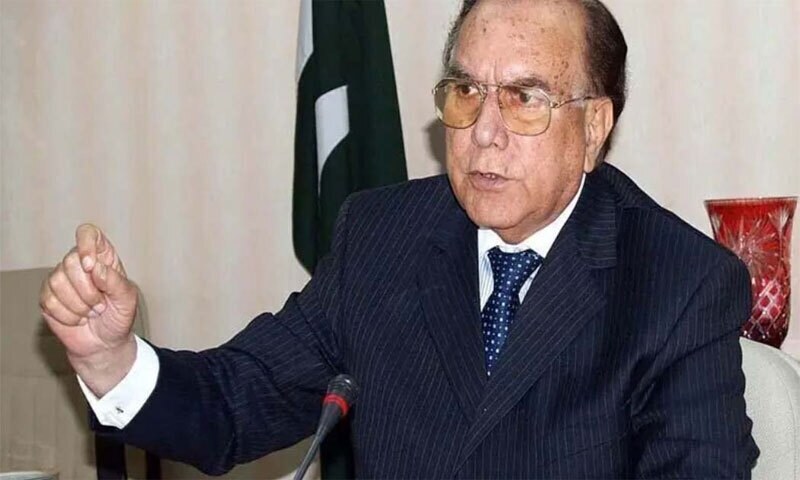
Mian Manzoor Ahmed Wattoo, a former chief minister of Punjab and one of Pakistan’s most durable political survivors, passed away on December 16, 2025, at the age of 86. His death marks the passing of a particular species of politician — less ideological than instinctive, less rhetorical than tactical — who thrived in the interstices of power rather than at its commanding heights.
Wattoo was never the face of a movement, nor the author of a grand political vision. Yet, for decades, he remained relevant in Punjab, Pakistan’s most populous and politically decisive province, precisely because he understood how power there actually worked. He belonged to a generation shaped by instability.
Born in Okara district, in the fertile plains of central Punjab, Wattoo came of age in a Pakistan where democracy was episodic and political loyalty was often provisional. Coups, dissolutions of assemblies and abrupt changes of regime were not aberrations but recurring features of national life.
In such a setting, political survival required adaptability, a strong local base and a keen sense of timing. Wattoo possessed all three. Unlike dynastic politicians whose surnames opened doors, he built his career from the constituency upwards.

Mian Manzoor Wattoo, the former Punjab chief minister who passed away December 16, had mastered the art of political endurance. His life offers a lens through which to understand how power actually works in Pakistani politics
A MASTER OF RETAIL POLITICS
Rural Punjab politics is intimate and transactional: voters expect access, mediation and tangible benefits rather than abstract promises. Wattoo excelled at this retail politics. His influence rested less on charisma than on networks — of biradari [kinship], local notables and bureaucratic intermediaries. He cultivated them patiently, and they repaid him with loyalty when it mattered most.

Wattoo’s rise to national prominence came during one of Pakistan’s most chaotic democratic interludes. The early 1990s were marked by a relentless tug-of-war between elected governments and the presidency, backed by an assertive establishment.
Nawaz Sharif’s first government collapsed in 1993 amid institutional paralysis. It was in this vacuum that Wattoo emerged as a compromise choice for chief minister of Punjab. He did not represent a sweeping mandate; he represented feasibility. As chief minister, his style was cautious and conciliatory. Punjab’s administration, vast and deeply entrenched, often overwhelms its political masters.
Wattoo did not attempt to bend it dramatically to his will. Instead, he sought workable accommodations, keeping the machinery of government running while Islamabad convulsed. His tenure was brief and lacked headline-grabbing reforms but, in a period when paralysis was the norm, continuity itself counted as an achievement.
That episode cemented Wattoo’s reputation as a political fixer — someone who could assemble numbers when arithmetic mattered more than ideology. Over the years, he aligned himself with multiple political platforms, most notably the Pakistan Peoples Party (PPP). His long association with the PPP was pragmatic rather than romantic.
OPERATING IN THE GREY ZONE
Wattoo was useful to the party in Punjab, where it often struggled against more entrenched rivals, and the party was useful to him as a national vehicle. When circumstances changed, so did his positioning. This flexibility earned him criticism.
Detractors accused him of opportunism and of embodying the transactional politics that has long weakened Pakistan’s party system. Admirers countered that he was a realist, navigating an unforgiving landscape. In a country where elected governments have repeatedly been cut short, ideological purity can be politically suicidal. Wattoo chose endurance over martyrdom.
Wattoo was comfortable operating in the grey zone between formal party politics and informal power. He understood bureaucrats, courted electables and maintained lines of communication across political divides. Unlike flamboyant populists, he rarely courted controversy. His public persona was understated, his speeches workmanlike. Influence, for him, was something to be exercised quietly, often away from cameras.
That discretion helped him persist while more strident figures flared and faded. Yet his career also reveals the limitations of such an approach.
THE LIMITS OF TACTICAL BRILLIANCE
Wattoo never converted his tactical skills into a lasting institutional legacy. He did not create a durable political faction bearing his imprint, nor did he champion a transformative policy agenda for Punjab. His impact was situational rather than structural, strongest in moments of uncertainty and weakest when politics stabilised around dominant leaders.
Still, Wattoo remained electorally resilient. Time and again, he returned to office, buoyed by his constituency connections and his reputation as a dependable intermediary. For voters in Okara and beyond, he was less a national statesman than a local patron — someone who could navigate the corridors of power on their behalf. In Pakistan’s political economy, that role is often more valued than lofty rhetoric.
In his later years, Wattoo witnessed a profound transformation in Pakistani politics. The rise of mass-mediated populism, the centrality of television studios and social media, and the sharpening of ideological polarisation left little room for his quieter style.
Politics grew louder, faster and more absolutist. Yet, even as he receded from the foreground, his counsel was sought by younger politicians, eager to understand an older grammar of power — one based on negotiation rather than confrontation. His life offers a lens through which to view Pakistan’s democratic evolution.
Figures like Wattoo rarely inspire hagiographies, but they perform a stabilising function in fragile systems. They absorb shocks, broker compromises and keep institutions functioning when formal rules falter. That such skills are necessary at all is itself an indictment of Pakistan’s political volatility.
Mian Manzoor Ahmed Wattoo was neither a hero nor a villain. He was, above all, a survivor — adept at reading the moment, adjusting his stance and remaining relevant in a shifting landscape. As Pakistan continues to debate how to strengthen its democracy and deepen its parties, his passing serves as a reminder of an era when politics was practised less as performance and more as patient brokerage.
He is survived by his family and by a political tradition he exemplified: pragmatic, unsentimental and deeply attuned to the realities of power in Punjab. Whether that tradition is fading or merely adapting remains an open question.
The writer is a columnist, educator and film critic. He can be contacted at mnazir1964@yahoo.co.uk.
X: @NaazirMahmood
Published in Dawn, EOS, December 28th, 2025


