



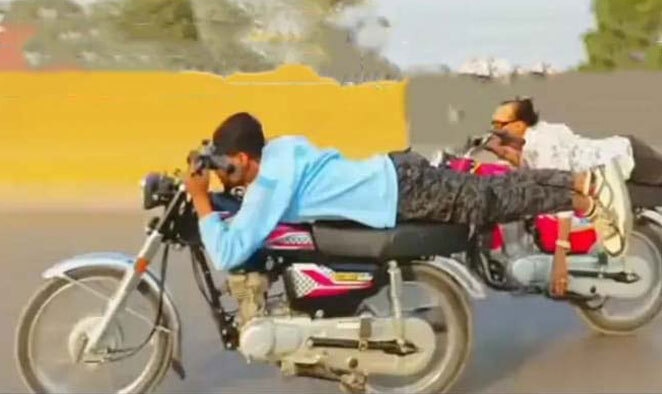
It’s a situation most drivers on Karachi’s major thoroughfares have experienced, especially on weekend nights and public holidays: a ghost motorcycle closing in at breakneck speed.
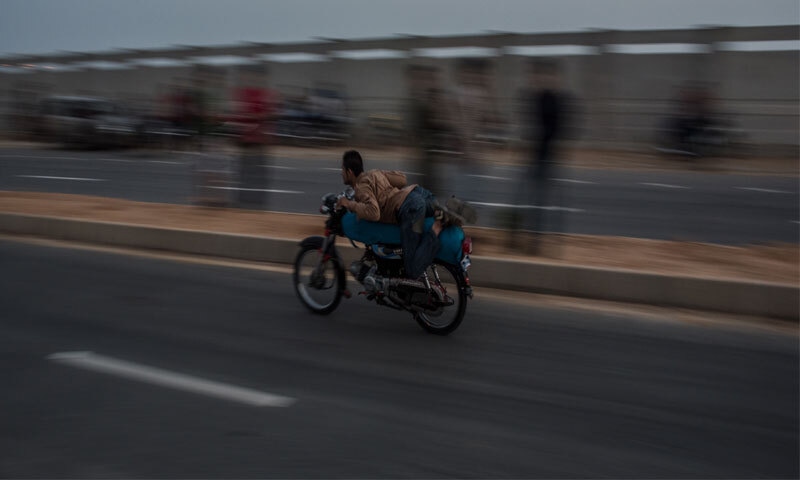
At first, it is little more than a blur in the rear-view mirror. Then, as it bears down, the driver finally registers the young man lying flat along the length of the motorcycle, his eyes peering forward just above the handlebar. The speedometer is missing. The rider’s arms are tucked tight to the side — either holding the handle or, in some cases, clutching the suspension on the sides and using shoulders to steer the handlebar. His legs lie flat or are scissored tightly at the ankle, his body locked in an aerodynamic pose.
Most drivers know what to do when faced with such a motorcycle: hold your line without moving in either direction. Do not brake suddenly. Do not swerve. Almost without fail, the rider veers away at the very last second, zigzagging between vehicles and vanishing in the blink of an eye.

But it is rarely a lone escape. A swarm of similar motorcycles arrives next, streaking past from every direction, forcing drivers to grip the steering wheel and mutter silent prayers — for the rider’s safety as much as their own. At these speeds, even a minor error — a sudden lane change, a startled brake, a moment’s hesitation — can prove fatal: not just for the motorcyclist but anyone sharing the road.
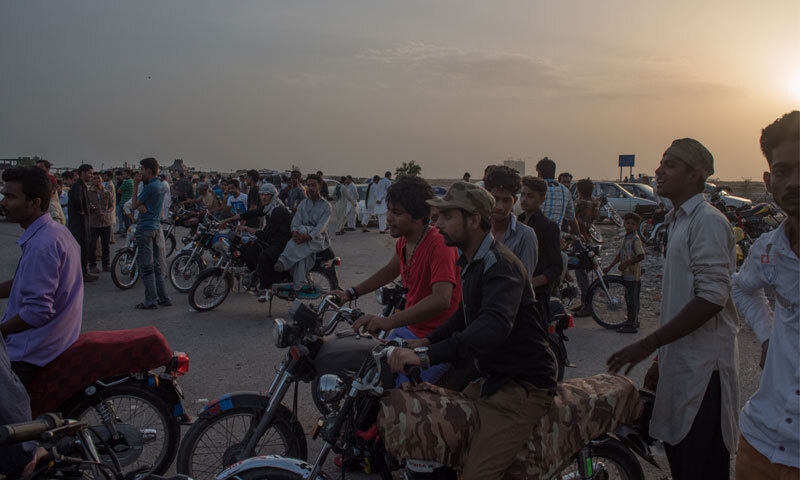
Daredevil motorbike riders speeding through the busy roads of Karachi without any protective gear have built up a vibrant subculture around themselves that is sustained often as much through social media as word of mouth. Why does this perilous practice continue to attract thrill-seekers and can it be made less dangerous, not just for the riders but also for those they share the roads with?
These riders, mostly young and often underage, wear no protective gear beyond goggles to keep the dust from blurring their vision. Their motorcycles are stripped to the bare minimum, every unnecessary part removed in pursuit of speed and control.

On Karachi’s roads, they are known by a single name: Shapatars.
WHAT MAKES A SHAPATAR?
The origins and the exact meaning of the term is unclear, though most experienced motorcycle racers in Karachi suggest it’s a portmanteau of sharp and funter [a local version of the term punter] and refers to those who show street smarts and mastery on two wheels at a young age.
The term has circulated since the 1990s, sometimes loosely associated with political muscle and petty crime, though racers insist this is no longer representative.
“Most of us are simply hardworking people who are passionate about racing,” says Muhammad Tariq, a stocky 24-year-old racer popularly known as Tariq 180. He is also a proficient mechanic and now runs a workshop. He left school early and started work as an apprentice in 2009.
Tariq’s forays into racing started with wheelies on his motorcycle. “Around 2013-14, I bought a CB 180cc bike, which resulted in me getting the name 180,” he says. But Tariq has one major advantage over a majority of his peers: he is not only a rider but also an ustaad, an expert mechanic who understands the ins and outs of a motorcycle and knows how to get the best out of it for any particular race.
But one young man, arguably the most well-known shapatar of Karachi, rose to the top of this illegal racing circuit based solely on his riding skills. His most famous race, also his last, remains shrouded in mystery and, seemingly, adds to his legend.
THE LEGEND OF BABU 70
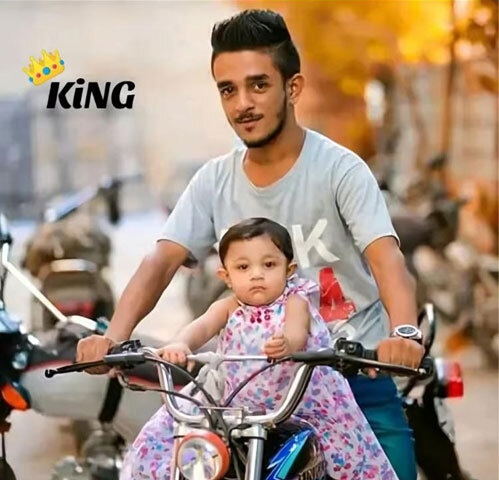
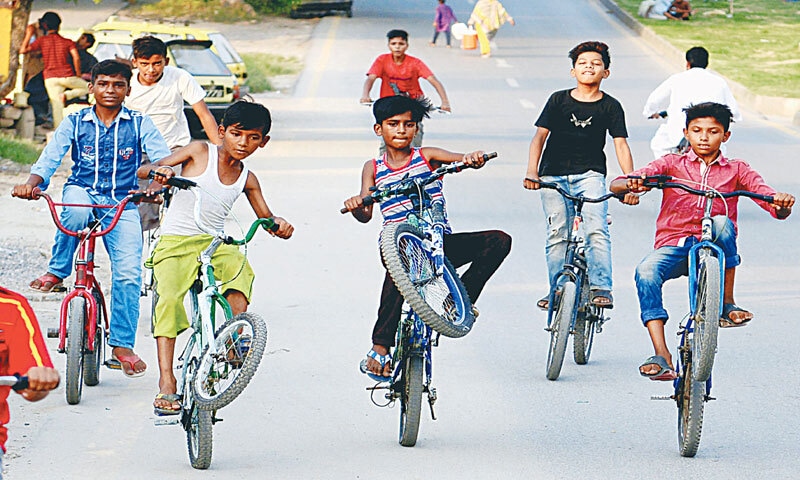
Like Tariq, Uzaib Mustafa’s love for daredevilry began with doing wheelies on his bicycle while growing up in Gazdarabad (aka Ranchore Lines) in downtown Karachi. Like most young men of his area, which has a large number of motorcycle parts and repair shops, he started hanging out at the workshop of one Rehan Ustaad, according to his brother Murtaza.
A slightly-built teen, around 5’6” in height, he was the ideal racer. His proficiency in doing wheelies, initially, on his bicycle and, later, on motorcycles, had already established his credentials. He became known as Babu 70, after his father — a former department-level footballer who drove a 70cc bike.
Babu 70 started racing before he had a license, as most shapatars do. His big break came in 2011, at 18, after beating champion racer Bali X. Over five years, he established dominance on Sharae Faisal — the city’s main thoroughfare — and other tracks. By 2016, he was neck-and-neck with Saqib Sanki, Karachi’s reigning shapatar. Their rivalry would culminate in one final, fatal race.
Murtaza, Babu’s brother, says that there was a point when Sanki wanted to back out of the race due to some bad blood between Babu and him, over the verdict of an earlier race. But it went ahead after Babu insisted, citing his planned departure to Dubai two days later, where his friends were helping him set up a business.
The race was set for 4am in early November 2016. Initially, it was planned as a 12km race on Sharae Faisal, starting from near the airport and ending at the FTC Bridge. But oil on the road meant that the distance was adjusted, with the starting point moved up to the crossing on the Drigh Road Railway Station.
Once the race started, Babu quickly took the lead. It stayed that way well beyond the halfway mark. This is what everyone agrees on. What happened after is contested.
Babu’s brother Murtaza, who was at the race, says that he was hit by a car, but is unsure if it was a sedan or a hatchback. Ali, a young man who is no longer involved in racing, claims it was Sanki’s boys in the vehicle and that Sanki also kicked Babu’s motorcycle.
Tariq 180 dismisses claims of foul play. “Babu’s motorcycle’s engine malfunctioned due to the race and was dripping oil, which fell on the wheel and led to him losing control,” he asserts.
Murtaza says that Babu’s accident took place while victory was just a short distance away. “He got dragged for almost a km and sustained multiple injuries,” he tells Eos at his motorcycle parts shop.
Babu spent almost four weeks in the hospital before passing away. The family didn’t file any police report over his death, lending credence to Tariq’s assertion that there was no foul play.
Eos made several efforts to contact Saqib Sanki but was informed by his apprentices that he didn’t want to speak to a journalist, even though they regularly upload his videos and races on social media. One reason could be his legal troubles: Saqib is currently on bail in a 2022 dacoity case, with the hearings ongoing.
Saqib’s legal troubles means he often takes unscheduled breaks from racing. Despite that, he still enjoys a massive following, with his acolytes running multiple accounts dedicated to him on TikTok, Facebook and Instagram.
But there still remain those who think Babu was better than him. “Babu was clearly a better rider and his victory against Sanki would have established him as the undisputed champion shapatar of Karachi,” says Ibrahim, another former racer who knew Babu well. “If you ask young boys who they want to be like, most will say Babu 70,” he adds.
For a few years after his death, Babu’s admirers took out commemorative rallies on his death anniversary. His race videos and exploits continue to dominate digital platforms. Any discussion about the best racers in Karachi or Pakistan invariably sees his name mentioned, with claims and counterclaims on who is the greatest shapatar to ride on the roads of Karachi.
THE RACE, THE RIDER AND THE RIDE
For a rider to achieve greatness, he needs an equally good ustaad, says Tariq. “Yes, it’s the rider who is putting his life on the line, but it is the ustaad who will alter the motorcycle for the race,” he explains.
Despite being mostly uneducated, these riders have an experiential, if not instinctive, grasp of select physics concepts, including aerodynamics and air pressure. The shapatar riding posture is aerodynamically optimal and riding in a vehicle’s slipstream reduces air pressure and increases speed. Tariq even has a GPS meter downloaded in his phone, which he uses to assess the performance of his motorcycle before races.
But it is the ustaad who is likely to have the magical touch. Their understanding is developed over years of trial and error, taking apart motorcycles and putting them back together, tinkering and tailoring with various components. “That’s how a 70cc bike reaches speeds of 150+ [km/h],” says Tariq. “An ustaad can ensure his rider stays unbeatable, but not the other way round,” he adds, saying both the rider and the ustaad are equally important.
This is why when a rider wants to race against someone, he will mention his ustaad in the challenge — which are now posted on social media groups, primarily on Facebook. Once a challenge is accepted, the two parties decide on a munsif, a judge — mostly a veteran racer and, ideally, one with a fast motorcycle to tailgate the racers and record a video for the final verdict. The race wager — ranging from Rs15,000 to even Rs150,000 or more — is deposited with the munsif to be handed over to the winner.
Race conditions are negotiated in unique terminology: such as “apni hawa” (not entering another’s slipstream) or “CS Alter” (carburetor and sprockets can be modified). The most dangerous format is “freestyle”, where riders can hit, grab and kick rivals. “This has mostly been discontinued following consensus between ustaads,” says Tariq.
Before racing, both parties inspect vehicles to ensure no violations. The munsif can disqualify either party if objections are upheld.
There are also “showroom-to-showroom” races, in which the two parties acquire motorcycles from a showroom and take them directly to the designated track for the race. This emerged, according to Tariq, because of the innovation in alterations.
“We have such funtergiri [cleverness] nowadays that even ustaads can’t detect alterations,” he says before adding that most such alterations are done by mechanics in Lahore. “Karachi has better riders, but Lahore has better ustaads.”
THE COST OF DAREDEVILRY
For all the skill, bravado and mythology surrounding shapatars, the risks they take extend far beyond themselves.
Karachi’s busy and poorly regulated roads are already a menace for commuters, with the city reporting at least 500 road traffic casualties (RTC) last year. The majority of these casualties tend to be motorcyclists. However, this data doesn’t differentiate for motorcyclists.
The Road Traffic Injury Research and Prevention Programme (RTIRPP), initiated by neurosurgeon Dr Rashid Jooma, was the only programme through which data regarding road traffic accidents in Karachi was collected. The programme, which was shut down due to lack of support and funding in 2017, found that there were 9,129 road fatalities from 2007-2014. “Motorbikes as primary vehicles were responsible for 3,871 (44.7 percent) RTC fatalities out of the 8,654, for which this information was available,” it observed in its November 2016 report.
A conversation with any motorcycle racer will see them list off a litany of names of friends killed while racing or practising for it. Tariq shows off the scar on his head which, he says, required two dozen stitches. He has another one on his back. “Around five, six boys of Mehmoodabad [in Karachi] have died in the last few years, including Ustaad Sohail S-1,” he says.
Traffic police officials say enforcement remains difficult, as races are organised spontaneously and often take place in the early hours of the morning, when roads appear deceptively empty. “These motorcyclists often ride without number plates or safety gear and are difficult to intercept due to their riding skills,” says Pir Muhammad Shah, the deputy inspector general of Traffic in Karachi. Shah tells Eos that they have recently introduced aerial surveillance and hope to crackdown on such elements.
Most motorcycle racers shrug off concerns over the latest e-challans or crackdown by traffic authorities. They are more concerned with law enforcement, particularly at the time of the start of the race. “When there is a race, even on the highway, riders congregate at the starting point and momentarily block the road, so the racers can have a clear, vehicle-free track,” explains Tariq. “Cops showing up during that time can land the people who are blocking the road in trouble,” he adds.
Nasrullah Khan, a seasoned police officer who served as the station house officer in various localities that were racing hotspots, says that such races are not only illegal, but those who alter motorcycles are also committing a crime. “You pay the government tax of a 70cc bike while your vehicle functions as 150cc,” he points out.
Khan adds the popular “Devil’s Point” on Sea View was a hotbed of all kinds of races, until the erection of barriers in the middle of the road. “I’d have entry and exit points blocked and conduct raids to apprehend racers, whether in cars or on bikes,” he says, admitting they could only charge them with negligent driving and seize their vehicles over it.
Khan contends that a lot of motorcycles used in such races are stolen or fitted with stolen parts. Tariq, the racer and mechanic, says that, to avoid such an eventuality, he asks customers to bring their vehicles’ documents with them.
Both the cop and the racer agree that bike racing will continue, regardless of restrictions or crackdowns.
The only solution, suggests Nasrullah, is to make racing less dangerous — not just for the shapatars but for others on the road. “One possible solution could be to provide them a dedicated area, so they can race there,” says Khan, citing the example of jeep rallies and other races that take place.
Karachi’s mayor Murtaza Wahab tells Eos that the city administration is open to the idea. “If we could find such a space, it would be on the outskirts of the city and most people don’t want to go that far,” he tells Eos.
Tariq would tell the mayor that most major races are already taking place on stretches of the highway, sometimes as far out as Nooriabad on the outskirts of the city.
But until they find a space of their own, shapatars will continue to appear in rear-view mirrors across Karachi — a blur closing in at impossible speed, forcing drivers to hold their line and hope.
On these roads, the distance between legend and tragedy is measured not in kilometres, but in split seconds. And for every Babu 70 who becomes a myth, there are dozens more willing to risk everything for that same fleeting immortality.
The writer is a staff member. X: @hydada83
Published in Dawn, EOS, December 21st, 2025


