



For decades, public mobilisation followed a predictable path in Pakistan: political parties issued calls, clerics announced processions, and unions organised marches. The police relied on this structure for years — negotiating with leaders, planning routes, and anticipating escalation based on past patterns.
But crowds across the country no longer mobilise the way our institutions imagine them. That world is gone.
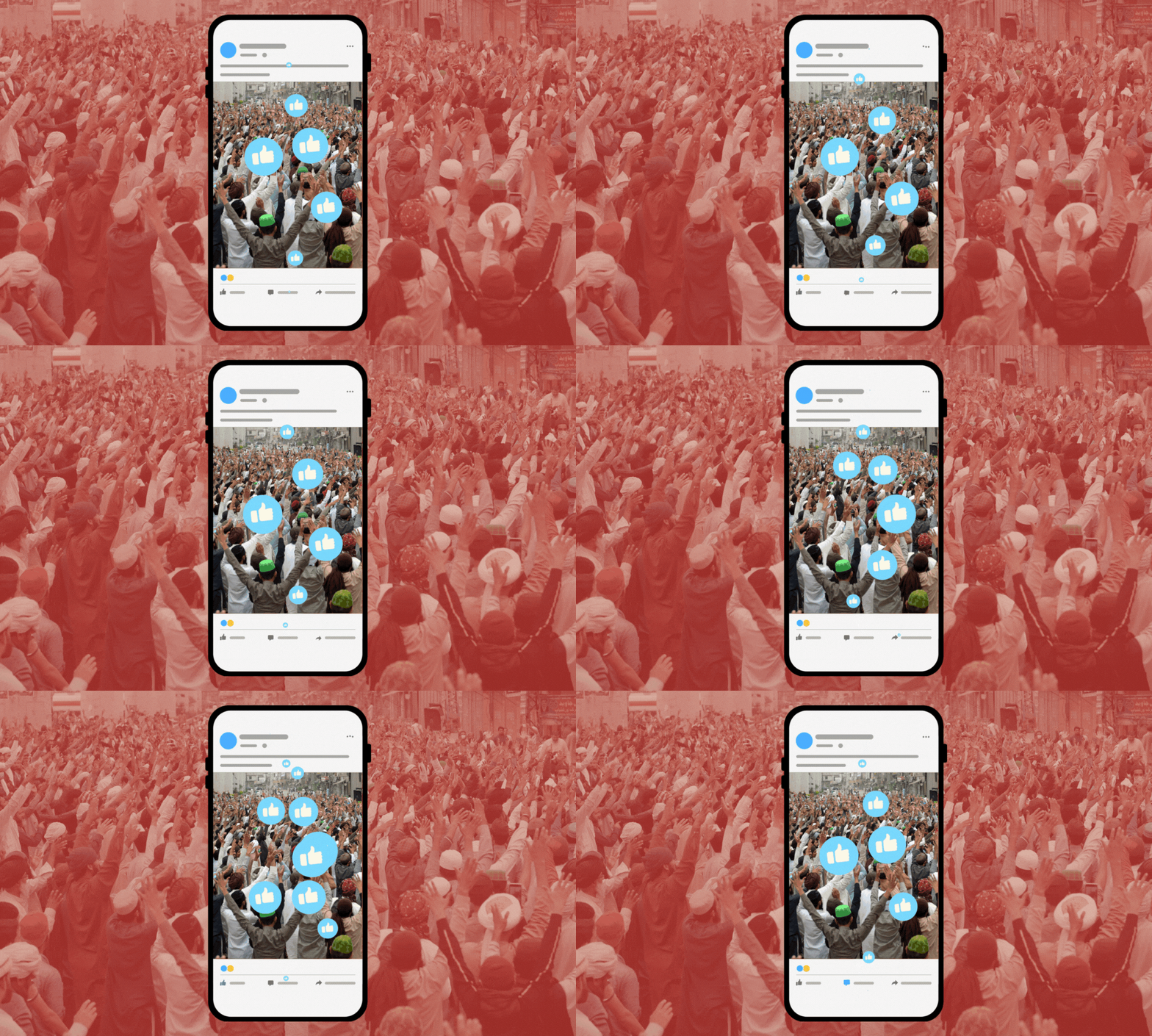
Today’s crowd forms inside a smartphone long before it appears on the street. A short video, an edited clip, a voice note, or a rumour forwarded through WhatsApp can spark movement faster than any political directive.
TikTok, Facebook, Instagram, and YouTube have become Pakistan’s real mobilisation engines. Their algorithms reward emotionally charged content — anger, outrage, victimhood, religious sentiment — and rapidly push it to millions.

When virality becomes a security threat
Having commanded almost 11,861 public order operations in Lahore — including political protests, religious marches, Muharram and Ashura processions, and Independence Day crowds — one reality has become increasingly clear: the crowd forms digitally before it forms physically. By the time the first police unit arrives at a disturbance, the emotional ignition has already occurred online.
This is not traditional mobilisation. This is algorithmic mobilisation.
A telling example is the fabricated rape alert that circulated among students of the Punjab College for Women last year. It went instantly viral, triggering the mobilisation of thousands in major cities across the province.

In another instance, in October 2025, a pro-Palestine protest near Lahore’s Press Club initially remained peaceful before turning violent following the spread of incendiary content and live clips online. What happened next was triggered by an algorithm-driven surge.
A crowd of hundreds and thousands attempted to target a sensitive building, creating a high-risk security situation. The protest was brought under control through rapid containment, controlled use of force, leadership isolation and engagement with organisers. Subsequently, critical infrastructure was secured.
Mobilisation, when it is religious, becomes even more rapid and volatile — a short sermon, a recycled clip, a video cunningly cropped to imply blasphemy. They travel at the speed of light. In several instances, painstaking negotiations built over days collapsed the moment such a clip began circulating, triggering spontaneous gatherings far beyond the anticipated scale.
Muharram and other religious events now unfold alongside a parallel digital arena that is often more combustible than the physical procession itself. During a Chehlum procession in 2024, a brief sectarian altercation occurred at Pir Makki Cut after a small group violated pre-approved procession routes. An unauthorised crossing led to verbal provocation and a minor physical confrontation.
However, context-stripped videos of the incident were rapidly amplified online, inflating the perceived threat far beyond the actual ground reality and creating the risk of wider mobilisation. The situation was ultimately contained through immediate physical separation, strict route enforcement, and negotiations with local Shia and Sunni elders, preventing an algorithm-driven digital escalation from translating into street-level disorder.
And Independence Day in Lahore revealed a new phenomenon altogether: performative disorder. Large groups (mostly young) were not motivated by politics or grievance but by visibility. Their behaviour was shaped by the possibility of going viral. Livestreams encouraged risk-taking, aggression and harassment.
Despite these shifts, Pakistan’s policing model remains rooted in assumptions that no longer hold.
Managing viral mobilisation beyond force
We still prepare for events by focusing on the number of participants, the political leadership involved, and the route. But algorithmic crowds do not follow leaders, do not mobilise gradually, and do not behave predictably. Their motivation is shaped less by ideology and more by emotion — and emotion today is engineered by digital platforms.
Simply put, our public order challenges now begin online.
If Pakistan is to manage these rapidly changing patterns of mobilisation, it must adopt a digital-first approach to public safety, which includes establishing specialised units dedicated to monitoring real-time digital sentiment, identifying viral triggers, and tracking the spread of provocative content. Safe City authorities, telecom regulators, and intelligence agencies must work together to create a unified operational picture that combines online signals with on-ground indicators.
This shift is already occurring, but primarily through a law-and-order lens. Punjab is moving to legislate a dedicated Riot Management Unit (RMU) under the Police Order (Second Amendment) Act, 2025, aimed at responding to “unlawful” protests and mobs through specialised training and equipment.
The proposed law would empower authorities to declare riot zones, cordon off areas, evacuate civilians, and provide legal cover to RMU personnel acting “in good faith”. It also seeks to hold protest organisers and instigators financially liable for damage to life and property, while expanding punitive reach through harsher penalties, including up to 10 years’ imprisonment and heavy fines for violence or vandalism during protests.
Yet, enforcement alone cannot keep pace with digitally driven mobilisation. Equally important is the use of predictive analytics and heat maps — tools that can detect when online anger is clustering around specific locations, identities, or events.
Standard operating procedures must be updated to treat digital triggers as early warning signals, not background noise. Public order units must be capable of responding within minutes, not hours, before misinformation hardens into mass mobilisation. This urgency exists within a broader security environment where the state is under constant pressure to demonstrate control.
Evolving beyond batons
Pakistan’s repeated calls for neighbouring countries to address cross-border terror concerns, alongside domestic incidents such as the killing of a key murder suspect during an Abbottabad operation, reflect an institutional climate where decisiveness is prioritised amid volatility. In such a setting, public order management risks becoming reactive and force-centric unless it is recalibrated for the digital age.
None of this means restricting speech or policing dissent. It means recognising that public order today is shaped by forces operating far faster than conventional intelligence systems were designed to handle. When a video travels faster than verification, and outrage spreads faster than reason, policing must evolve beyond batons, barricades, and after-action reports.
Pakistan is entering a period where crowds will form faster, disperse faster, and act more unpredictably than ever before. If institutions fail to adapt, the next major crisis will not begin with a political announcement or a religious sermon, but with a 12-second clip circulating on a platform engineered to reward emotion.
To preserve public safety, the state must begin by accepting a simple truth: the crowd now begins in the feed, not on the street.


