



Earlier this month, Karachi awoke once again to a tragedy that should shake any functioning society to its core. A three-year-old boy, Ibrahim, was walking along a familiar street when he slipped into a gaping manhole and never made it out. His body was recovered the next day, after a 15-hour rescue operation.
The CCTV clip many of us have now seen lasts only a few seconds, yet it’s impossible to forget: one moment he’s there; the next, he’s swallowed whole by the very city meant to protect him.
That hole didn’t open by chance. It was left yawning on a busy Karachi artery, unbarricaded, unmarked, unlit. And yet, we reach for the word “accident.” It isn’t. It’s the predictable consequence of a city abandoned to rot, theft, and overlapping jurisdictions, where the most basic promise of safety collapses under the weight of indifference.
An act of negligence, not a tragedy of nature
Karachi’s infrastructure is not just failing us; it is killing us.

In the days after the incident, officials traded blame. An internal municipal report pointed to nearby construction and commercial entities for leaving the manhole uncovered. Karachi Mayor Murtaza Wahab promised an “impartial inquiry”. The Sindh High Court (SHC) is now hearing a plea for a judicial probe. But for Ibrahim’s family, and for a city that has seen this pattern before, the real question is larger than one uncovered opening or one report.
Because this was not a freak event. Karachi is now a city where its drainage system can swallow a child whole. A city where the infrastructure meant to carry away sewage and storm water has become a standing threat to life.
Each exposed opening on the roadside represents a chain of failures: a missing or broken cover, a stolen iron lid sold as scrap, a repair job left unfinished, a complaint left unattended. Residents across Karachi know the sight all too well — a gaping hole marked by a half-broken stick, a stone, or nothing at all.
But the finger-pointing only underscores a deeper truth: Karachi’s governance is fragmented to the point of paralysis.

Responsibilities for drains, roads, footpaths, sewerage, water supply and public safety are divided among the KMC, 25 town municipal corporations, around 250 union committees, the KDA, the water and sewerage corporation, cantonment boards, the Sindh government and private utilities. The city is run by a patchwork of authorities that rarely coordinate, and often contradict one another. When everyone is partially responsible, no one is responsible at all.
A city breaking at the seams
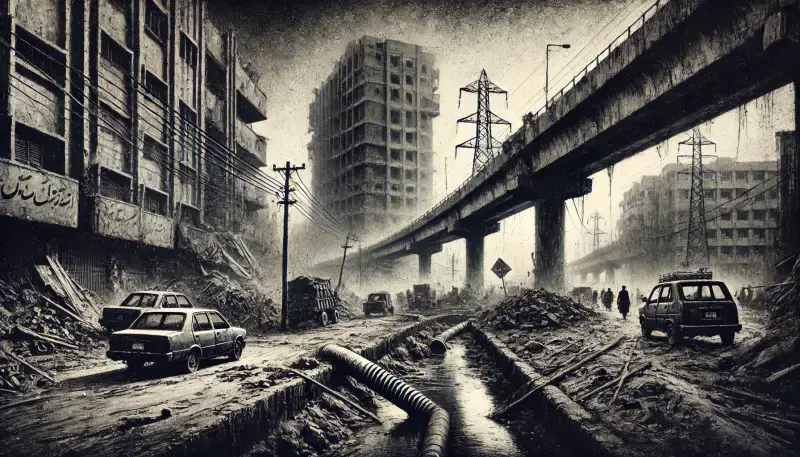
Karachi’s infrastructure is not failing in occasional bursts; it is failing constantly, everywhere, and all at once. The city’s physical systems have deteriorated to the point that no single malfunction can be understood in isolation. A collapsed sewer line, a flooded artery, a ruptured water main, a caved-in footpath — each is part of a larger story of slow, structural decay.
Roads do not simply crumble under traffic. They collapse because sewerage lines beneath them leak for months, softening the soil and hollowing out foundations. Drainage channels do not overflow only during the monsoon; they spend most of the year choked with silt, waste and debris, so that even modest rainfall pushes them past capacity. Flooded streets are not exceptional moments caused by extraordinary weather, they are predictable outcomes of systems that are clogged, fractured or altogether absent.
The sewerage network mirrors this dysfunction. Wastewater seeps into alleys not because of rare blockages but because lines rupture routinely, pumping stations falter without warning, and manholes remain damaged or partially open for weeks. In many neighbourhoods, residents have grown accustomed to laying narrow brick pathways to avoid permanent pools of sewage outside their doorsteps. Karachiites have become so practiced in navigating hazards that they can map the city’s potholes, broken manholes and flooded stretches more confidently than its public spaces and landmarks.
The water supply system suffers from the same long-term neglect. Vast volumes of water leak from corroded pipelines before they ever reach the tap. Illegal connections flourish in the absence of oversight, while legitimate consumers are forced to rely on private tankers whose costs steadily eat into household incomes. In some parts of the city, municipal water has become so irregular that entire communities no longer remember what a consistent supply feels like. Scarcity has replaced reliability as the norm.
These systems do not fail independently; they collapse together in a cycle of deterioration where each weakness accelerates the next. A leaking sewer line undermines a road; the damaged road blocks a nearby drain; the blocked drain floods a stretch of neighbourhoods; the stagnant water hides open manholes; the uncovered manholes exist because no agency has maintained them in years. Karachi’s infrastructure has become an interconnected web of fragility, where every unattended repair magnifies the pressure on the next vulnerable point.
In many cities, you move through infrastructure without a second thought. In Karachi, you move through it carefully, hoping it won’t give way beneath you.
The roads we drive on, the footpaths we step across, the drains we pass by, the water we hope to receive, each carries a hidden risk. What happened to a child at Nipa Chowrangi was not an isolated disaster or the result of a single missing cover. It was the clearest expression of a city whose built environment has been allowed to erode faster than it can be fixed, leaving its residents to carry the costs and the dangers of that neglect every day.
The cost of indifference
The danger now is not only that Karachi’s systems are failing, but that their failure has become normalised. The city continues to expand, its population continues to grow, and climate pressures intensify each year; yet the fundamental maintenance of civic infrastructure has not kept pace. Temporary fixes are stretched into permanent solutions, and permanent responsibilities are repeatedly deferred.
Karachi does not need another inquiry or another round of finger-pointing. It needs recognition, political, bureaucratic and public that the city is living through a slow-moving infrastructure crisis with profound human consequences. A crisis that will not be resolved by patchwork repairs, by reactive governance measures triggered only after tragedy, by inquiry commissions whose reports disappear, or by the press conferences and political point-scoring that substitute for action. But by sustained, coordinated and depoliticised investment in the systems that make a city safe.
Until such a shift occurs, each tragedy will expose the same vulnerabilities; each neighbourhood will continue to build its own makeshift defenses; each resident will learn to navigate hazards that should never exist.
Infrastructure is meant to protect people. In Karachi, it has become the reason people are dying.
Header image: The image is created via generative AI.


