



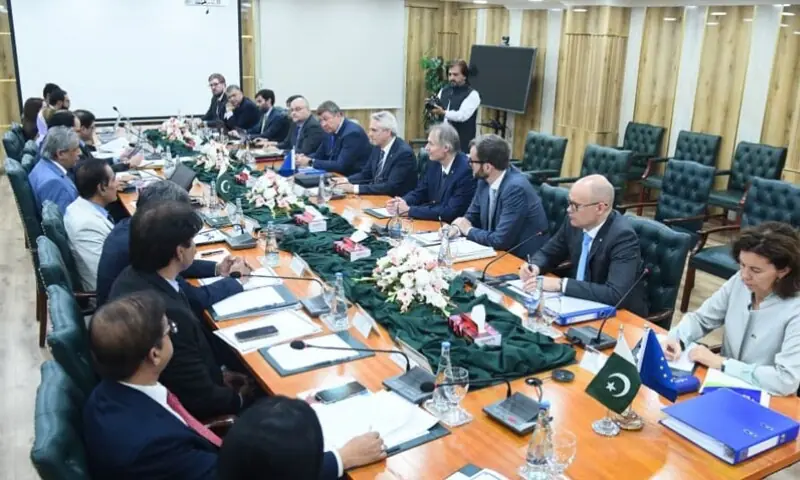
Pakistan assured the visiting European Union (EU) Monitoring Mission on Thursday of its total and complete commitment to the Generalised Scheme of Preferences Plus (GSP+).
The country was granted GSP+ status by the EU in 2014, resulting in a 108 per cent increase in Pakistani textile exports to the EU due to concessional tariffs. In October 2023, the European Parliament unanimously voted to extend the GSP+ status for another four years until 2027 for developing countries, including Pakistan.
A seven-member EU delegation is currently visiting Karachi as part of the fifth Biennial Review of the GSP+ scheme. It is led by Sirgio Baliberia, adviser to the GSP+ Directorate in the Directorate General for Trade. The monitoring mission will scrutinise Pakistan’s record on 27 international conventions tied to the trade scheme. Maintaining GSP+ status is critical for Pakistan to keep export costs low.
A press release issued by the human rights ministry today said Human Rights and Law Minister Azam Nazeer Tarar welcomed the delegation at its headquarters today.

“Pakistan reaffirmed its strong commitment to the GSP+ framework, emphasising that the Pakistan–EU partnership remains central to governance reforms, institutional strengthening, and sustainable development. As one of the largest beneficiaries of GSP+, Pakistan highlighted the programme’s role in advancing human-rights protections and aligning domestic legislation with international standards,” the press release said.

The delegation was briefed on “significant legislative and policy progress” since 2014, including strengthened protective mechanisms for women, children, labour, marginalised groups and people with disabilities.
The Pakistani side reaffirmed its commitment to uphold human rights despite “challenges posed by counter-terrorism and climate change” and institutional advancements were highlighted with the retention of the National Commission for Human Rights’ “A” status under the Global Alliance of National Human Rights Institutions and the continued independent functioning of the National Commission on the Rights of Child (NCRC) and the National Commission on the Status of Women.

The delegation was also informed that implementation of the National Action Plans on Human Rights and Business and Human Rights was ongoing at the federal and provincial levels.
It was also briefed on key initiatives promoting gender equality, including the National Gender Policy Framework (2022), gender-responsive budgeting and provincial measures.
“Flagship programmes such as the Benazir Income Support Programme, benefiting over 9.1 million women and the Prime Minister’s Women Empowerment Package were highlighted as major drivers of women’s socio-economic inclusion.
“Progress on child rights was emphasised, including the establishment of NCRC, Zainab Alert, Response and Recovery Agency and Child Protection Institutes, alongside recent child marriage restraint legislation. Efforts continue to address child labour, online exploitation and out-of-school children,” the press release said.
The Pakistani side further reaffirmed its commitment to freedom of expression and media safety, supported by the National Commission for Protection of Journalists and Media Professionals, and provided updates on sensitive human-rights measures, including reductions in capital offences, implementation of the Mercy Petition Policy, enforcement of the Torture and Custodial Death Act and an over 85 per cent resolution of cases by the Commission of Inquiry on Enforced Disappearances.
Tarar also underlined the country’s “robust constitutional and legal safeguards”, noting Pakistan’s recent election to the UN Human Rights Council as a “testament to the international community’s confidence in its constructive role”.
The press release pointed out that the delegation highlighted “certain areas for further attention” regarding human rights in the country and key issues requiring government action, including the need for strengthened policies, legislation, and robust institutions to effectively fulfil Pakistan’s obligations under the 27 core United Nations conventions.
“The minister reassured the delegation that the government of Pakistan remains fully committed to these obligations and noted that progress achieved to date, ongoing challenges, and future plans would be shared in detail during the delegation’s ongoing visit.
“The minister welcomed the EU’s constructive suggestions on enhancing data integration, inter-provincial coordination, treaty reporting and implementation mechanisms. Pakistan has taken these points on board and is advancing progress through strengthened reporting, provincial engagement and robust monitoring,” it said.
The press release concluded by saying that the ministry officials also commended ongoing EU-Pakistan cooperation under the Huqooq-i-Pakistan Project and reaffirmed its commitment to sustaining GSP+ progress, advancing human rights and promoting an inclusive, rights-based, and sustainable future.
GSP+ status is a special incentive awarded to developing countries to “pursue sustainable development and good governance” in exchange for cutting import duties to zero on two-thirds of the tariff lines of its exports. Governments with this status need to implement 27 international conventions on human rights, labour rights, good governance and the environment.
Pakistan and the EU underlined the importance last week of further deepening trade and investment ties, including through the GSP+ scheme, as a driver for sustainable growth, export diversification, job creation and mutually beneficial economic opportunity.
Earlier that week, EU Ambassador to Pakistan Raimundas Karoblis had said the country needed to “do more” in terms of fulfilling its commitments under the GSP+ scheme ahead of a review.
