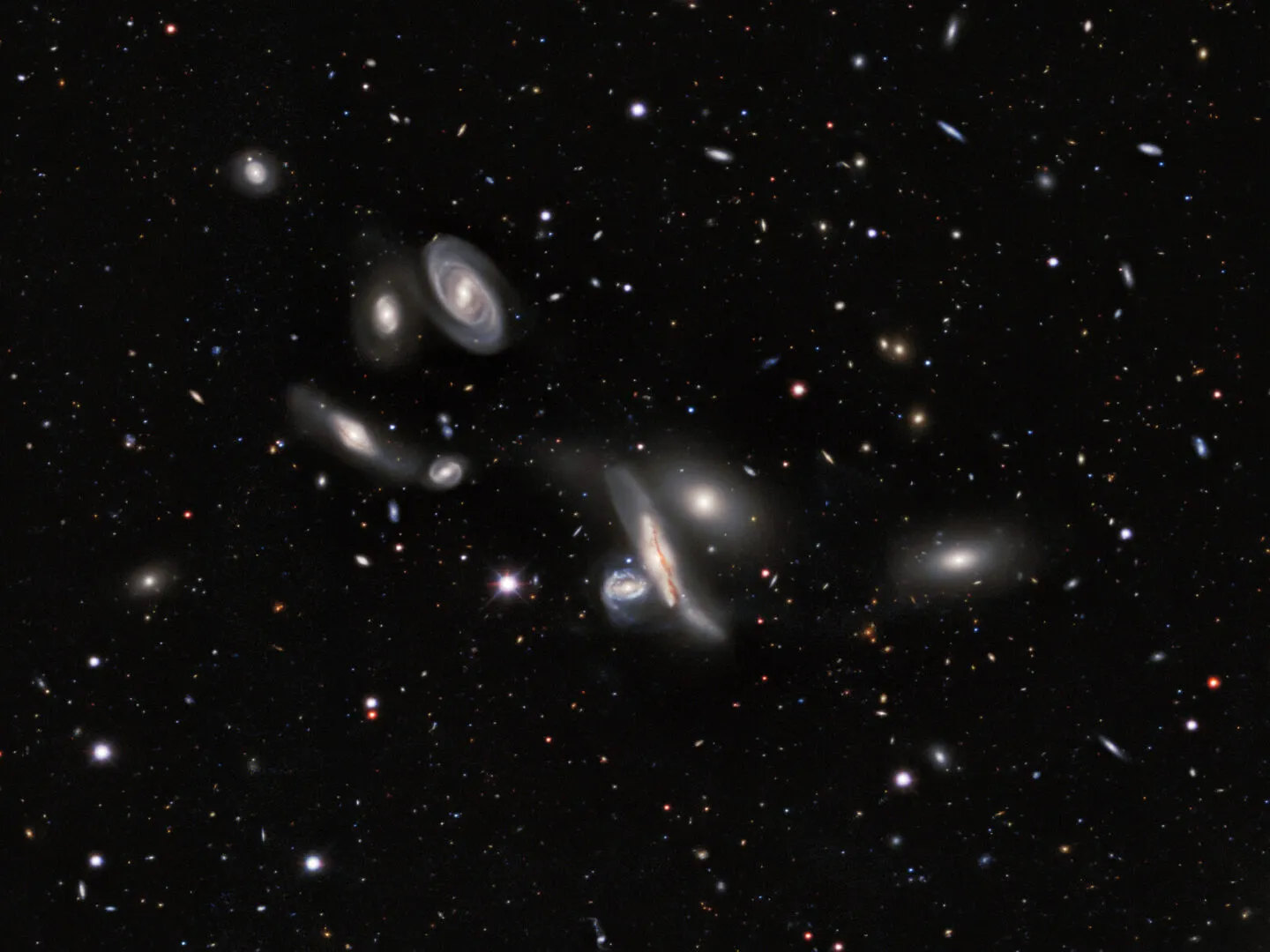


The DESI Legacy Imaging Surveys team has released the largest 2D color map of the universe ever created. The map contains 5.6 trillion pixels and nearly 4 billion celestial objects, mainly stars and galaxies. The data is available to everyone and can be viewed publicly through the Legacy Survey Sky Viewer.
Astronomers and citizen scientists can use the map to explore space or combine it with their own observations to learn more about the universe. Researchers can also use it to search for rare phenomena such as gravitational lenses, study short-lived events such as supernovae and investigate two major mysteries in physics: dark matter, the invisible material that accounts for most of the mass in the universe, and dark energy, which is driving the universe’s accelerating expansion.
The new map is an updated version of earlier maps created by the DESI Legacy Imaging Surveys. Those maps have already become an important resource for scientists, with more than 1,800 research papers referencing Legacy Surveys data published so far.

“It’s part of the fabric of astronomy research now,” said David Schlegel, a co-lead of the Legacy Surveys and a scientist at the Department of Energy’s Lawrence Berkeley National Laboratory. He said astronomers often begin their work by using the Legacy Imaging Viewer to understand what they are seeing.

The updated map covers about 75% of the sky in visible and near-infrared light. It provides a detailed view of the universe beyond the Milky Way while avoiding areas obscured by dust and stars in our galaxy. Researchers expect the map to remain the most comprehensive 2D view of the universe for years.
More than 160 scientists helped collect data for the project, while a team of 20 researchers produced the final dataset. The map combines 263,407 telescope exposures from three ground-based surveys: the Dark Energy Camera Legacy Survey (DECaLS) at NSF Cerro Tololo Inter-American Observatory, the Mayall z-band Legacy Survey (MzLS) at NSF Kitt Peak National Observatory and the Beijing-Arizona Sky Survey (BASS) at the University of Arizona’s Steward Observatory.

The project also includes years of data from NASA’s Wide-field Infrared Survey Explorer (WISE) satellite mission, along with other publicly available data.
“For our team, these data are fundamental to our investigation of the expansion history of the universe and the formation of our galaxy,” said Arjun Dey, co-lead of the Legacy Surveys and an astronomer at NSF NOIRLab.
Dey added that the sky belongs to everyone and said the survey gives people around the world an opportunity to explore space and appreciate its wonders.