



PUBLISHED
August 02, 2026
“Israel is Fatherland, and India is Motherland.”
This line from Indian Prime Minister Narendra Modi’s February 2026 speech at the Israeli parliament, the Knesset, did more than raise eyebrows. It sparked a debate about identity, ideology, and the direction of India’s foreign policy.
Critics were quick to seize on the phrase, calling it diplomatically awkward, unnecessary, and even revealing. For them, it wasn’t rhetorical flourish but ideological signaling — an attempt, they argue, to cultivate a civilisational affinity between India and Israel.

As the debate heated up, opposition leaders jumped into the fray. Congress MP Rajiv Shukla accused Modi of “lowering the standard of public discourse.” He said the speech marked a departure from India’s traditional foreign policy. Fellow Congress leader Pawan Khera was more scathing. He said Modi’s style of diplomacy has invited “ridicule on the international stage.”

Supporters, however, dismissed the outrage as semantic overreach. They argued the remark was purely metaphorical — a rhetorical gesture meant to convey diplomatic warmth.
But to reduce the debate to mere wordplay is to miss the larger point.

Shared ideology
Modi’s remark wasn’t an isolated slip or a rhetorical device. It was an instinctive expression of a shared worldview. The Indian prime minister and his Israeli counterpart Benjamin Netanyahu have several similarities. The most striking is their strong ideological alignment characterised by racial supremacism, ruthless state control, and expansionist geopolitical ambitions. Modi’s approach in occupied Kashmir mirrors the strategy long employed by Israel in the occupied Palestinian territories.
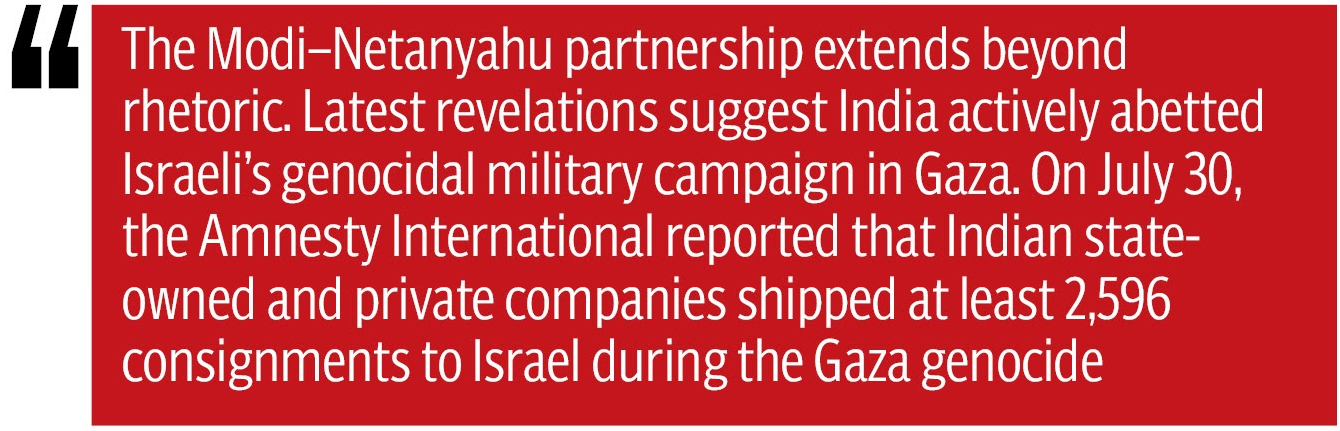
“The Modi-Netanyahu bonhomie is shaped by three factors: a shared strongman affinity, overlapping strategic interests, particularly in countering Pakistan, and a broader geopolitical alignment. And this alignment acts as a collective pivot against Muslim populations regionally and globally, reflecting both leaders’ policies and ideological orientations,” says security and defence analyst Maj Gen (retd) Inam Ul Haq.
4Deepening ties
Modi’s Knesset speech left little doubt. He received several standing ovations from MPs and later accepted the “Speaker of the Knesset Medal”, Israel’s highest parliamentary honour. It was a powerful display of the increasingly close relationship between New Delhi and Tel Aviv — or, more precisely, between Modi and Netanyahu.
The unprecedented diplomatic sojourn marked a clear departure from India’s traditional policy of supporting the Palestinian cause and their right to statehood.
“We are looking at two aspects: a strong personal bond between Narendra Modi and Benjamin Netanyahu marked by shared views, and an India-Israel partnership. Traditionally balanced between Israel and Palestine, India signalled a shift under Modi — evident in his Israel visit which skipped a Ramallah stopover, indicating a clear tilt. Ties have since evolved into a ‘special strategic partnership,’ covering defence, economic, and agricultural cooperation,” says former ambassador Sardar Masood Khan.
Strategic misstep
Tellingly, Modi’s visit to Tel Aviv came just 48 hours before the US-Israel war on Iran began. While Delhi downplayed it as mere coincidence, analysts questioned the timing.
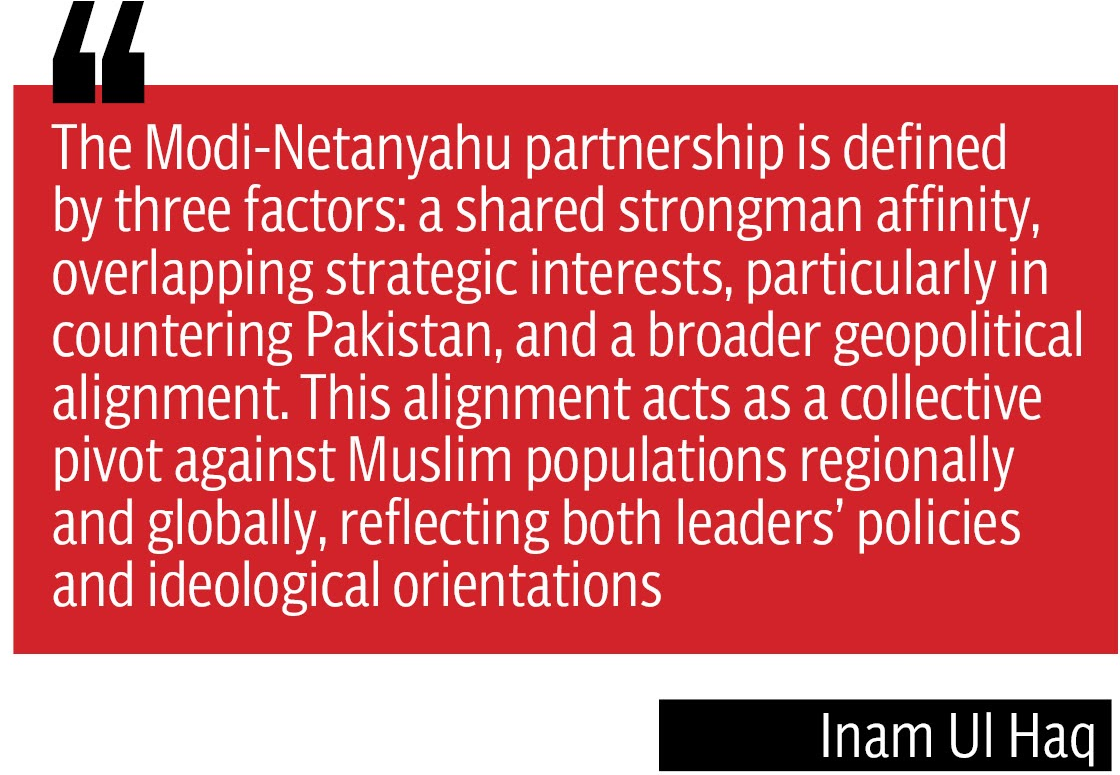
“When the United States and Israel attacked Iran 48 hours after Modi’s visit, he likely expected an easy victory and calculated that closer ties with Israel would yield strategic gains,” says air commodore (retd) Khalid Chishti. “However, this turned out to be a miscalculation, as the resolve and resilience of the Iranian people were underestimated, straining Iran’s long-standing ties with India.”
The India-Israel ties have not always been this close. For decades, Delhi strongly backed Palestine. It opposed the 1947 UN partition plan, recognised the PLO in 1974, and the state of Palestine in 1988. While Delhi recognised Israel in 1950, full diplomatic relations began only in 1992 and remained low-key for years. However, by October 27, 2023, India indicated a shift, abstaining from a UN resolution calling for a humanitarian truce in Gaza.
Breaking tradition
“Historically, Indian leaders had resisted external pressure to back controversial wars. Indira Gandhi declined to support the US during the Vietnam war, and Atal Bihari Vajpayee refused to endorse the 2003 US-led invasion of Iraq, both calling them unjustified,” says Chishti.
“India maintained steady support for Palestine, from recognising the PLO under Yasser Arafat to backing the Oslo Accords (1993-95), which promised a two-state solution,” he adds. “However, the current leadership appears to signal a shift. During his Tel Aviv visit, Modi said, ‘the pain of Israelis is the pain of Indians,’ a statement that reflects a move away from India’s balanced position on Palestine.”
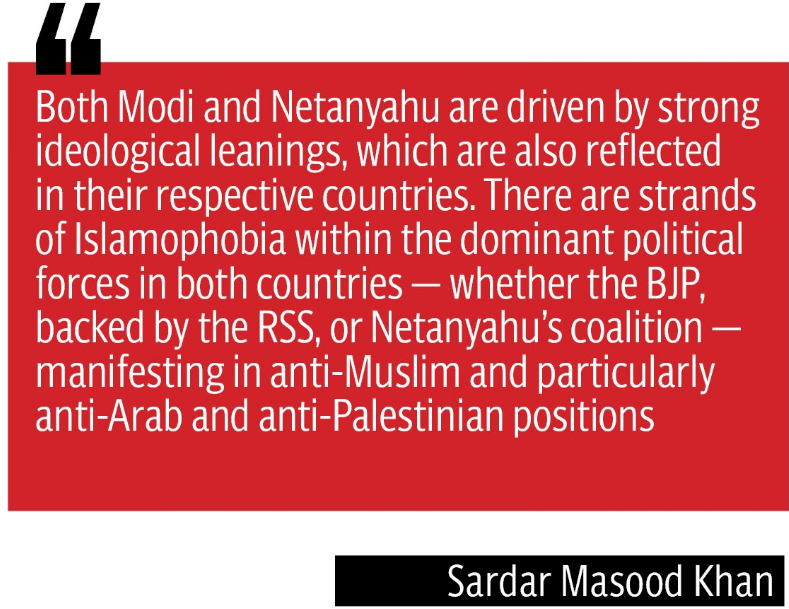
A recent report laid bare the scale of the partnership between the two countries. Released by Amnesty International last week, the report suggested that India had actively abetted Israel’s genocidal military campaign in Gaza. Indian state-owned and private companies shipped at least 2,596 consignments to Israel during the conflict, the report states. The shipments — sent between 7 October 2023 and 30 November 2025 — included machine-gun components, 155mm high-explosive artillery shells supplied to Elbit Systems, explosive warheads for SkyStriker “kamikaze” drones, and armoured vehicle components destined for major suppliers to the Israeli military.
Expansionist visions
What has driven this radical shift in India’s policy on the Palestinian-Israeli conflict? Analysts point to the supremacist and exclusionary ideologies of Modi and Netanyahu. “The current tilt towards Israel appears driven largely by the BJP’s ideological orientation and the influence of the RSS,” says Inam.
Khan agrees, but places more stress on their shared expansionist ambitions.
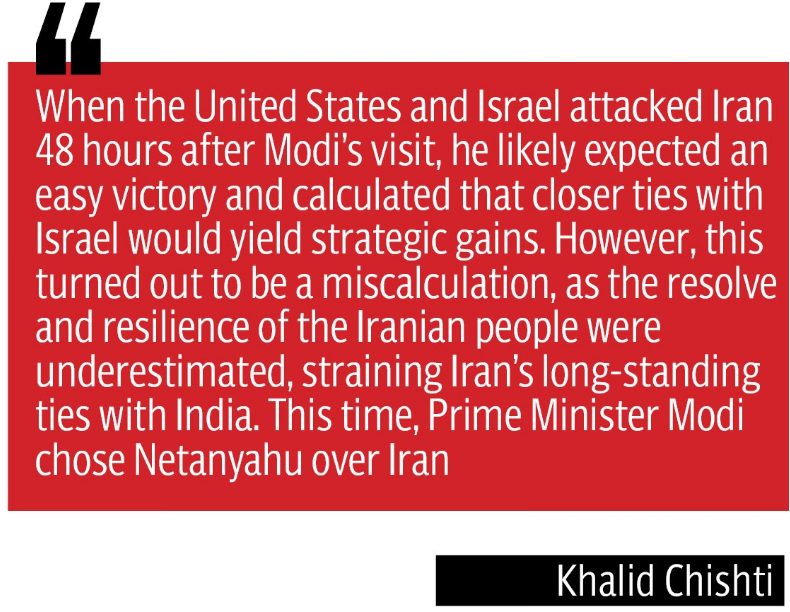
“I think both Modi and Netanyahu are driven by strong ideological leanings, which are also reflected in their respective countries. There are strands of Islamophobia within the dominant political forces in both countries — whether the BJP, backed by the RSS, or Netanyahu’s coalition — manifesting in anti-Muslim and particularly anti-Arab and anti-Palestinian positions,” he says.
“Beyond this, both are influenced by expansionist or irredentist ideas, such as ‘Akhand Bharat’ in India and ‘Greater Israel.’ These shared ideological roots and ambitions bring the two countries closer.”
Modi’s India has increasingly adopted the “Israeli playbook.” Its spy agency, RAW, has carried out extrajudicial killings on foreign soil. Security forces have imposed collective punishment in occupied Kashmir, while the government has pursued demographic changes by settling non-locals in the disputed region. These actions mirror Israel’s approach under Netanyahu, particularly Mossad-linked assassinations in Iran and the expansion of illegal settlements in the occupied West Bank.
Kashmir-Gaza parallel
“There are strong parallels between Palestine and Kashmir. Both disputes date back to 1948 and remain unresolved, with neither population having exercised its right to self-determination — blocked, respectively, by Israel and India. In both cases, we see militarisation, settler-colonial practices, and widespread human suffering,” says ambassador Masood Khan, who has also served as the President of Azad Jammu and Kashmir.
He argues that the revocation of Kashmir’s constitutional autonomy by the Modi administration in August 2019 and subsequent attempts at demographic changes reflect Israel’s actions in the occupied Palestinian territories, including large-scale violence and expanding settlements.
Inam, meanwhile, says the conflicts are historically similar but differ in objectives and dynamics. “In Gaza, Israel is widely seen as entrenching control while resisting a two-state solution and exerting pressure that could displace Palestinians. In Kashmir, India, particularly after revoking Article 370, has moved to integrate the region more fully into the Union, altering its demographic and political landscape,” he adds.
Defence ties
Under Modi, the Tel Aviv-Delhi relationship has evolved into a multifaceted alliance covering defence, intelligence, technology, and political coordination. Israel has emerged as one of India’s key defence suppliers, providing advanced military technologies that, according to analysts, have enhanced its operational capabilities, particularly in sensitive regions like Kashmir.
“Historically, India has lagged behind Pakistan in drone and surveillance capabilities, triggering criticism from retired Indian military officials after the events of May 2025. Since then, Israel has supplied India with platforms such as the IAI Harpy drones and related technologies,” Chishti says referring to last year’s brief military confrontation between Pakistan and India.
Drone warfare
Intelligence-sharing and joint strategic planning have also become important components of their defence relationship. “During the May 7-9 hostilities, Indian drones reportedly entered Pakistan and struck select targets — operations that, according to some assessments, may have involved active Israeli support. These systems combine strike capability with surveillance, mapping, intelligence gathering and communications monitoring, and are increasingly being used by India to enhance operational awareness, particularly in Kashmir.”
Echoing Chishti, Inam says defence cooperation between the two countries also includes advisory support and joint production. He cites recent reports that point to Israeli advisory input during Operation Sindoor, alongside a wider strategic partnership focused on defence manufacturing.
The two countries jointly produce key systems, including UAVs and missile platforms such as the Barak-8, with collaboration between entities like DRDO, Israel Aerospace Industries, Hindustan Aeronautics Limited, and private firms, including Adani Group and Elbit Systems. They also cooperate on systems like AWACS and the SPYDER air defence platform.
“India remains the largest buyer of Israeli military hardware, with defence imports reaching nearly $3.9 billion in 2025-26, alongside ongoing technology transfer and joint development programmes. Cooperation further extends to cyber capabilities, with initiatives such as a joint centre of excellence for cyber warfare,” adds Inam.
Destabilising impact
Analysts warn that the deepening Modi-Netanyahu partnership could prove destabilising not only for their respective regions but also for the wider world, citing their exclusionary ideologies, disregard for international law and expansionist agendas.
“Not just in South Asia, but in the broader Asia-Pacific region, India has been a destabilising factor. Israel too operates through a kind of anarchy and disorder in its neighbourhood. It divides nations and has made examples of countries such as Syria, Libya, and Tunisia. At its instigation, the United States attacked Iraq and has also fought a prolonged war in Syria,” says Khan. “Both countries, therefore, are contributing to regional instability and are becoming increasingly isolated in their neighbourhoods.”
 Pakistan factor
In South Asia, Indian and Israeli strategic interests also converge, as both view Pakistan as an adversary. Delhi faced humiliation in the May 2025 conflict with Pakistan, while Tel Aviv has become growingly isolated over its Gaza campaign. And this has brought the two countries even closer. At the same time, Pakistan has gained international relevance through its mediation in the ongoing Iran-United States conflict, showing its ability to contribute to regional stability and facilitate dialogue.
“I believe India has not accepted this shift, which is contributing to closer India-Israel ties and to efforts to destabilise Pakistan through proxies and militant activity, particularly in Khyber-Pakhtunkhwa and Balochistan,” Chishti says, referring to the latest surge in terrorist violence in the two volatile provinces.
Some analysts, however, do not see the Modi-Netanyahu partnership lasting long, given India’s demographic diversity, communal tensions, and a huge Muslim minority. They believe much will depend on the next elections in both countries — Israel’s scheduled for September 2026 and India’s in 2029.
“India has de-hyphenated Israel from the Palestine issue, but this policy may not be sustainable in the long run given the country’s internal ethnic diversity and sizable Muslim population,” says Inam. “The ideological affinity between the BJP and Israel is also unlikely to endure, as it continues to draw criticism for both Israel and its principal supporter, the United States. Overall, I feel this approach runs against the broader grain of Indian politics and may not support a lasting alignment with Israel.”
Global concerns
Experts argue that ideological alignment, majoritarian political narratives — Hindu nationalism in India and Zionist nationalism in Israel — apartheid treatment of Muslim minorities, and demographic changes in disputed regions, cannot be mere coincidence. This growing convergence of strategic interests and racial superiority-based ideologies has raised alarm globally.
Human rights organisations, including Amnesty International, Human Rights Watch, and Genocide Watch, along with international observers, have drawn comparisons between Kashmir and Gaza. Critics argue that these parallels point to broader concerns about governance, human rights and the treatment of civilian populations in the two territories. Proponents, however, claim the India-Israel partnership is rooted in shared strategic interests amid growing global volatility, rather than ideology.
The trajectory of India-Israel ties reflects a complex interplay of strategic interests, ideological affinities, and evolving geopolitical realignments. While the partnership has yielded tangible outcomes in defence and technology, it has also drawn criticism over the exclusionary and expansionist ideologies of Modi and Netanyahu, as well as its broader implications for regional stability. Whether this alignment endures will depend not only on leadership choices but also on domestic political dynamics and international pressures.


