


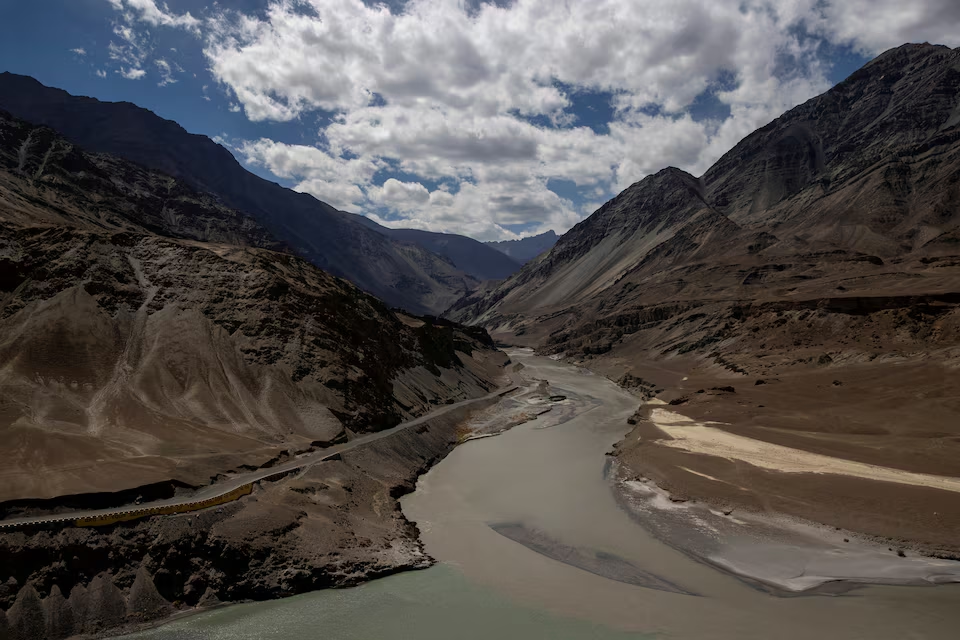
FOR more than sixty-five years, the Indus Waters Treaty (IWT) has stood as one of the world’s renowned, most enduring and successful transboundary water-course division arrangements between two nation states.
Beyond its legal and international significance, it has also been the cornerstone of Pakistan’s water resources development.
The certainty and predictability of flows provided by the treaty enabled Pakistan to develop the Indus Basin Irrigation System (IBIS); the world’s largest contiguous irrigation system, comprising three major reservoirs, six barrages, twelve inter-river link canals and an extensive distribution network that irrigates nearly 35 million acres and supports more than 90 per cent of the country’s food production.
Pakistan’s hydropower system, irrigated agriculture and much of its economic development have evolved on the foundation of uninterrupted and predictable flows from the western rivers. The treaty has also contributed significantly in the overall strategic stability of South Asia.

While the world looks to strengthen governance and transparency on shared river basins in pursuit of the ‘One Water-One Vision’ principle, India is moving entirely in the opposite direction

That strategic stability was fundamentally challenged in May 2025, when India illegally and unilaterally announced that it was holding the IWT in abeyance. The Indian move is being increasingly categorised as blatant violation of its binding treaty obligations, and international law.
In the recently concluded Water Convention under UN arrangements at Geneva, nation states have been asked to strengthen governance and transparency on shared river basins in pursuit of the “One Water-One Vision” principle.

India, on the contrary, is moving entirely in the opposite direction.
Regardless of the legal debate concerning the Indian decision, its strategic consequences for Pakistan are very serious. It marks a departure from more than six decades of treaty-based water cooperation and introduces uncertainty into a river system that guarantees Pakistan’s water, food and energy security.
Since May 2025, India has continued to accelerate the development of upstream infrastructure on the western rivers, while inviting bids for fast-track implementation of additional projects, including the planned expansion of Ranbir Canal and the Chenab-Beas Link Tunnel.
Considered collectively, these developments can severely threaten Pakistan’s long-term water security.
India has also suspended sharing of hydrological data for the Western Rivers with Pakistan’s Commissioner for Indus Waters, contrary to the data-sharing obligations envisaged under the IWT. During the 2025 flood season, the absence of timely river flow information adversely affected Pakistan’s flood forecasting and emergency preparedness, increasing risks to human life, critical infrastructure, and livelihoods.
Such actions are inconsistent with humanitarian principles, undermine international water-course cooperation and violate the fundamental objective of safeguarding populations from transboundary flood hazards. Moreover, Indian actions limit Pakistan’s ability of realising Sustainable Development Goals (SDGs) 6.5, 6.5.1 and 6.5.2, which are globally shared objectives.
As a lower riparian state, Pakistan’s irrigation system, reservoirs, agriculture, growing population, and industrial development depend heavily on reliable and predictable river flows originating upstream. Any uncertainty in the quantity or timing of these flows presents a strategic challenge that extends far beyond conventional water management, directly affecting national water, food, energy, environmental, and economic security.
The geographical configuration of Indus Basin makes the reliability and predictability of flows in Chenab River indispensable for safe and efficient operation of IBIS. The non-availability of river flow data from upstream significantly weakens Pakistan’s ability to regulate canal diversions, manage floods, and issue timely warnings. In the event of extreme hydrological conditions, the absence of such information can endanger human lives, damage critical infrastructure, and increase economic losses.
Pakistan’s concern is frequently misunderstood: neither is it based upon any single dam, hydropower project or engineering structure, nor is it confined to the annual volume of water received under the Treaty.
The emerging challenge is the cumulative capability created by multiple upstream projects to increasingly regulate the quantity, timing and predictability of flows entering Pakistan. For a lower riparian country whose irrigation system, depends upon reliable river flows, this represents an existential challenge that extends well beyond conventional water management. Among the western rivers, Chenab occupies a uniquely critical position.
Carrying an average annual flow of 25 million acre-feet (MAF) at Marala, it irrigates nearly 10 million acres through the Marala, Khanki, Qadirabad, Trimmu and Punjnad Barrages. These command areas constitute one of Pakistan’s most productive agricultural regions, contributing significantly to national production of wheat, rice, sugarcane and other strategic crops while supporting millions of rural livelihoods.
More importantly, the River Chenab forms an integral and vital component of the interconnected Indus Basin Irrigation System. Reservoirs, barrages, link canals and irrigation canals across the basin operate as one coordinated hydraulic network. Consequently, any sustained alteration in the quantity or timing of Chenab flows extends well beyond its immediate command area, influencing canal regulation and irrigation supplies across the wider basin.
The strategic significance of Chenab is further amplified by geography. Almost the entire catchment of this river lies upstream in India before it enters Pakistan at Marala. Unlike rivers receiving substantial downstream tributary inflows, Pakistan has limited capacity to offset prolonged upstream regulation through additional local runoff. This geographical reality makes the reliability and predictability of Chenab flows indispensable for maintaining the operational stability of the Indus Basin Irrigation System.
Until recently, the technical debate had focused primarily on whether individual Indian projects are within the engineering criteria of Indus Waters Treaty, or otherwise. While that scrutiny remains important, it no longer captures the broader strategic picture.
Following India’s decision to hold the treaty in abeyance, Pakistan’s concern has shifted from individual projects to the cumulative impact of multiple upstream interventions operating together.
Technical assessments indicate that existing operational projects already provide India with the capability to regulate Chenab flows over significant periods during the year. As projects presently under construction become operational, this capability is expected to increase substantially.
Diversion works, including the planned expansion of the Ranbir Canal and Chenab–Beas Link Tunnel, would further enhance this capability, particularly during the lean-flow months when Pakistan’s dependence on the Chenab is greatest. The implications for Pakistan are more serious than a limited military conflict with India.
The strategic challenge confronting Pakistan demands a response that is comprehensive, forward looking and implemented through a whole-of-the-nation approach. This is not a moment for rhetoric; it is a moment for national resolve, sound diplomacy and accelerated development.
Pakistan’s response must rest on three mutually reinforcing pillars: diplomatic engagement, legal action and strategic water development.
Firstly, Pakistan should continue to pursue all available diplomatic avenues to preserve the integrity of the Indus Waters Treaty. The Permanent Indus Commission must remain the principal platform for technical dialogue, information exchange and resolution of emerging issues.
Simultaneously, Pakistan should actively engage the World Bank, friendly countries and the broader international community to reinforce the importance of honoring international treaty obligations.
The credibility of international agreements depends not merely on the negotiation process but on faithful implementation of each clause particularly the treaties recognised internationally. Hence, Indian actions have to be viewed by international community seriously as these carry dangerous potential for jeopardizing regional peace.
Secondly, Pakistan should continue to safeguard its rights through the legal mechanisms provided under the Indus Waters Treaty and applicable principles of international law. The treaty has governed one of the world’s largest transboundary river systems for more than six decades because it established clearly defined rights, obligations and dispute resolution procedures.
These mechanisms must continue to serve as the primary means of addressing differences. A rules-based approach remains indispensable for maintaining confidence in international water governance and regional stability.
Thirdly, Pakistan must significantly accelerate the development of its own water resources. Diplomacy and legal processes are essential, but they cannot substitute for national preparedness. The Planning Commission of Pakistan has established promising targets for the next decade to strengthen Pakistan’s water security.
These include increasing national strategic water storage capacity from 13.5 MAF to 23.5 MAF, enhancing water availability at farm gates from 64 MAF to 84 MAF, and improving overall irrigation water-use efficiency from approximately 40pc to 70pc. Achieving these targets will require sustained investments in storage infrastructure, irrigation modernization, watershed management, and institutional reforms.
Timely completion of the Diamer-Basha dam, Mohmand dam, the Dasu Hydropower Project and Tarbela’s fifth extension must remain national priorities to increase storage, improve flood regulation and expand clean hydropower generation.
Similarly, projects such as the Mangla–Marala Link Canal, Sindh Barrage, Chashma Right-Bank Canal, Kachhi Canal, the K-IV Water Supply Project and the proposed Chenab Cascade projects should be expedited through broader national consensus to enhance operational flexibility, irrigation efficiency and drought resilience.
These projects are no longer simply development initiatives; these are strategic investments in Pakistan’s long-term water, food and energy security.
The debate over the construction of large dams in Pakistan may continue; however, the hydrological realities of Indus Basin are unequivocal. Approximately 84pc of the country’s annual river flows occur within only three to four months, while the remaining 16pc is distributed over the other eight to nine months of the year. This pronounced seasonal variability makes adequate water storage indispensable for ensuring sustainable water supplies, strengthening food security, enhancing energy generation, mitigating floods, and improving resilience to climate change.
Under Pakistan’s current leadership, a historic breakthrough has been achieved in the form of national consensus on cost sharing for water security projects. For the first time since independence, provinces have collectively agreed to support development of strategic water storage infrastructure and have agreed to contribute financially towards the implementation of these nationally vital projects. This consensus marks a major milestone in fast tracking ongoing and future water and energy sector projects.
The Tarbela and Mangla dams were constructed at an approximate cost of $2 billion each (excluding subsequent raising and rehabilitation investments). Since commissioning, these strategic national assets have generated extraordinary economic benefits through irrigation, hydropower production, flood mitigation, and water regulation.
Based on World Bank estimates, Tarbela Dam has contributed economic benefits exceeding $460 billion, while Mangla Dam has generated benefits exceeding $301 billion, making them among the most economically productive infrastructure investments in Pakistan’s history.
Pakistan must also modernise the management of Indus Basin system through real-time telemetry, satellite-based monitoring, artificial intelligence, advanced hydrological forecasting and integrated basin modelling.
In an era where upstream regulation capability is expanding, timely and reliable information has become as important as physical infrastructure. Scientific water management and data-driven decision-making must become central components of Pakistan’s national water strategy.
Pakistan’s response must be guided by confidence rather than complacency. The country should continue to defend the treaty through diplomacy, technical engagement and international law, with the firm expectation that India will have to return to its obligations under the treaty, while sustaining its long-standing national requirement of investing in strategic water infrastructure, expanding storage capacity, improving irrigation efficiency and adopting modern technologies for basin management.
The Indus Waters Treaty has endured because it recognised a fundamental principle: the sustainable management of trans-boundary rivers is essential for peace, stability and shared prosperity. Preserving the treaty’s faithful implementation is, therefore, not merely a legal obligation; it is indispensable for safeguarding Pakistan’s water, food and energy security.
History will judge our generation not by the challenges it inherited, but by whether or not it had the vision, unity and resolve to secure water for Pakistan’s rapidly growing future needs.
The writer is currently serving as chairman of the Water and Power Development Authority.
This article was published in the July 6 and 7 editions of the paper as a two-part series. Both parts have been reproduced above for the convenience of our readers.
