



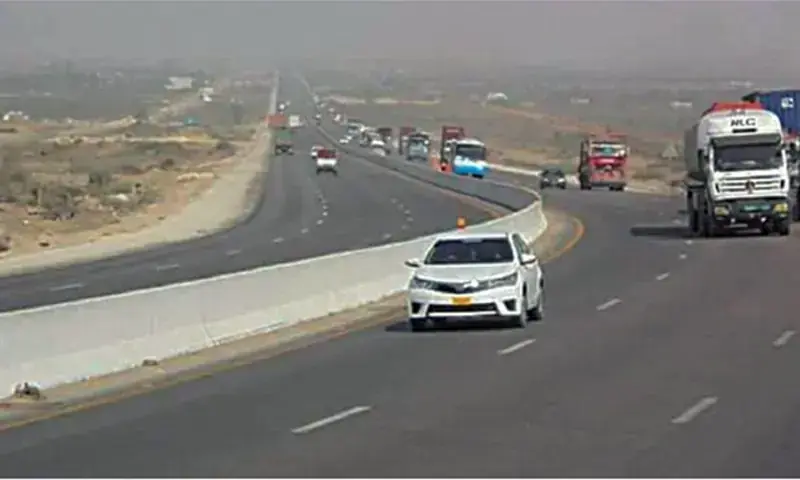
ISLAMABAD: The multi-billion-rupee Sukkur-Hyderabad Motorway (M-6) project, the construction of which is scheduled to begin in the current fiscal year, has been split into five sections.
This was revealed during a meeting of the National Assembly Standing Committee on Communications on Friday, chaired by its chairman, Aijaz Hussain Jakhrani.
Reviewing the latest progress on the M-6 project, the committee was informed that the project comprises five sections: Hyderabad–Tando Adam, Tando Adam–Nawabshah, Nawabshah–Naushahro Feroze, Naushahro Feroze–Ranipur, and Ranipur–Sukkur.
The project has already been delayed by more than five years due to several factors.

The committee was informed that Rs30 billion had been allocated in the current financial year against a total requirement of Rs70 billion.

The committee was informed that Sections I and II would be executed under the public-private partnership (PPP) model, Sections IV and V through financing from the Islamic Development Bank, and Section III through financing from the OPEC Fund.
The Ministry of Communications also briefed the committee on the expected commencement schedule and the progress of each section.

The committee also reviewed its previous recommendations concerning the Public Sector Development Programme (PSDP) schemes.
The committee was informed that, out of the total PSDP outlay of Rs3.7 trillion, approximately Rs2.6 trillion comprised throw-forward schemes. It was further informed that around Rs60 billion allocated to the National Highway Authority (NHA) had been reduced in the federal budget owing to austerity measures and emerging security requirements.
The committee was also informed that 71 ongoing projects fall under the category of throw-forward schemes. It sought a comprehensive status report on these schemes, including their province-wise bifurcation and expected completion timelines.
The committee chairman observed that expenditure on road maintenance had remained significantly constrained over the past two years and directed the ministry to submit a comprehensive report on the utilisation of maintenance funds, particularly in Sindh.
Meanwhile, a lawmaker from Balochistan raised concerns over the delay in the execution of the Lasbela–Awaran road project and pointed out that Rs5 billion allocated for the Kharan–Basima road had remained unutilised for several years.
Regarding the New Baran Bridge project, the secretary of the Ministry of Communications informed the committee that the feasibility study had been completed and that the project had been taken up as a new scheme to be financed through funding from the Asian Infrastructure Investment Bank (AIIB).
The committee also sought an update on the slow pace of work on the Keti Bandar Road project and requested the ministry to provide its expected completion timeline.
The meeting expressed serious concern over the prolonged delay in the Quetta–Zhob road project due to numerous diversions along its 320-kilometre length.
Members also emphasised that the 13-kilometre stretch from Fort Munro to Loralai, which carries substantial inter-provincial traffic, should be accorded the highest priority.
The committee also discussed the incomplete Shahdadkot Bypass project and directed that the general manager, NHA Sukkur, must attend the next meeting of the committee.
The meeting also highlighted that the Rajanpur Toll Plaza continued to collect substantial toll revenue despite the road not being fully completed and contrary to the committee’s earlier recommendations. The committee also questioned the rationale behind awarding the operation of all toll plazas in Sindh to a single contractor.
The meeting reviewed the facilities being provided by the NHA to commuters on motorways and national highways. While acknowledging the existing arrangements, members observed that further improvements were required.
The NHA was directed to take strict action against contractors found violating the prescribed Standard Operating Procedures (SOPs).
The NA body constituted a sub-committee under the convenorship of Syed Hafeezuddin, with Ramesh Lal, Sardar Muhammad Yaqoob Khan Nasar, and Shamsher Ali Mazari as its members.
The sub-committee was tasked with examining the details of the NHA throw-forward schemes, including their commencement and completion dates, original approved cost against expenditure incurred, and province-wise bifurcation.
The sub-committee was also mandated to review the toll plaza tendering process, including the award of all toll plazas in Sindh to a single contractor, and to examine the collection of toll tax on under-construction roads despite the committee’s earlier recommendations.
