



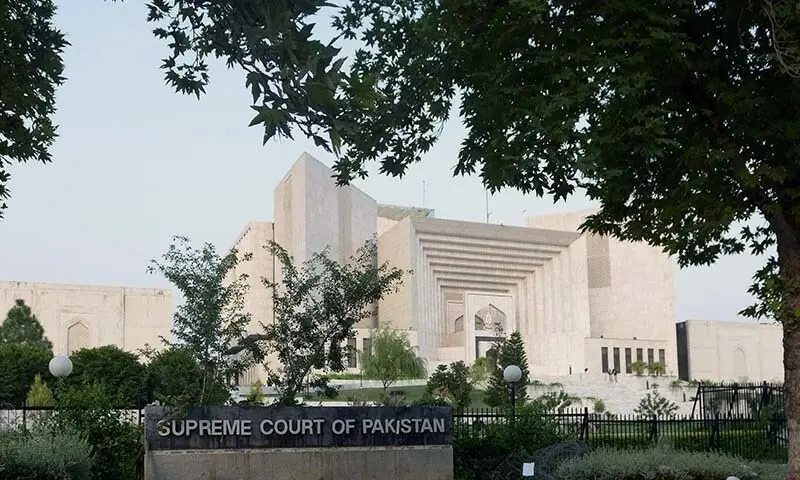
ISLAMABAD: The Supreme Court on Tuesday set aside the dismissal of a Ministry of Commerce officer who had been removed from service for unauthorised absence, and remanded his case to the Federal Service Tribunal (FST) for a fresh decision on his service appeal.
The appeal is to be decided de novo, preferably within three months, after providing an opportunity of hearing to all parties from the date of receipt of the judgement, observed Justice Muhammad Ali Mazhar in a ruling he authored.
Justice Mazhar was part of a two-judge bench headed by Chief Justice of Pakistan (CJP) Yahya Afridi, which heard an appeal filed by Arslan Ahmed against the FST Islamabad’s rejection of his plea on Nov 21, 2023.
The petitioner, Arslan Ahmed, had been granted ex-Pakistan leave from Oct 1, 2018, to Sept 30, 2020.

However, upon the expiry of his leave, he was unable to resume duty due to the suspension of flight operations during the Covid-19 pandemic. In addition, his wife had contracted Covid-19 and was seriously ill.

Orders fresh hearing; questions rationale behind ‘extraordinary leave’ adjustment
Although he was directed to report on Nov 4, 2020, he resumed duty on Jan 27, 2021, after flight operations returned to normal. He participated in inquiry proceedings and, during their pendency, was issued a posting order as deputy secretary (China) via a letter dated March 5, 2021.

After assuming charge, he was informed through a notification dated March 12, 2021, that the period of his absence would be regularised later. Subsequently, in June 2021, his wife, who was working at a hospital in England, fell seriously ill and suffered a deterioration in eyesight.
The petitioner had to travel urgently to England on June 26, 2021, to care for his wife and children, and applied for leave.
However, the ministry, invoking Rule 14 of the Civil Servants (Efficiency and Discipline) Rules, 2020, initiated ex parte proceedings, with communications sent to an incorrect postal and email address.
He later learnt of the proceedings through a colleague via WhatsApp and approached the relevant authority, following which he was granted an online hearing on March 17, 2022.
Despite this, a dismissal order was issued on Sept 21, 2022. Simultaneously, his absence from June 27, 2021, to Sept 6, 2022, was treated as Extraordinary Leave (EOL).
His departmental appeal was rejected, and a subsequent service appeal before the FST was also dismissed.
Justice Mazhar observed that the retrospective adjustment of EOL was not a punishment but a mechanism to reconcile difficult situations. He questioned the rationale behind converting absence into EOL while simultaneously imposing the penalty of dismissal.
He noted that when a competent authority opts to show leniency by regularising absence as EOL, it must independently assess whether dismissal from service is still warranted.
The judgement further explained that Rule 9(3) of the Revised Leave Rules, 1980, empowers the competent authority to grant EOL, but this is not necessarily tied to the imposition of a penalty and depends on the specific facts of each case.
The court also noted that although the original dismissal order did not include EOL adjustment, it was later added inadvertently by deputy secretary (HRM), while official records confirmed that the EOL had been approved by the commerce secretary.
Terming the case suitable for fresh adjudication, the Supreme Court converted the petition into an appeal, set aside the FST’s earlier judgement, and remanded the matter back to the tribunal for a decision within three months after hearing all parties.
Published in Dawn, April 22nd, 2026
